

Elements of Modern Physics
326
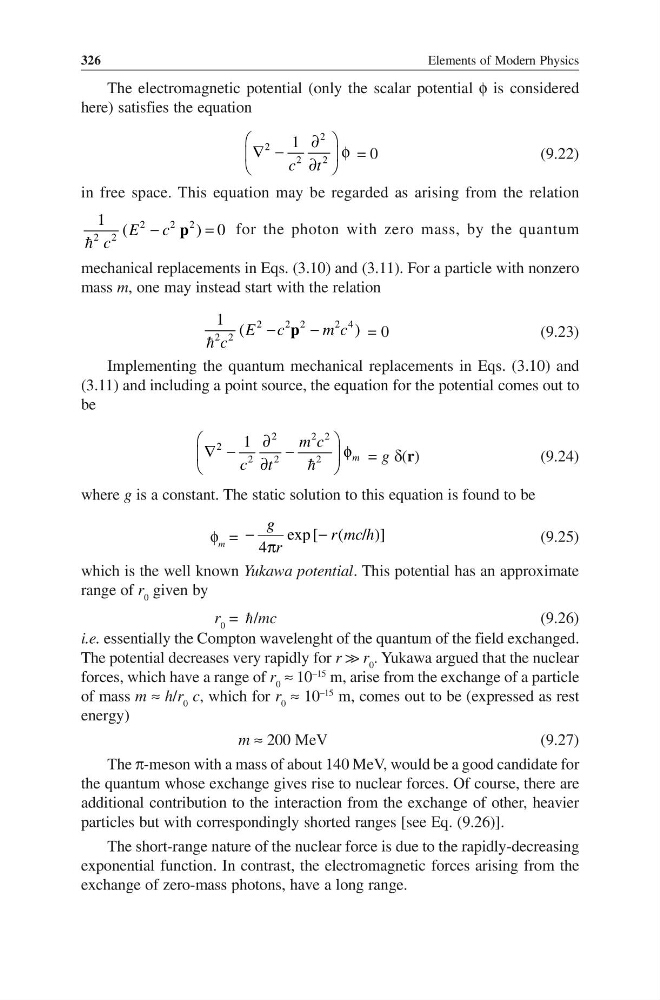
The electromagnetic potential (only the scalar potential φ is considered
here) satisfies the equation
2
2
2
2
1
c t
∂
∇ −
φ
∂
= 0
(9.22)
in free space. This equation may be regarded as arising from the relation
2
2 2
2 2
1 (
) 0
E c
c
−
=
p
for the photon with zero mass, by the quantum
mechanical replacements in Eqs. (3.10) and (3.11). For a particle with nonzero
mass m, one may instead start with the relation
2
2 2
2 4
2 2
1 (
)
E c
m c
c
−
−
p
= 0
(9.23)
Implementing the quantum mechanical replacements in Eqs. (3.10) and
(3.11) and including a point source, the equation for the potential comes out to
be
2 2
2
2
2
2
1
m
m c
c t
2
∂
∇ −
−
φ
∂
= g δ(r)
(9.24)
where g is a constant. The static solution to this equation is found to be
φ m =
exp [ ( / )]
4
g
r mc h
r
−
−
π
(9.25)
which is the well known Yukawa potential. This potential has an approximate
range of r 0 given by
r 0 = /mc
(9.26)
i.e. essentially the Compton wavelenght of the quantum of the field exchanged.
The potential decreases very rapidly for r >> r 0 . Yukawa argued that the nuclear
forces, which have a range of r 0 ≈ 10
–15
m, arise from the exchange of a particle
of mass m ≈ h/r 0 c, which for r 0 ≈ 10
–15
m, comes out to be (expressed as rest
energy)
m ≈ 200 MeV
(9.27)
The π-meson with a mass of about 140 MeV, would be a good candidate for
the quantum whose exchange gives rise to nuclear forces. Of course, there are
additional contribution to the interaction from the exchange of other, heavier
particles but with correspondingly shorted ranges [see Eq. (9.26)].
The short-range nature of the nuclear force is due to the rapidly-decreasing
exponential function. In contrast, the electromagnetic forces arising from the
exchange of zero-mass photons, have a long range.
326
The electromagnetic potential (only the scalar potential φ is considered
here) satisfies the equation
2
2
2
2
1
c t
∂
∇ −
φ
∂
= 0
(9.22)
in free space. This equation may be regarded as arising from the relation
2
2 2
2 2
1 (
) 0
E c
c
−
=
p
for the photon with zero mass, by the quantum
mechanical replacements in Eqs. (3.10) and (3.11). For a particle with nonzero
mass m, one may instead start with the relation
2
2 2
2 4
2 2
1 (
)
E c
m c
c
−
−
p
= 0
(9.23)
Implementing the quantum mechanical replacements in Eqs. (3.10) and
(3.11) and including a point source, the equation for the potential comes out to
be
2 2
2
2
2
2
1
m
m c
c t
2
∂
∇ −
−
φ
∂
= g δ(r)
(9.24)
where g is a constant. The static solution to this equation is found to be
φ m =
exp [ ( / )]
4
g
r mc h
r
−
−
π
(9.25)
which is the well known Yukawa potential. This potential has an approximate
range of r 0 given by
r 0 = /mc
(9.26)
i.e. essentially the Compton wavelenght of the quantum of the field exchanged.
The potential decreases very rapidly for r >> r 0 . Yukawa argued that the nuclear
forces, which have a range of r 0 ≈ 10
–15
m, arise from the exchange of a particle
of mass m ≈ h/r 0 c, which for r 0 ≈ 10
–15
m, comes out to be (expressed as rest
energy)
m ≈ 200 MeV
(9.27)
The π-meson with a mass of about 140 MeV, would be a good candidate for
the quantum whose exchange gives rise to nuclear forces. Of course, there are
additional contribution to the interaction from the exchange of other, heavier
particles but with correspondingly shorted ranges [see Eq. (9.26)].
The short-range nature of the nuclear force is due to the rapidly-decreasing
exponential function. In contrast, the electromagnetic forces arising from the
exchange of zero-mass photons, have a long range.