

Solid State Physics
267
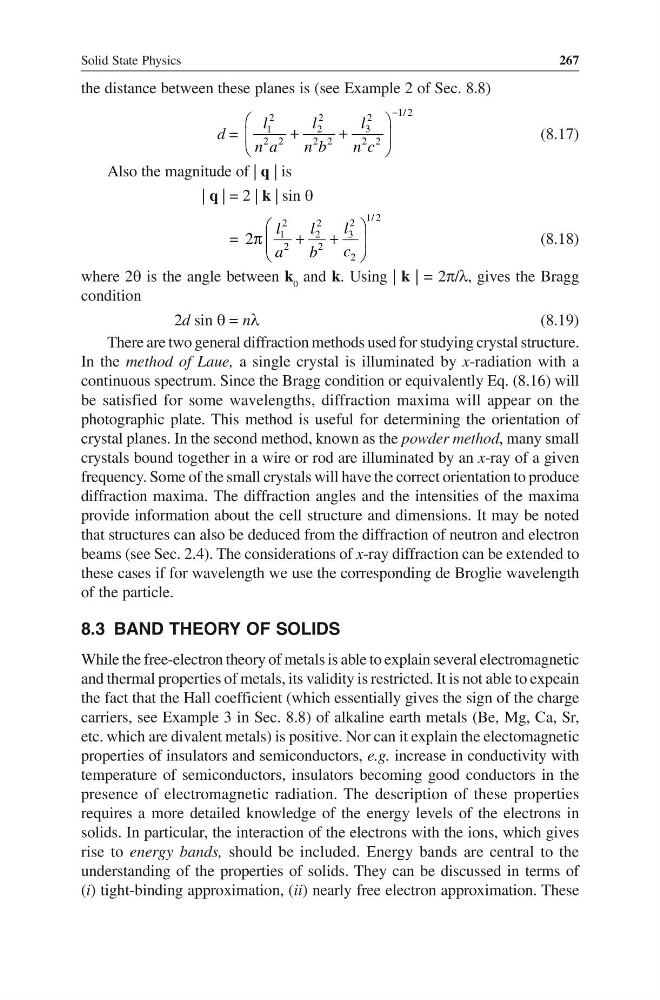
the distance between these planes is (see Example 2 of Sec. 8.8)
d =
1/ 2
2
2
2
3
1
2
2 2
2 2
2 2
l
l
l
n a
n b
n c
−
+
+
(8.17)
Also the magnitude of | q | is
| q | = 2 | k | sin θ
=
1/ 2
2
2
2
3
1
2
2
2
2
2
l
l
l
c
a
b
π
+
+
(8.18)
where 2θ is the angle between k 0 and k. Using | k | = 2π/λ, gives the Bragg
condition
2d sin θ = nλ
(8.19)
There are two general diffraction methods used for studying crystal structure.
In the method of Laue, a single crystal is illuminated by x-radiation with a
continuous spectrum. Since the Bragg condition or equivalently Eq. (8.16) will
be satisfied for some wavelengths, diffraction maxima will appear on the
photographic plate. This method is useful for determining the orientation of
crystal planes. In the second method, known as the powder method, many small
crystals bound together in a wire or rod are illuminated by an x-ray of a given
frequency. Some of the small crystals will have the correct orientation to produce
diffraction maxima. The diffraction angles and the intensities of the maxima
provide information about the cell structure and dimensions. It may be noted
that structures can also be deduced from the diffraction of neutron and electron
beams (see Sec. 2.4). The considerations of x-ray diffraction can be extended to
these cases if for wavelength we use the corresponding de Broglie wavelength
of the particle.
8.3 BAND THEORY OF SOLIDS
While the free-electron theory of metals is able to explain several electromagnetic
and thermal properties of metals, its validity is restricted. It is not able to expeain
the fact that the Hall coefficient (which essentially gives the sign of the charge
carriers, see Example 3 in Sec. 8.8) of alkaline earth metals (Be, Mg, Ca, Sr,
etc. which are divalent metals) is positive. Nor can it explain the electomagnetic
properties of insulators and semiconductors, e.g. increase in conductivity with
temperature of semiconductors, insulators becoming good conductors in the
presence of electromagnetic radiation. The description of these properties
requires a more detailed knowledge of the energy levels of the electrons in
solids. In particular, the interaction of the electrons with the ions, which gives
rise to energy bands, should be included. Energy bands are central to the
understanding of the properties of solids. They can be discussed in terms of
(i) tight-binding approximation, (ii) nearly free electron approximation. These
267
the distance between these planes is (see Example 2 of Sec. 8.8)
d =
1/ 2
2
2
2
3
1
2
2 2
2 2
2 2
l
l
l
n a
n b
n c
−
+
+
(8.17)
Also the magnitude of | q | is
| q | = 2 | k | sin θ
=
1/ 2
2
2
2
3
1
2
2
2
2
2
l
l
l
c
a
b
π
+
+
(8.18)
where 2θ is the angle between k 0 and k. Using | k | = 2π/λ, gives the Bragg
condition
2d sin θ = nλ
(8.19)
There are two general diffraction methods used for studying crystal structure.
In the method of Laue, a single crystal is illuminated by x-radiation with a
continuous spectrum. Since the Bragg condition or equivalently Eq. (8.16) will
be satisfied for some wavelengths, diffraction maxima will appear on the
photographic plate. This method is useful for determining the orientation of
crystal planes. In the second method, known as the powder method, many small
crystals bound together in a wire or rod are illuminated by an x-ray of a given
frequency. Some of the small crystals will have the correct orientation to produce
diffraction maxima. The diffraction angles and the intensities of the maxima
provide information about the cell structure and dimensions. It may be noted
that structures can also be deduced from the diffraction of neutron and electron
beams (see Sec. 2.4). The considerations of x-ray diffraction can be extended to
these cases if for wavelength we use the corresponding de Broglie wavelength
of the particle.
8.3 BAND THEORY OF SOLIDS
While the free-electron theory of metals is able to explain several electromagnetic
and thermal properties of metals, its validity is restricted. It is not able to expeain
the fact that the Hall coefficient (which essentially gives the sign of the charge
carriers, see Example 3 in Sec. 8.8) of alkaline earth metals (Be, Mg, Ca, Sr,
etc. which are divalent metals) is positive. Nor can it explain the electomagnetic
properties of insulators and semiconductors, e.g. increase in conductivity with
temperature of semiconductors, insulators becoming good conductors in the
presence of electromagnetic radiation. The description of these properties
requires a more detailed knowledge of the energy levels of the electrons in
solids. In particular, the interaction of the electrons with the ions, which gives
rise to energy bands, should be included. Energy bands are central to the
understanding of the properties of solids. They can be discussed in terms of
(i) tight-binding approximation, (ii) nearly free electron approximation. These