

Elements of Modern Physics
266
= B′ exp [ik . r]
, ,
exp [ . (
)]
+ +
∑
u v w
i u v
w
q a b
c ,
q = k 0 – k
(8.13)
The summation leads to
| A | =
1
1
1
2
2
2
1
1
2
2
sin [ . (
1)] sin [ . (
1)]
sin ( . )
sin ( . )
+
+
′
n
n
B
a q
b q
a q
b q
1
3
2
1
2
sin [ . (
1)]
sin ( . )
+
×
n
c q
c q
(8.14)
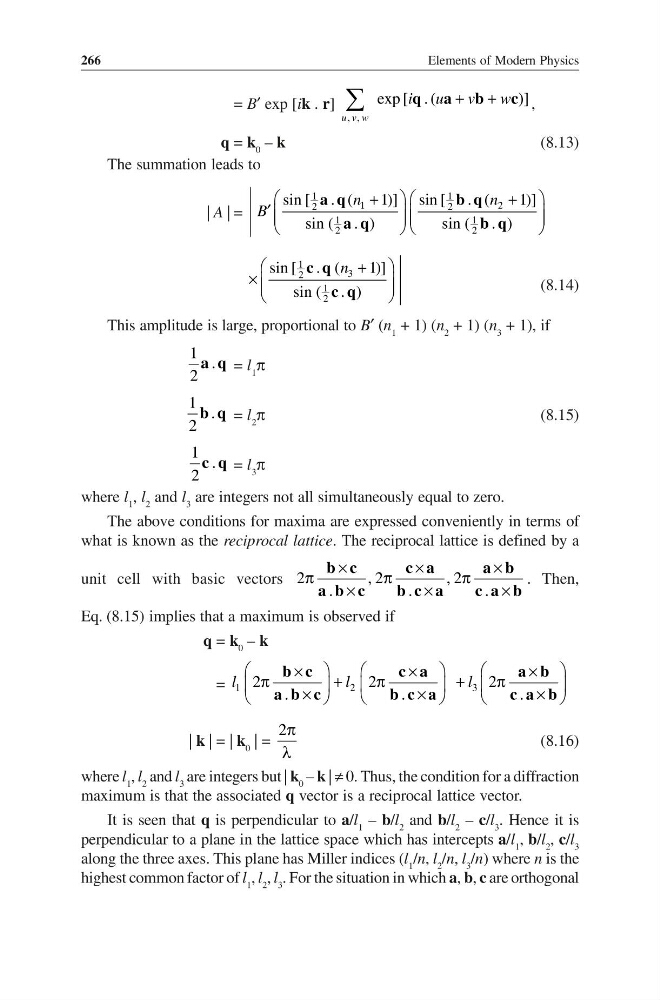
This amplitude is large, proportional to B′ (n 1 + 1) (n 2 + 1) (n 3 + 1), if
1 .
2
a q = l 1 π
1 .
2
b q = l 2 π
(8.15)
1 .
2
c q = l 3 π
where l 1 , l 2 and l 3 are integers not all simultaneously equal to zero.
The above conditions for maxima are expressed conveniently in terms of
what is known as the reciprocal lattice. The reciprocal lattice is defined by a
unit cell with basic vectors 2
,2
,2
.
.
.
×
×
×
π
π
π
×
×
×
b c
c a
a b
a b c
b c a
c a b
. Then,
Eq. (8.15) implies that a maximum is observed if
q = k 0 – k
= 1
2
2
2
.
.
×
×
π
+
π
×
×
l
l
b c
c a
a b c
b c a
3 2 .
×
+
π
×
l
a b
c a b
| k | = | k 0 | =
2π
λ
(8.16)
where l 1 , l 2 and l 3 are integers but | k 0 – k | ≠ 0. Thus, the condition for a diffraction
maximum is that the associated q vector is a reciprocal lattice vector.
It is seen that q is perpendicular to a/l 1 – b/l 2 and b/l 2 – c/l 3 . Hence it is
perpendicular to a plane in the lattice space which has intercepts a/l 1 , b/l 2 , c/l 3
along the three axes. This plane has Miller indices (l 1 /n, l 2 /n, l 3 /n) where n is the
highest common factor of l 1 , l 2 , l 3 . For the situation in which a, b, c are orthogonal
266
= B′ exp [ik . r]
, ,
exp [ . (
)]
+ +
∑
u v w
i u v
w
q a b
c ,
q = k 0 – k
(8.13)
The summation leads to
| A | =
1
1
1
2
2
2
1
1
2
2
sin [ . (
1)] sin [ . (
1)]
sin ( . )
sin ( . )
+
+
′
n
n
B
a q
b q
a q
b q
1
3
2
1
2
sin [ . (
1)]
sin ( . )
+
×
n
c q
c q
(8.14)
This amplitude is large, proportional to B′ (n 1 + 1) (n 2 + 1) (n 3 + 1), if
1 .
2
a q = l 1 π
1 .
2
b q = l 2 π
(8.15)
1 .
2
c q = l 3 π
where l 1 , l 2 and l 3 are integers not all simultaneously equal to zero.
The above conditions for maxima are expressed conveniently in terms of
what is known as the reciprocal lattice. The reciprocal lattice is defined by a
unit cell with basic vectors 2
,2
,2
.
.
.
×
×
×
π
π
π
×
×
×
b c
c a
a b
a b c
b c a
c a b
. Then,
Eq. (8.15) implies that a maximum is observed if
q = k 0 – k
= 1
2
2
2
.
.
×
×
π
+
π
×
×
l
l
b c
c a
a b c
b c a
3 2 .
×
+
π
×
l
a b
c a b
| k | = | k 0 | =
2π
λ
(8.16)
where l 1 , l 2 and l 3 are integers but | k 0 – k | ≠ 0. Thus, the condition for a diffraction
maximum is that the associated q vector is a reciprocal lattice vector.
It is seen that q is perpendicular to a/l 1 – b/l 2 and b/l 2 – c/l 3 . Hence it is
perpendicular to a plane in the lattice space which has intercepts a/l 1 , b/l 2 , c/l 3
along the three axes. This plane has Miller indices (l 1 /n, l 2 /n, l 3 /n) where n is the
highest common factor of l 1 , l 2 , l 3 . For the situation in which a, b, c are orthogonal