

Elements of Modern Physics
264
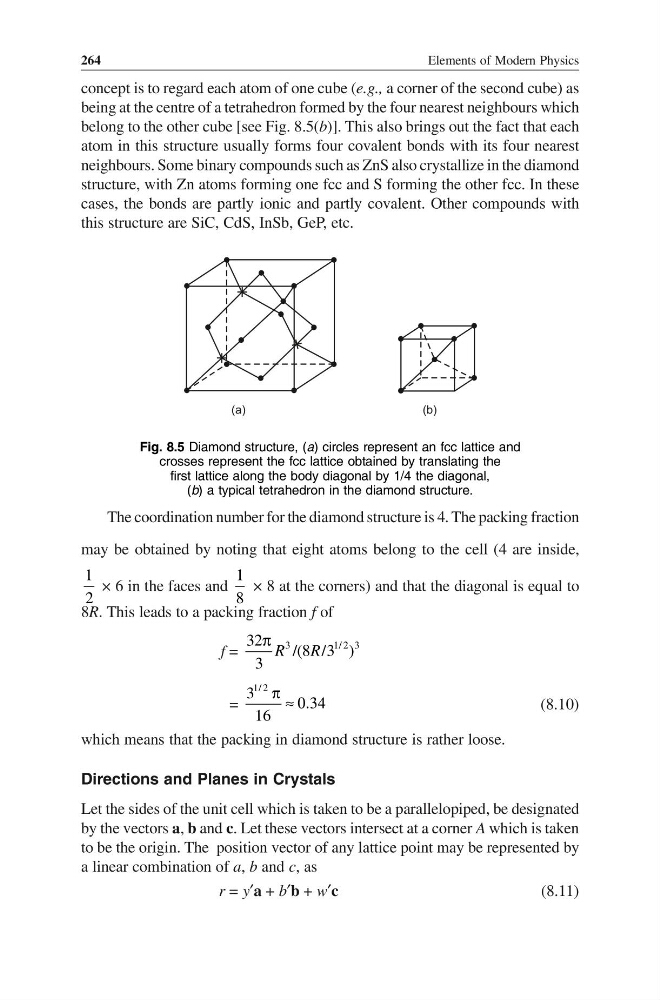
concept is to regard each atom of one cube (e.g., a corner of the second cube) as
being at the centre of a tetrahedron formed by the four nearest neighbours which
belong to the other cube [see Fig. 8.5(b)]. This also brings out the fact that each
atom in this structure usually forms four covalent bonds with its four nearest
neighbours. Some binary compounds such as ZnS also crystallize in the diamond
structure, with Zn atoms forming one fcc and S forming the other fcc. In these
cases, the bonds are partly ionic and partly covalent. Other compounds with
this structure are SiC, CdS, InSb, GeP, etc.
(a)
(b)
Fig. 8.5 Diamond structure, (a) circles represent an fcc lattice and
crosses represent the fcc lattice obtained by translating the
first lattice along the body diagonal by 1/4 the diagonal,
(b) a typical tetrahedron in the diamond structure.
The coordination number for the diamond structure is 4. The packing fraction
may be obtained by noting that eight atoms belong to the cell (4 are inside,
1
2
× 6 in the faces and
1
8
× 8 at the corners) and that the diagonal is equal to
8R. This leads to a packing fraction f of
f =
3
1 / 23
32
/(8 /3 )
3
R
R
π
=
1/ 2
3
16
π ≈ 0.34
(8.10)
which means that the packing in diamond structure is rather loose.
Directions and Planes in Crystals
Let the sides of the unit cell which is taken to be a parallelopiped, be designated
by the vectors a, b and c. Let these vectors intersect at a corner A which is taken
to be the origin. The position vector of any lattice point may be represented by
a linear combination of a, b and c, as
r = y′a + b′b + w′c
(8.11)
264
concept is to regard each atom of one cube (e.g., a corner of the second cube) as
being at the centre of a tetrahedron formed by the four nearest neighbours which
belong to the other cube [see Fig. 8.5(b)]. This also brings out the fact that each
atom in this structure usually forms four covalent bonds with its four nearest
neighbours. Some binary compounds such as ZnS also crystallize in the diamond
structure, with Zn atoms forming one fcc and S forming the other fcc. In these
cases, the bonds are partly ionic and partly covalent. Other compounds with
this structure are SiC, CdS, InSb, GeP, etc.
(a)
(b)
Fig. 8.5 Diamond structure, (a) circles represent an fcc lattice and
crosses represent the fcc lattice obtained by translating the
first lattice along the body diagonal by 1/4 the diagonal,
(b) a typical tetrahedron in the diamond structure.
The coordination number for the diamond structure is 4. The packing fraction
may be obtained by noting that eight atoms belong to the cell (4 are inside,
1
2
× 6 in the faces and
1
8
× 8 at the corners) and that the diagonal is equal to
8R. This leads to a packing fraction f of
f =
3
1 / 23
32
/(8 /3 )
3
R
R
π
=
1/ 2
3
16
π ≈ 0.34
(8.10)
which means that the packing in diamond structure is rather loose.
Directions and Planes in Crystals
Let the sides of the unit cell which is taken to be a parallelopiped, be designated
by the vectors a, b and c. Let these vectors intersect at a corner A which is taken
to be the origin. The position vector of any lattice point may be represented by
a linear combination of a, b and c, as
r = y′a + b′b + w′c
(8.11)