

Solid State Physics
263
f =
1/ 2
3(2 )
π ≈ 74%
(8.8)
For the hcp structure, six atoms belong to each cell and occupy a volume of
8πR
3
. The area of the base of the hexagon is 6 (3
1/2
) R
2
while the height of the
hexagon is 4(2/3)
1/2
R, from which the packing fraction is again found to be
f =
1/ 2
74%
3(2 )
π ≈
(8.9)
A
A
A
A
A
A
A
A
A
A
A
B
B
B
B
B
C
C
C
C
C
(a)
(b)
(c)
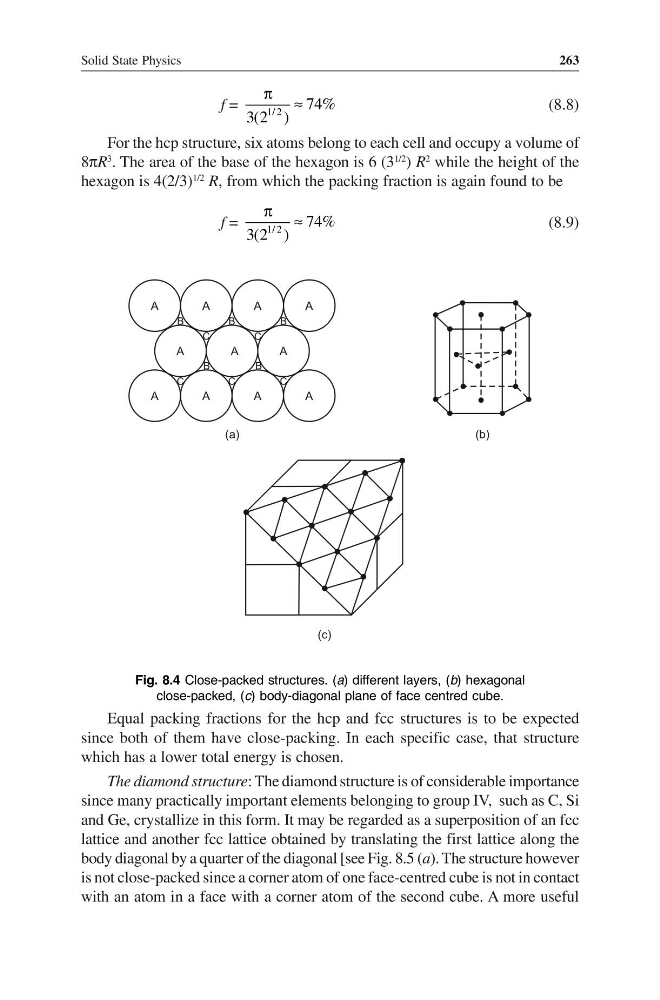
Fig. 8.4 Close-packed structures. (a) different layers, (b) hexagonal
close-packed, (c) body-diagonal plane of face centred cube.
Equal packing fractions for the hcp and fcc structures is to be expected
since both of them have close-packing. In each specific case, that structure
which has a lower total energy is chosen.
The diamond structure: The diamond structure is of considerable importance
since many practically important elements belonging to group IV, such as C, Si
and Ge, crystallize in this form. It may be regarded as a superposition of an fcc
lattice and another fcc lattice obtained by translating the first lattice along the
body diagonal by a quarter of the diagonal [see Fig. 8.5 (a). The structure however
is not close-packed since a corner atom of one face-centred cube is not in contact
with an atom in a face with a corner atom of the second cube. A more useful
263
f =
1/ 2
3(2 )
π ≈ 74%
(8.8)
For the hcp structure, six atoms belong to each cell and occupy a volume of
8πR
3
. The area of the base of the hexagon is 6 (3
1/2
) R
2
while the height of the
hexagon is 4(2/3)
1/2
R, from which the packing fraction is again found to be
f =
1/ 2
74%
3(2 )
π ≈
(8.9)
A
A
A
A
A
A
A
A
A
A
A
B
B
B
B
B
C
C
C
C
C
(a)
(b)
(c)
Fig. 8.4 Close-packed structures. (a) different layers, (b) hexagonal
close-packed, (c) body-diagonal plane of face centred cube.
Equal packing fractions for the hcp and fcc structures is to be expected
since both of them have close-packing. In each specific case, that structure
which has a lower total energy is chosen.
The diamond structure: The diamond structure is of considerable importance
since many practically important elements belonging to group IV, such as C, Si
and Ge, crystallize in this form. It may be regarded as a superposition of an fcc
lattice and another fcc lattice obtained by translating the first lattice along the
body diagonal by a quarter of the diagonal [see Fig. 8.5 (a). The structure however
is not close-packed since a corner atom of one face-centred cube is not in contact
with an atom in a face with a corner atom of the second cube. A more useful