

Elements of Modern Physics
16
1/ 2
2
2
1
1
1
1
v
c t
c t
c
x
v
c
∂
∂
∂
=
−
−
∂
∂
∂
−
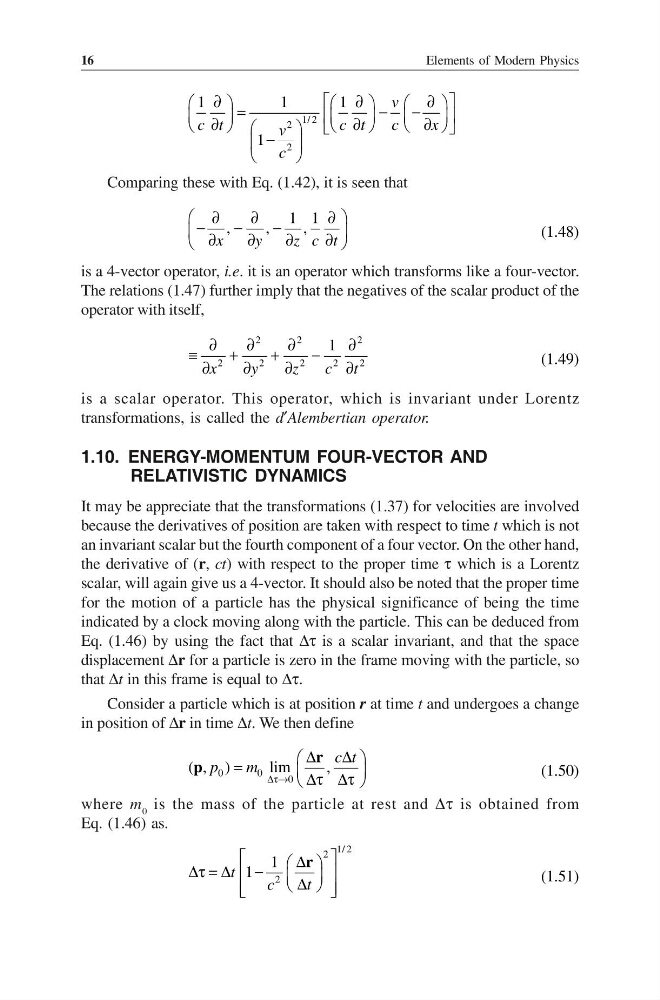
Comparing these with Eq. (1.42), it is seen that
1 1
,
,
,
x
y
z c t
∂
∂
∂
−
−
−
∂
∂
∂
∂
(1.48)
is a 4-vector operator, i.e. it is an operator which transforms like a four-vector.
The relations (1.47) further imply that the negatives of the scalar product of the
operator with itself,
2
2
2
2
2
2
2
2
1
x
y
z
c t
∂
∂
∂
∂
≡
+
+
−
∂
∂
∂
∂
(1.49)
is a scalar operator. This operator, which is invariant under Lorentz
transformations, is called the d′Alembertian operator.
1.10. ENERGY-MOMENTUM FOUR-VECTOR AND
RELATIVISTIC DYNAMICS
It may be appreciate that the transformations (1.37) for velocities are involved
because the derivatives of position are taken with respect to time t which is not
an invariant scalar but the fourth component of a four vector. On the other hand,
the derivative of (r, ct) with respect to the proper time τ which is a Lorentz
scalar, will again give us a 4-vector. It should also be noted that the proper time
for the motion of a particle has the physical significance of being the time
indicated by a clock moving along with the particle. This can be deduced from
Eq. (1.46) by using the fact that ∆τ is a scalar invariant, and that the space
displacement ∆r for a particle is zero in the frame moving with the particle, so
that ∆t in this frame is equal to ∆τ.
Consider a particle which is at position r at time t and undergoes a change
in position of ∆r in time ∆t. We then define
0
0
0
( , )
lim
,
∆τ→
∆
∆
=
∆τ ∆τ
c t
p
m
r
p
(1.50)
where m 0 is the mass of the particle at rest and ∆τ is obtained from
Eq. (1.46) as.
1/ 2
2
2
1
1
∆
∆τ = ∆ −
∆
t
t
c
r
(1.51)
16
1/ 2
2
2
1
1
1
1
v
c t
c t
c
x
v
c
∂
∂
∂
=
−
−
∂
∂
∂
−
Comparing these with Eq. (1.42), it is seen that
1 1
,
,
,
x
y
z c t
∂
∂
∂
−
−
−
∂
∂
∂
∂
(1.48)
is a 4-vector operator, i.e. it is an operator which transforms like a four-vector.
The relations (1.47) further imply that the negatives of the scalar product of the
operator with itself,
2
2
2
2
2
2
2
2
1
x
y
z
c t
∂
∂
∂
∂
≡
+
+
−
∂
∂
∂
∂
(1.49)
is a scalar operator. This operator, which is invariant under Lorentz
transformations, is called the d′Alembertian operator.
1.10. ENERGY-MOMENTUM FOUR-VECTOR AND
RELATIVISTIC DYNAMICS
It may be appreciate that the transformations (1.37) for velocities are involved
because the derivatives of position are taken with respect to time t which is not
an invariant scalar but the fourth component of a four vector. On the other hand,
the derivative of (r, ct) with respect to the proper time τ which is a Lorentz
scalar, will again give us a 4-vector. It should also be noted that the proper time
for the motion of a particle has the physical significance of being the time
indicated by a clock moving along with the particle. This can be deduced from
Eq. (1.46) by using the fact that ∆τ is a scalar invariant, and that the space
displacement ∆r for a particle is zero in the frame moving with the particle, so
that ∆t in this frame is equal to ∆τ.
Consider a particle which is at position r at time t and undergoes a change
in position of ∆r in time ∆t. We then define
0
0
0
( , )
lim
,
∆τ→
∆
∆
=
∆τ ∆τ
c t
p
m
r
p
(1.50)
where m 0 is the mass of the particle at rest and ∆τ is obtained from
Eq. (1.46) as.
1/ 2
2
2
1
1
∆
∆τ = ∆ −
∆
t
t
c
r
(1.51)