

Special Theory of Relativity
15
Here, unlike the three-dimensional case, the length of the vector may be
real or imaginary depending on whether (A 0
2
– A·A) ≥ 0 or (A 0
2
– A·A) < 0,
respectively.
Two examples of four-vectors are given which are of particular
importance. Consider two events characterized by the vectors x µ = (r, ct),
x µ * = (r*, ct*). The separation between these two events,
x µ * – x µ = (r* – r, c (t* – t))
(1.45)
is a 4-vector, and the interval between the two events is defined to be ∆τ where
2
2
2
1
( ) ( * )
( * ) ( * )
∆τ =
− −
− ⋅
−
t t
c
r
r r
r
(1.46)
This interval ∆τ is a scalar invariant and is called the proper time interval
between the two events. The proper time interval is said to be timelike if
(∆τ)
2
> 0, spacelike if (∆τ) < 0 and lightlike if (∆τ)
2
= 0. Since (r* – r, c (t*– t)
transforms as a 4-vector, it may be observed that for a timelike interval, there is
an inertial frame in which the events occur at the same place. This is the frame
which moves with velocity v = (r* – r)/(t* – t) with respect to the given frame
(|v|) < c since |r*–r| < c |t*–t|. On the other hand, for a spacelike interval, the
events occur at the same time in the frame which moves with velocity v = c
2
|r*–r| |t*–t|/|r*–r|
2
with respect to the given frame (|v| < c since |r*–r| > c
|t*–t|. Finally, for a lightlike interval, a light pulse starting at (r, ct) would just
reach (r*, ct*).
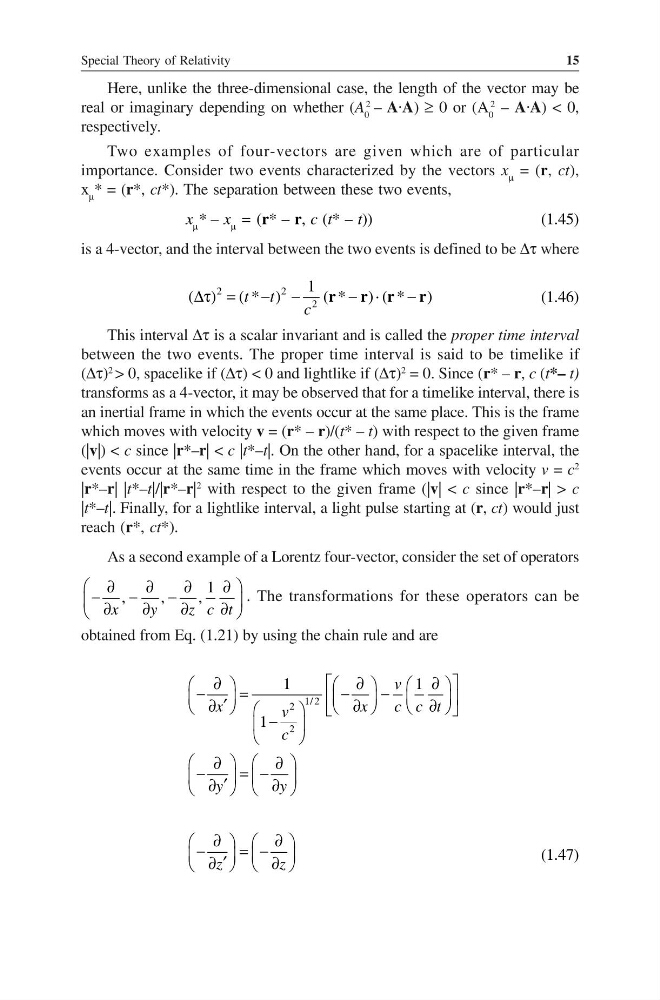
As a second example of a Lorentz four-vector, consider the set of operators
1
,
,
,
x
y
z c t
∂
∂
∂
∂
−
−
−
∂
∂
∂
∂
. The transformations for these operators can be
obtained from Eq. (1.21) by using the chain rule and are
1/ 2
2
2
1
1
1
v
x
x
cct
v
c
y
y
∂
∂
∂
−
=
−
−
′
∂
∂
∂
−
∂
∂
−
= −
′
∂
∂
z
z
∂
∂
−
= −
′
∂
∂
(1.47)
15
Here, unlike the three-dimensional case, the length of the vector may be
real or imaginary depending on whether (A 0
2
– A·A) ≥ 0 or (A 0
2
– A·A) < 0,
respectively.
Two examples of four-vectors are given which are of particular
importance. Consider two events characterized by the vectors x µ = (r, ct),
x µ * = (r*, ct*). The separation between these two events,
x µ * – x µ = (r* – r, c (t* – t))
(1.45)
is a 4-vector, and the interval between the two events is defined to be ∆τ where
2
2
2
1
( ) ( * )
( * ) ( * )
∆τ =
− −
− ⋅
−
t t
c
r
r r
r
(1.46)
This interval ∆τ is a scalar invariant and is called the proper time interval
between the two events. The proper time interval is said to be timelike if
(∆τ)
2
> 0, spacelike if (∆τ) < 0 and lightlike if (∆τ)
2
= 0. Since (r* – r, c (t*– t)
transforms as a 4-vector, it may be observed that for a timelike interval, there is
an inertial frame in which the events occur at the same place. This is the frame
which moves with velocity v = (r* – r)/(t* – t) with respect to the given frame
(|v|) < c since |r*–r| < c |t*–t|. On the other hand, for a spacelike interval, the
events occur at the same time in the frame which moves with velocity v = c
2
|r*–r| |t*–t|/|r*–r|
2
with respect to the given frame (|v| < c since |r*–r| > c
|t*–t|. Finally, for a lightlike interval, a light pulse starting at (r, ct) would just
reach (r*, ct*).
As a second example of a Lorentz four-vector, consider the set of operators
1
,
,
,
x
y
z c t
∂
∂
∂
∂
−
−
−
∂
∂
∂
∂
. The transformations for these operators can be
obtained from Eq. (1.21) by using the chain rule and are
1/ 2
2
2
1
1
1
v
x
x
cct
v
c
y
y
∂
∂
∂
−
=
−
−
′
∂
∂
∂
−
∂
∂
−
= −
′
∂
∂
z
z
∂
∂
−
= −
′
∂
∂
(1.47)