

Solid State Physics
261
that the atoms are hard spheres and that the nearest neighbours touch each other,
we can deduce the packing fraction for a given crystal pattern.
Simple cube: The simple cubic structure is perhaps the simplest possible
form, tough polonium is the only element which has this structure. The reason
for this is that the cubic structure is rather an open form with a considerable
amount of empty space.
Cubic P
Cubic I
Cubic F
Tetragonal P
Tetragonal I
Orthorhombic P
Orthorhombic S
Orthorhombic I
Orthorhombic F
Monoclinic P
Monoclinic C
Triclinic P
Trigonal R
Trigonal and hexagonal P
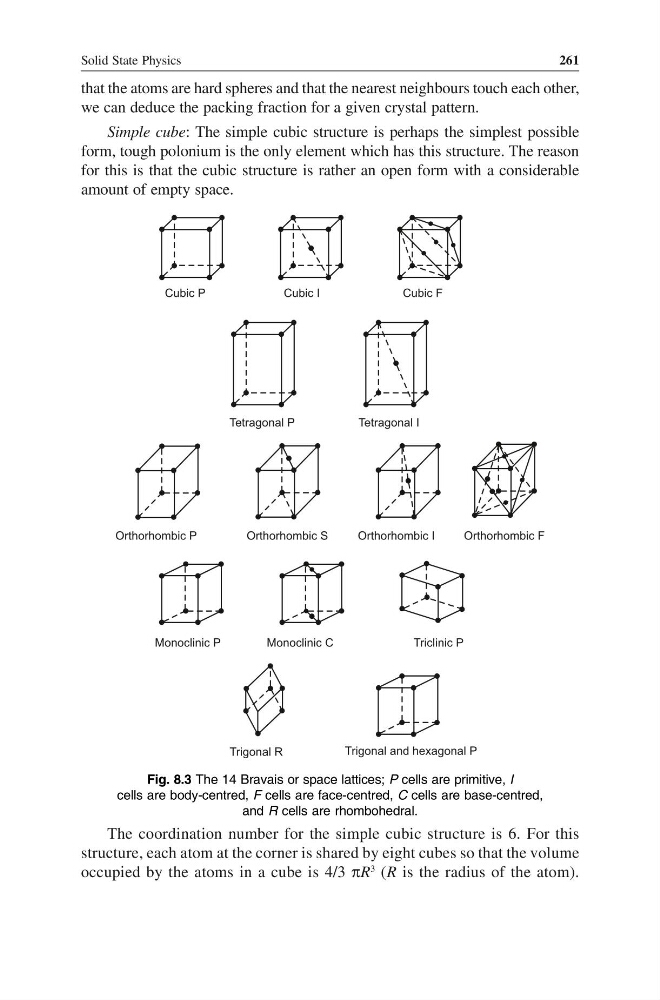
Fig. 8.3 The 14 Bravais or space lattices; P cells are primitive, I
cells are body-centred, F cells are face-centred, C cells are base-centred,
and R cells are rhombohedral.
The coordination number for the simple cubic structure is 6. For this
structure, each atom at the corner is shared by eight cubes so that the volume
occupied by the atoms in a cube is 4/3 πR
3
(R is the radius of the atom).
261
that the atoms are hard spheres and that the nearest neighbours touch each other,
we can deduce the packing fraction for a given crystal pattern.
Simple cube: The simple cubic structure is perhaps the simplest possible
form, tough polonium is the only element which has this structure. The reason
for this is that the cubic structure is rather an open form with a considerable
amount of empty space.
Cubic P
Cubic I
Cubic F
Tetragonal P
Tetragonal I
Orthorhombic P
Orthorhombic S
Orthorhombic I
Orthorhombic F
Monoclinic P
Monoclinic C
Triclinic P
Trigonal R
Trigonal and hexagonal P
Fig. 8.3 The 14 Bravais or space lattices; P cells are primitive, I
cells are body-centred, F cells are face-centred, C cells are base-centred,
and R cells are rhombohedral.
The coordination number for the simple cubic structure is 6. For this
structure, each atom at the corner is shared by eight cubes so that the volume
occupied by the atoms in a cube is 4/3 πR
3
(R is the radius of the atom).