

Elements of Modern Physics
260
It may be noted that in a real crystal, the actual binding is due to a mixture
of different types of bonds though one of them may be predominant.
8.2 CRYSTAL STRUCTURES
It is convenient to discuss the structures of crystals in terms of space lattices. A
space lattice is an array of lines, which divides the space into identical volumes.
These volumes fill the space completely and are known as unit cells. The
intersections of the lines are the lattice points and each lattice point is usually
associated with an atom or a group of atoms. Therefore may also be atoms at
the centres of the cells or the faces of the cells. Obviously, the choice of a unit
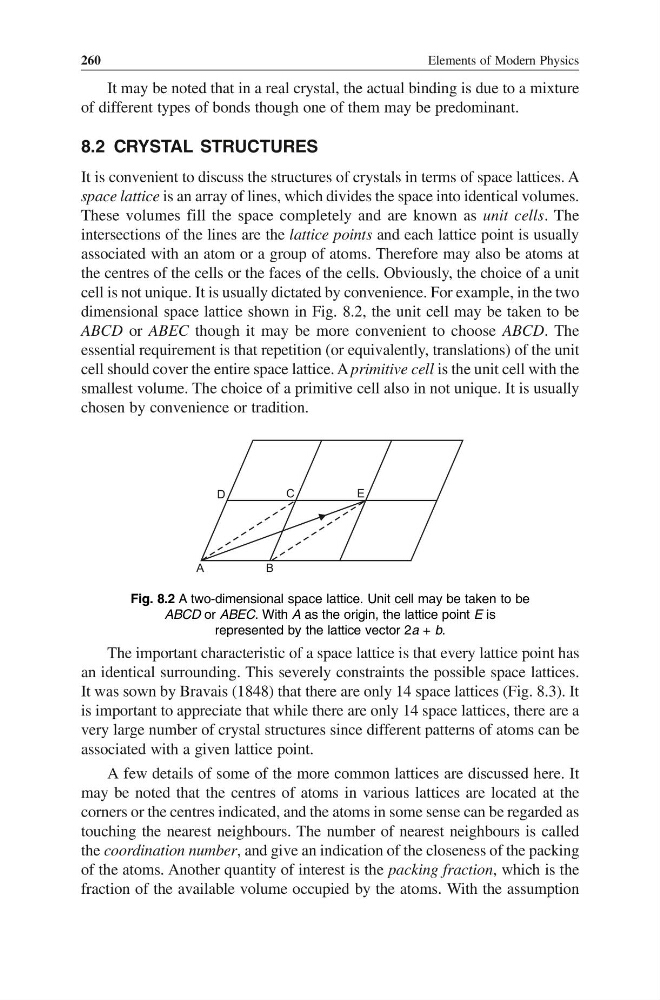
cell is not unique. It is usually dictated by convenience. For example, in the two
dimensional space lattice shown in Fig. 8.2, the unit cell may be taken to be
ABCD or ABEC though it may be more convenient to choose ABCD. The
essential requirement is that repetition (or equivalently, translations) of the unit
cell should cover the entire space lattice. A primitive cell is the unit cell with the
smallest volume. The choice of a primitive cell also in not unique. It is usually
chosen by convenience or tradition.
D
C
E
A
B
Fig. 8.2 A two-dimensional space lattice. Unit cell may be taken to be
ABCD or ABEC. With A as the origin, the lattice point E is
represented by the lattice vector 2a + b.
The important characteristic of a space lattice is that every lattice point has
an identical surrounding. This severely constraints the possible space lattices.
It was sown by Bravais (1848) that there are only 14 space lattices (Fig. 8.3). It
is important to appreciate that while there are only 14 space lattices, there are a
very large number of crystal structures since different patterns of atoms can be
associated with a given lattice point.
A few details of some of the more common lattices are discussed here. It
may be noted that the centres of atoms in various lattices are located at the
corners or the centres indicated, and the atoms in some sense can be regarded as
touching the nearest neighbours. The number of nearest neighbours is called
the coordination number, and give an indication of the closeness of the packing
of the atoms. Another quantity of interest is the packing fraction, which is the
fraction of the available volume occupied by the atoms. With the assumption
260
It may be noted that in a real crystal, the actual binding is due to a mixture
of different types of bonds though one of them may be predominant.
8.2 CRYSTAL STRUCTURES
It is convenient to discuss the structures of crystals in terms of space lattices. A
space lattice is an array of lines, which divides the space into identical volumes.
These volumes fill the space completely and are known as unit cells. The
intersections of the lines are the lattice points and each lattice point is usually
associated with an atom or a group of atoms. Therefore may also be atoms at
the centres of the cells or the faces of the cells. Obviously, the choice of a unit
cell is not unique. It is usually dictated by convenience. For example, in the two
dimensional space lattice shown in Fig. 8.2, the unit cell may be taken to be
ABCD or ABEC though it may be more convenient to choose ABCD. The
essential requirement is that repetition (or equivalently, translations) of the unit
cell should cover the entire space lattice. A primitive cell is the unit cell with the
smallest volume. The choice of a primitive cell also in not unique. It is usually
chosen by convenience or tradition.
D
C
E
A
B
Fig. 8.2 A two-dimensional space lattice. Unit cell may be taken to be
ABCD or ABEC. With A as the origin, the lattice point E is
represented by the lattice vector 2a + b.
The important characteristic of a space lattice is that every lattice point has
an identical surrounding. This severely constraints the possible space lattices.
It was sown by Bravais (1848) that there are only 14 space lattices (Fig. 8.3). It
is important to appreciate that while there are only 14 space lattices, there are a
very large number of crystal structures since different patterns of atoms can be
associated with a given lattice point.
A few details of some of the more common lattices are discussed here. It
may be noted that the centres of atoms in various lattices are located at the
corners or the centres indicated, and the atoms in some sense can be regarded as
touching the nearest neighbours. The number of nearest neighbours is called
the coordination number, and give an indication of the closeness of the packing
of the atoms. Another quantity of interest is the packing fraction, which is the
fraction of the available volume occupied by the atoms. With the assumption