

Elements of Modern Physics
258
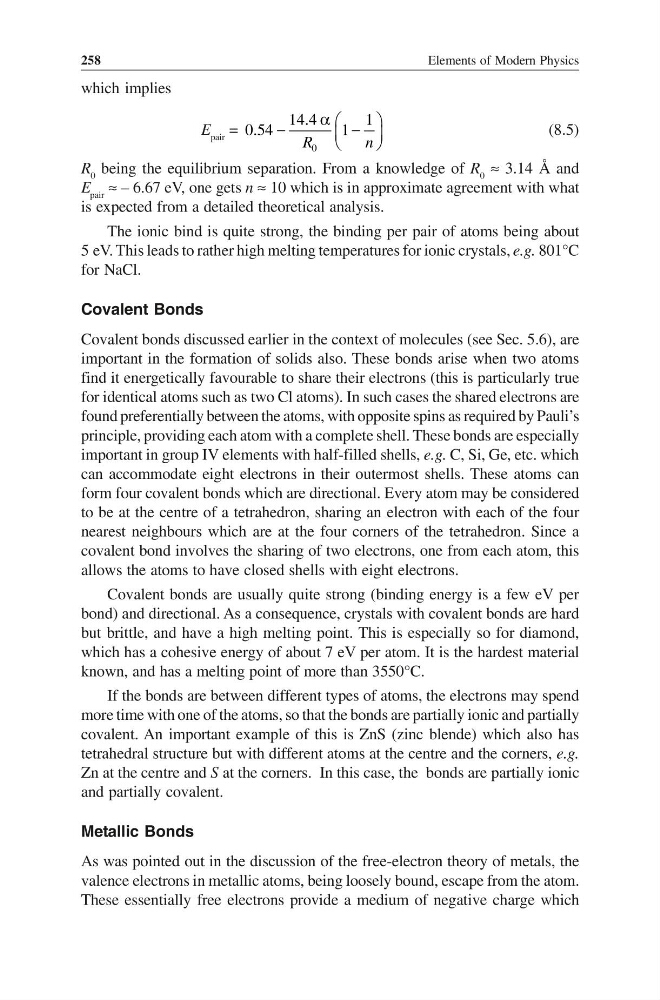
which implies
E pair =
0
14.4
1
0.54
1
R
n
α
−
−
(8.5)
R 0 being the equilibrium separation. From a knowledge of R 0 ≈ 3.14 Å and
E pair ≈ – 6.67 eV, one gets n ≈ 10 which is in approximate agreement with what
is expected from a detailed theoretical analysis.
The ionic bind is quite strong, the binding per pair of atoms being about
5 eV. This leads to rather high melting temperatures for ionic crystals, e.g. 801°C
for NaCl.
Covalent Bonds
Covalent bonds discussed earlier in the context of molecules (see Sec. 5.6), are
important in the formation of solids also. These bonds arise when two atoms
find it energetically favourable to share their electrons (this is particularly true
for identical atoms such as two Cl atoms). In such cases the shared electrons are
found preferentially between the atoms, with opposite spins as required by Pauli’s
principle, providing each atom with a complete shell. These bonds are especially
important in group IV elements with half-filled shells, e.g. C, Si, Ge, etc. which
can accommodate eight electrons in their outermost shells. These atoms can
form four covalent bonds which are directional. Every atom may be considered
to be at the centre of a tetrahedron, sharing an electron with each of the four
nearest neighbours which are at the four corners of the tetrahedron. Since a
covalent bond involves the sharing of two electrons, one from each atom, this
allows the atoms to have closed shells with eight electrons.
Covalent bonds are usually quite strong (binding energy is a few eV per
bond) and directional. As a consequence, crystals with covalent bonds are hard
but brittle, and have a high melting point. This is especially so for diamond,
which has a cohesive energy of about 7 eV per atom. It is the hardest material
known, and has a melting point of more than 3550°C.
If the bonds are between different types of atoms, the electrons may spend
more time with one of the atoms, so that the bonds are partially ionic and partially
covalent. An important example of this is ZnS (zinc blende) which also has
tetrahedral structure but with different atoms at the centre and the corners, e.g.
Zn at the centre and S at the corners. In this case, the bonds are partially ionic
and partially covalent.
Metallic Bonds
As was pointed out in the discussion of the free-electron theory of metals, the
valence electrons in metallic atoms, being loosely bound, escape from the atom.
These essentially free electrons provide a medium of negative charge which
258
which implies
E pair =
0
14.4
1
0.54
1
R
n
α
−
−
(8.5)
R 0 being the equilibrium separation. From a knowledge of R 0 ≈ 3.14 Å and
E pair ≈ – 6.67 eV, one gets n ≈ 10 which is in approximate agreement with what
is expected from a detailed theoretical analysis.
The ionic bind is quite strong, the binding per pair of atoms being about
5 eV. This leads to rather high melting temperatures for ionic crystals, e.g. 801°C
for NaCl.
Covalent Bonds
Covalent bonds discussed earlier in the context of molecules (see Sec. 5.6), are
important in the formation of solids also. These bonds arise when two atoms
find it energetically favourable to share their electrons (this is particularly true
for identical atoms such as two Cl atoms). In such cases the shared electrons are
found preferentially between the atoms, with opposite spins as required by Pauli’s
principle, providing each atom with a complete shell. These bonds are especially
important in group IV elements with half-filled shells, e.g. C, Si, Ge, etc. which
can accommodate eight electrons in their outermost shells. These atoms can
form four covalent bonds which are directional. Every atom may be considered
to be at the centre of a tetrahedron, sharing an electron with each of the four
nearest neighbours which are at the four corners of the tetrahedron. Since a
covalent bond involves the sharing of two electrons, one from each atom, this
allows the atoms to have closed shells with eight electrons.
Covalent bonds are usually quite strong (binding energy is a few eV per
bond) and directional. As a consequence, crystals with covalent bonds are hard
but brittle, and have a high melting point. This is especially so for diamond,
which has a cohesive energy of about 7 eV per atom. It is the hardest material
known, and has a melting point of more than 3550°C.
If the bonds are between different types of atoms, the electrons may spend
more time with one of the atoms, so that the bonds are partially ionic and partially
covalent. An important example of this is ZnS (zinc blende) which also has
tetrahedral structure but with different atoms at the centre and the corners, e.g.
Zn at the centre and S at the corners. In this case, the bonds are partially ionic
and partially covalent.
Metallic Bonds
As was pointed out in the discussion of the free-electron theory of metals, the
valence electrons in metallic atoms, being loosely bound, escape from the atom.
These essentially free electrons provide a medium of negative charge which