

Solid State Physics
257
where R is the distance between the nearest neighbours and α is called the
Madelung constant. For example, in the case of NaCl, KCl, etc. (but not CsCl),
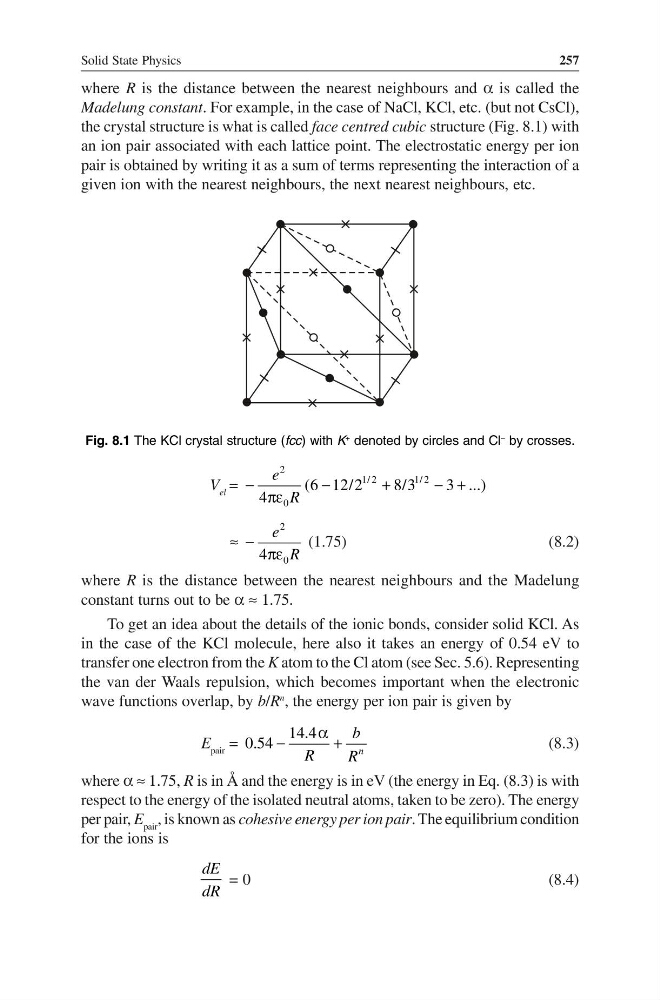
the crystal structure is what is called face centred cubic structure (Fig. 8.1) with
an ion pair associated with each lattice point. The electrostatic energy per ion
pair is obtained by writing it as a sum of terms representing the interaction of a
given ion with the nearest neighbours, the next nearest neighbours, etc.
Fig. 8.1 The KCl crystal structure (fcc) with K
+
denoted by circles and Cl
–
by crosses.
V el =
2
1/ 2
1/ 2
0
(6 12/2
8/3
3 ...)
4
e
R
−
−
+
− +
πε
≈
2
0
4
e
R
− πε
(1.75)
(8.2)
where R is the distance between the nearest neighbours and the Madelung
constant turns out to be α ≈ 1.75.
To get an idea about the details of the ionic bonds, consider solid KCl. As
in the case of the KCl molecule, here also it takes an energy of 0.54 eV to
transfer one electron from the K atom to the Cl atom (see Sec. 5.6). Representing
the van der Waals repulsion, which becomes important when the electronic
wave functions overlap, by b/R
n
, the energy per ion pair is given by
E pair =
14.4
0.54
n
b
R
R
α
−
+
(8.3)
where α ≈ 1.75, R is in Å and the energy is in eV (the energy in Eq. (8.3) is with
respect to the energy of the isolated neutral atoms, taken to be zero). The energy
per pair, E pair , is known as cohesive energy per ion pair. The equilibrium condition
for the ions is
dE
dR
= 0
(8.4)
257
where R is the distance between the nearest neighbours and α is called the
Madelung constant. For example, in the case of NaCl, KCl, etc. (but not CsCl),
the crystal structure is what is called face centred cubic structure (Fig. 8.1) with
an ion pair associated with each lattice point. The electrostatic energy per ion
pair is obtained by writing it as a sum of terms representing the interaction of a
given ion with the nearest neighbours, the next nearest neighbours, etc.
Fig. 8.1 The KCl crystal structure (fcc) with K
+
denoted by circles and Cl
–
by crosses.
V el =
2
1/ 2
1/ 2
0
(6 12/2
8/3
3 ...)
4
e
R
−
−
+
− +
πε
≈
2
0
4
e
R
− πε
(1.75)
(8.2)
where R is the distance between the nearest neighbours and the Madelung
constant turns out to be α ≈ 1.75.
To get an idea about the details of the ionic bonds, consider solid KCl. As
in the case of the KCl molecule, here also it takes an energy of 0.54 eV to
transfer one electron from the K atom to the Cl atom (see Sec. 5.6). Representing
the van der Waals repulsion, which becomes important when the electronic
wave functions overlap, by b/R
n
, the energy per ion pair is given by
E pair =
14.4
0.54
n
b
R
R
α
−
+
(8.3)
where α ≈ 1.75, R is in Å and the energy is in eV (the energy in Eq. (8.3) is with
respect to the energy of the isolated neutral atoms, taken to be zero). The energy
per pair, E pair , is known as cohesive energy per ion pair. The equilibrium condition
for the ions is
dE
dR
= 0
(8.4)