

Quantum Statistics
237
charge, pulls it back. In order to escape, the electrons must then have a minimum
energy φ above the Fermi level. This energy φ is known as the work function,
and usually has a value of the order of a few eV, e.g. 2.3 eV for Na, about 4.5 eV
for Cu, etc.
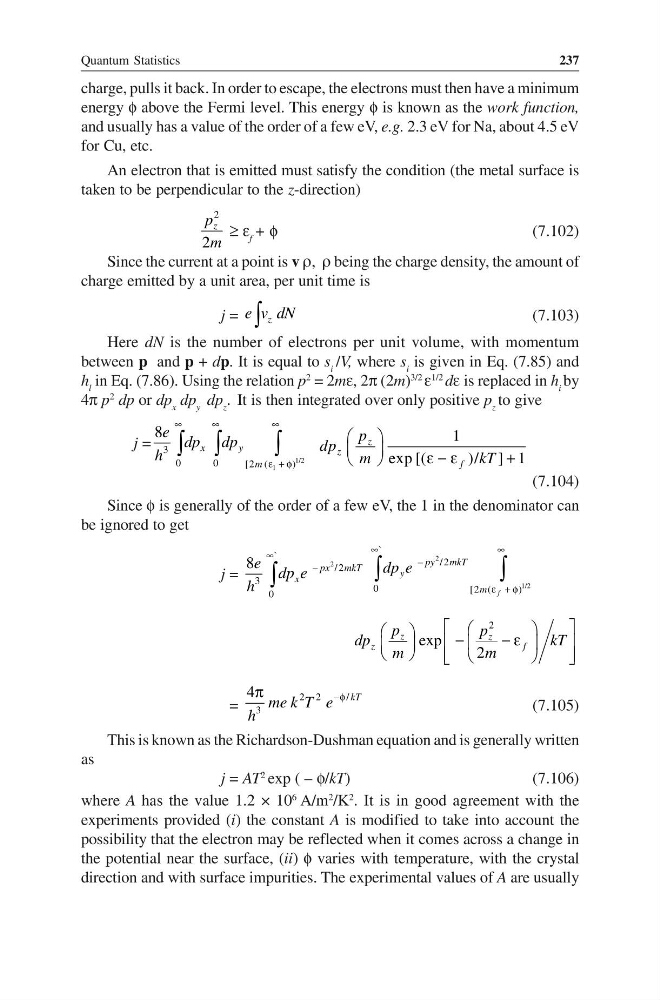
An electron that is emitted must satisfy the condition (the metal surface is
taken to be perpendicular to the z-direction)
2
2
z
p
m
≥ ε f + φ
(7.102)
Since the current at a point is v ρ, ρ being the charge density, the amount of
charge emitted by a unit area, per unit time is
j =
z
e v dN
∫
(7.103)
Here dN is the number of electrons per unit volume, with momentum
between p and p + dp. It is equal to s i /V, where s i is given in Eq. (7.85) and
h l in Eq. (7.86). Using the relation p
2
= 2mε, 2π (2m)
3/2
ε
1/2
dε is replaced in h i by
4π p
2
dp or dp x dp y dp z . It is then integrated over only positive p z to give
j =
1/2
1
3
0
0
[2 (
)
8
x
y
m
e dp dp
h
∞
∞
∞
ε + φ
∫ ∫
∫
1
exp [(
)/ ] 1
z
z
f
p
dp m
k T
ε − ε
+
(7.104)
Since φ is generally of the order of a few eV, the 1 in the denominator can
be ignored to get
j =
2
`
–
/2
3
0
8
px mkT
x
e dp e
h
∞
∫
2
1/2
`
–
/2
0
[2 (
)
f
py mkT
y
m
dp e
∞
∞
ε +φ
∫
∫
2
exp
2
z
z
z
f
p
p
dp
kT
m
m
−
−ε
=
2 2 – /
3
4
kT
me k T e
h
φ
π
(7.105)
This is known as the Richardson-Dushman equation and is generally written
as
j = AT
2
exp ( – φ/kT)
(7.106)
where A has the value 1.2 × 10
6
A/m
2
/K
2
. It is in good agreement with the
experiments provided (i) the constant A is modified to take into account the
possibility that the electron may be reflected when it comes across a change in
the potential near the surface, (ii) φ varies with temperature, with the crystal
direction and with surface impurities. The experimental values of A are usually
237
charge, pulls it back. In order to escape, the electrons must then have a minimum
energy φ above the Fermi level. This energy φ is known as the work function,
and usually has a value of the order of a few eV, e.g. 2.3 eV for Na, about 4.5 eV
for Cu, etc.
An electron that is emitted must satisfy the condition (the metal surface is
taken to be perpendicular to the z-direction)
2
2
z
p
m
≥ ε f + φ
(7.102)
Since the current at a point is v ρ, ρ being the charge density, the amount of
charge emitted by a unit area, per unit time is
j =
z
e v dN
∫
(7.103)
Here dN is the number of electrons per unit volume, with momentum
between p and p + dp. It is equal to s i /V, where s i is given in Eq. (7.85) and
h l in Eq. (7.86). Using the relation p
2
= 2mε, 2π (2m)
3/2
ε
1/2
dε is replaced in h i by
4π p
2
dp or dp x dp y dp z . It is then integrated over only positive p z to give
j =
1/2
1
3
0
0
[2 (
)
8
x
y
m
e dp dp
h
∞
∞
∞
ε + φ
∫ ∫
∫
1
exp [(
)/ ] 1
z
z
f
p
dp m
k T
ε − ε
+
(7.104)
Since φ is generally of the order of a few eV, the 1 in the denominator can
be ignored to get
j =
2
`
–
/2
3
0
8
px mkT
x
e dp e
h
∞
∫
2
1/2
`
–
/2
0
[2 (
)
f
py mkT
y
m
dp e
∞
∞
ε +φ
∫
∫
2
exp
2
z
z
z
f
p
p
dp
kT
m
m
−
−ε
=
2 2 – /
3
4
kT
me k T e
h
φ
π
(7.105)
This is known as the Richardson-Dushman equation and is generally written
as
j = AT
2
exp ( – φ/kT)
(7.106)
where A has the value 1.2 × 10
6
A/m
2
/K
2
. It is in good agreement with the
experiments provided (i) the constant A is modified to take into account the
possibility that the electron may be reflected when it comes across a change in
the potential near the surface, (ii) φ varies with temperature, with the crystal
direction and with surface impurities. The experimental values of A are usually