

Elements of Modern Physics
236
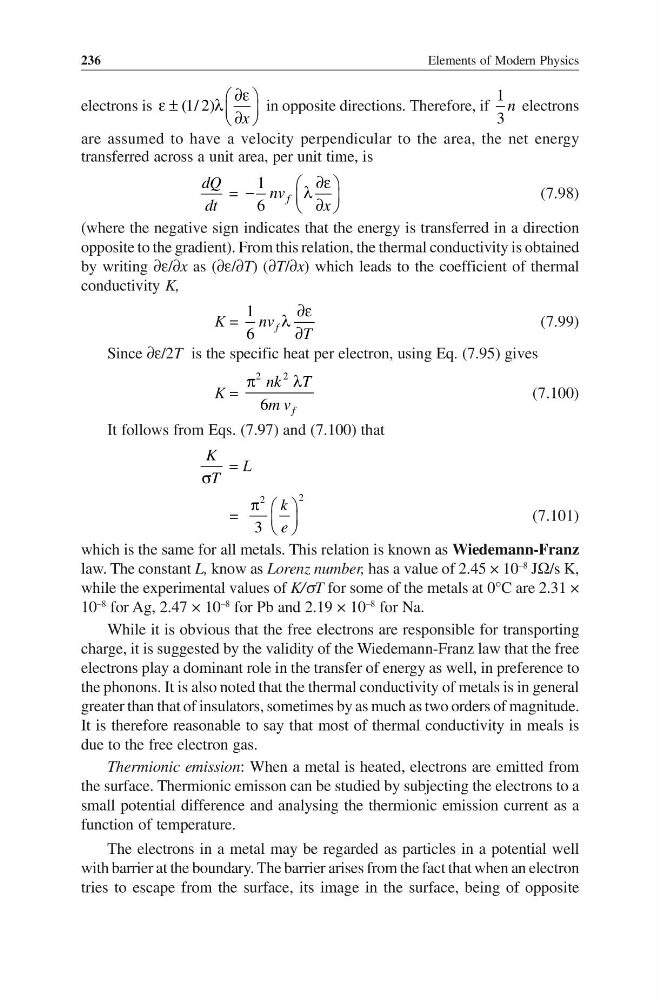
electrons is
(1/ 2)
x
∂ε
ε ±
λ
∂
in opposite directions. Therefore, if
1
3
n electrons
are assumed to have a velocity perpendicular to the area, the net energy
transferred across a unit area, per unit time, is
dQ
dt
=
1
6
f
nv
x
∂ε
−
λ
∂
(7.98)
(where the negative sign indicates that the energy is transferred in a direction
opposite to the gradient). From this relation, the thermal conductivity is obtained
by writing ∂ε/∂x as (∂ε/∂T) (∂T/∂x) which leads to the coefficient of thermal
conductivity K,
K =
1
6
f
nv
T
∂ε
λ ∂
(7.99)
Since ∂ε/2T is the specific heat per electron, using Eq. (7.95) gives
K =
2
2
6 f
nk T
m v
π
λ
(7.100)
It follows from Eqs. (7.97) and (7.100) that
K
T
σ
= L
=
2
2
3
k
e
π
(7.101)
which is the same for all metals. This relation is known as Wiedemann-Franz
law. The constant L, know as Lorenz number, has a value of 2.45 × 10
–8
JΩ/s K,
while the experimental values of K/σT for some of the metals at 0°C are 2.31 ×
10
–8
for Ag, 2.47 × 10
–8
for Pb and 2.19 × 10
–8
for Na.
While it is obvious that the free electrons are responsible for transporting
charge, it is suggested by the validity of the Wiedemann-Franz law that the free
electrons play a dominant role in the transfer of energy as well, in preference to
the phonons. It is also noted that the thermal conductivity of metals is in general
greater than that of insulators, sometimes by as much as two orders of magnitude.
It is therefore reasonable to say that most of thermal conductivity in meals is
due to the free electron gas.
Thermionic emission: When a metal is heated, electrons are emitted from
the surface. Thermionic emisson can be studied by subjecting the electrons to a
small potential difference and analysing the thermionic emission current as a
function of temperature.
The electrons in a metal may be regarded as particles in a potential well
with barrier at the boundary. The barrier arises from the fact that when an electron
tries to escape from the surface, its image in the surface, being of opposite
236
electrons is
(1/ 2)
x
∂ε
ε ±
λ
∂
in opposite directions. Therefore, if
1
3
n electrons
are assumed to have a velocity perpendicular to the area, the net energy
transferred across a unit area, per unit time, is
dQ
dt
=
1
6
f
nv
x
∂ε
−
λ
∂
(7.98)
(where the negative sign indicates that the energy is transferred in a direction
opposite to the gradient). From this relation, the thermal conductivity is obtained
by writing ∂ε/∂x as (∂ε/∂T) (∂T/∂x) which leads to the coefficient of thermal
conductivity K,
K =
1
6
f
nv
T
∂ε
λ ∂
(7.99)
Since ∂ε/2T is the specific heat per electron, using Eq. (7.95) gives
K =
2
2
6 f
nk T
m v
π
λ
(7.100)
It follows from Eqs. (7.97) and (7.100) that
K
T
σ
= L
=
2
2
3
k
e
π
(7.101)
which is the same for all metals. This relation is known as Wiedemann-Franz
law. The constant L, know as Lorenz number, has a value of 2.45 × 10
–8
JΩ/s K,
while the experimental values of K/σT for some of the metals at 0°C are 2.31 ×
10
–8
for Ag, 2.47 × 10
–8
for Pb and 2.19 × 10
–8
for Na.
While it is obvious that the free electrons are responsible for transporting
charge, it is suggested by the validity of the Wiedemann-Franz law that the free
electrons play a dominant role in the transfer of energy as well, in preference to
the phonons. It is also noted that the thermal conductivity of metals is in general
greater than that of insulators, sometimes by as much as two orders of magnitude.
It is therefore reasonable to say that most of thermal conductivity in meals is
due to the free electron gas.
Thermionic emission: When a metal is heated, electrons are emitted from
the surface. Thermionic emisson can be studied by subjecting the electrons to a
small potential difference and analysing the thermionic emission current as a
function of temperature.
The electrons in a metal may be regarded as particles in a potential well
with barrier at the boundary. The barrier arises from the fact that when an electron
tries to escape from the surface, its image in the surface, being of opposite