

Elements of Modern Physics
232
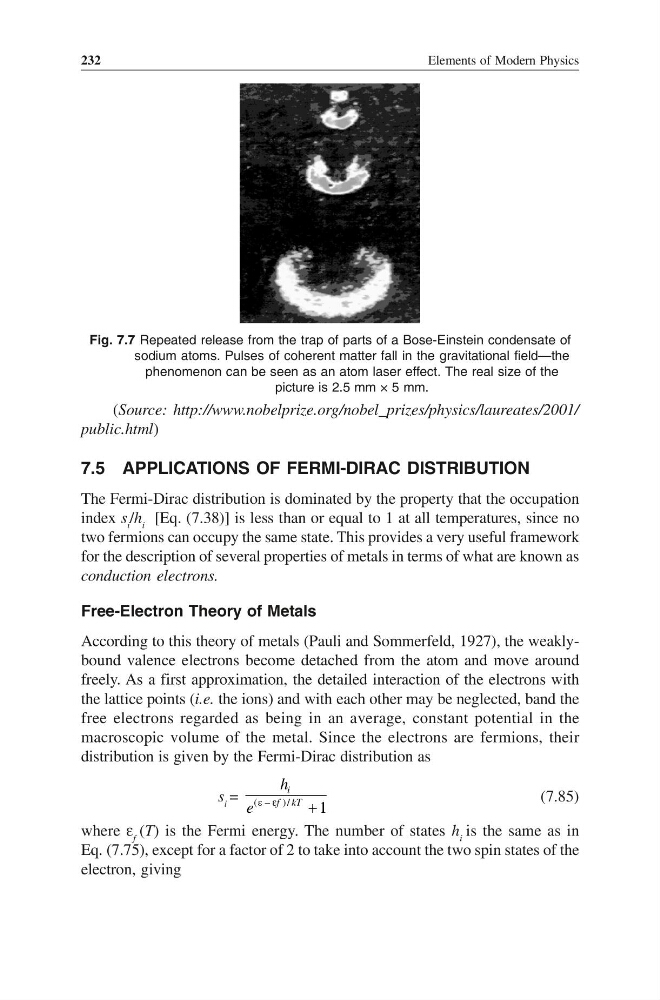
Fig. 7.7 Repeated release from the trap of parts of a Bose-Einstein condensate of
sodium atoms. Pulses of coherent matter fall in the gravitational field—the
phenomenon can be seen as an atom laser effect. The real size of the
picture is 2.5 mm × 5 mm.
(Source: http://www.nobelprize.org/nobel_prizes/physics/laureates/2001/
public.html)
7.5 APPLICATIONS OF FERMI-DIRAC DISTRIBUTION
The Fermi-Dirac distribution is dominated by the property that the occupation
index s i /h i [Eq. (7.38)] is less than or equal to 1 at all temperatures, since no
two fermions can occupy the same state. This provides a very useful framework
for the description of several properties of metals in terms of what are known as
conduction electrons.
Free-Electron Theory of Metals
According to this theory of metals (Pauli and Sommerfeld, 1927), the weaklybound valence electrons become detached from the atom and move around
freely. As a first approximation, the detailed interaction of the electrons with
the lattice points (i.e. the ions) and with each other may be neglected, band the
free electrons regarded as being in an average, constant potential in the
macroscopic volume of the metal. Since the electrons are fermions, their
distribution is given by the Fermi-Dirac distribution as
s i = (ε – )/
1
i
f kT
h
e
ε
+
(7.85)
where ε f (T) is the Fermi energy. The number of states h i is the same as in
Eq. (7.75), except for a factor of 2 to take into account the two spin states of the
electron, giving
232
Fig. 7.7 Repeated release from the trap of parts of a Bose-Einstein condensate of
sodium atoms. Pulses of coherent matter fall in the gravitational field—the
phenomenon can be seen as an atom laser effect. The real size of the
picture is 2.5 mm × 5 mm.
(Source: http://www.nobelprize.org/nobel_prizes/physics/laureates/2001/
public.html)
7.5 APPLICATIONS OF FERMI-DIRAC DISTRIBUTION
The Fermi-Dirac distribution is dominated by the property that the occupation
index s i /h i [Eq. (7.38)] is less than or equal to 1 at all temperatures, since no
two fermions can occupy the same state. This provides a very useful framework
for the description of several properties of metals in terms of what are known as
conduction electrons.
Free-Electron Theory of Metals
According to this theory of metals (Pauli and Sommerfeld, 1927), the weaklybound valence electrons become detached from the atom and move around
freely. As a first approximation, the detailed interaction of the electrons with
the lattice points (i.e. the ions) and with each other may be neglected, band the
free electrons regarded as being in an average, constant potential in the
macroscopic volume of the metal. Since the electrons are fermions, their
distribution is given by the Fermi-Dirac distribution as
s i = (ε – )/
1
i
f kT
h
e
ε
+
(7.85)
where ε f (T) is the Fermi energy. The number of states h i is the same as in
Eq. (7.75), except for a factor of 2 to take into account the two spin states of the
electron, giving