

Quantum Statistics
231
state, and this is Bose-Einstein condensation. It is sometimes said that a
“superatom” arises since the whole complex is described by one single wave
function exactly as in a single atom. We can also speak of coherent matter in
the same way as of coherent light in the case of a laser.
This was achieved with alkali atoms. For rubidium with mass number
87,
87
Rb, and sodium with its single stable isotope
23
Na, which both have integer
atomic spin, weak repulsive forces arise between the atoms in each case. BEC
occurs if the density, expressed as the number of atoms in a λ-sided cube exceeds
2.6. The atoms for realistic densities must move very slowly, at speeds of the
order of a few millimetres per second. This corresponds to temperatures of the
order of 100 nK (nanokelvin), i.e. a tenth of a millionth of a degree above
absolute zero.
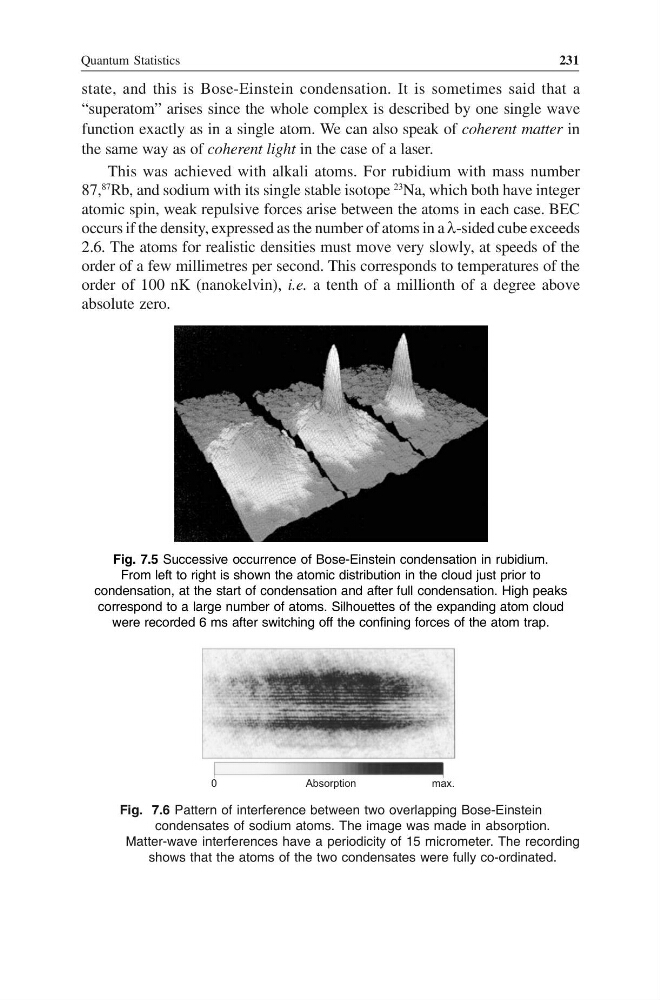
Fig. 7.5 Successive occurrence of Bose-Einstein condensation in rubidium.
From left to right is shown the atomic distribution in the cloud just prior to
condensation, at the start of condensation and after full condensation. High peaks
correspond to a large number of atoms. Silhouettes of the expanding atom cloud
were recorded 6 ms after switching off the confining forces of the atom trap.
0
Absorption
max.
Fig. 7.6 Pattern of interference between two overlapping Bose-Einstein
condensates of sodium atoms. The image was made in absorption.
Matter-wave interferences have a periodicity of 15 micrometer. The recording
shows that the atoms of the two condensates were fully co-ordinated.
231
state, and this is Bose-Einstein condensation. It is sometimes said that a
“superatom” arises since the whole complex is described by one single wave
function exactly as in a single atom. We can also speak of coherent matter in
the same way as of coherent light in the case of a laser.
This was achieved with alkali atoms. For rubidium with mass number
87,
87
Rb, and sodium with its single stable isotope
23
Na, which both have integer
atomic spin, weak repulsive forces arise between the atoms in each case. BEC
occurs if the density, expressed as the number of atoms in a λ-sided cube exceeds
2.6. The atoms for realistic densities must move very slowly, at speeds of the
order of a few millimetres per second. This corresponds to temperatures of the
order of 100 nK (nanokelvin), i.e. a tenth of a millionth of a degree above
absolute zero.
Fig. 7.5 Successive occurrence of Bose-Einstein condensation in rubidium.
From left to right is shown the atomic distribution in the cloud just prior to
condensation, at the start of condensation and after full condensation. High peaks
correspond to a large number of atoms. Silhouettes of the expanding atom cloud
were recorded 6 ms after switching off the confining forces of the atom trap.
0
Absorption
max.
Fig. 7.6 Pattern of interference between two overlapping Bose-Einstein
condensates of sodium atoms. The image was made in absorption.
Matter-wave interferences have a periodicity of 15 micrometer. The recording
shows that the atoms of the two condensates were fully co-ordinated.