

Quantum Statistics
217
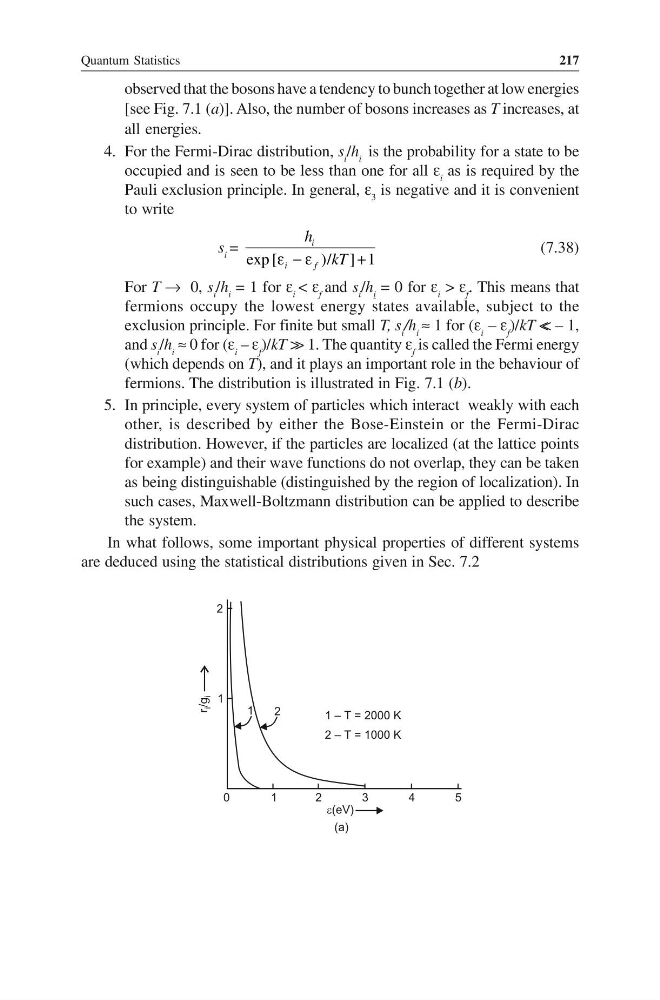
observed that the bosons have a tendency to bunch together at low energies
[see Fig. 7.1 (a)]. Also, the number of bosons increases as T increases, at
all energies.
4. For the Fermi-Dirac distribution, s i /h i is the probability for a state to be
occupied and is seen to be less than one for all ε i as is required by the
Pauli exclusion principle. In general, ε 3 is negative and it is convenient
to write
s i = exp [
)/ ] 1
i
i
f
h
kT
ε − ε
+
(7.38)
For T → 0, s i /h i = 1 for ε i < ε f and s i /h i = 0 for ε i > ε f . This means that
fermions occupy the lowest energy states available, subject to the
exclusion principle. For finite but small T, s i /h i ≈ 1 for (ε i – ε f )/kT < < – 1,
and s i /h i ≈ 0 for (ε i – ε f )/kT >> 1. The quantity ε f is called the Fermi energy
(which depends on T), and it plays an important role in the behaviour of
fermions. The distribution is illustrated in Fig. 7.1 (b).
5. In principle, every system of particles which interact weakly with each
other, is described by either the Bose-Einstein or the Fermi-Dirac
distribution. However, if the particles are localized (at the lattice points
for example) and their wave functions do not overlap, they can be taken
as being distinguishable (distinguished by the region of localization). In
such cases, Maxwell-Boltzmann distribution can be applied to describe
the system.
In what follows, some important physical properties of different systems
are deduced using the statistical distributions given in Sec. 7.2
2
1
0
1
2
3
4
5
r /g
i i
e(eV)
1
2
1 – T = 2000 K
2 – T = 1000 K
(a)
217
observed that the bosons have a tendency to bunch together at low energies
[see Fig. 7.1 (a)]. Also, the number of bosons increases as T increases, at
all energies.
4. For the Fermi-Dirac distribution, s i /h i is the probability for a state to be
occupied and is seen to be less than one for all ε i as is required by the
Pauli exclusion principle. In general, ε 3 is negative and it is convenient
to write
s i = exp [
)/ ] 1
i
i
f
h
kT
ε − ε
+
(7.38)
For T → 0, s i /h i = 1 for ε i < ε f and s i /h i = 0 for ε i > ε f . This means that
fermions occupy the lowest energy states available, subject to the
exclusion principle. For finite but small T, s i /h i ≈ 1 for (ε i – ε f )/kT < < – 1,
and s i /h i ≈ 0 for (ε i – ε f )/kT >> 1. The quantity ε f is called the Fermi energy
(which depends on T), and it plays an important role in the behaviour of
fermions. The distribution is illustrated in Fig. 7.1 (b).
5. In principle, every system of particles which interact weakly with each
other, is described by either the Bose-Einstein or the Fermi-Dirac
distribution. However, if the particles are localized (at the lattice points
for example) and their wave functions do not overlap, they can be taken
as being distinguishable (distinguished by the region of localization). In
such cases, Maxwell-Boltzmann distribution can be applied to describe
the system.
In what follows, some important physical properties of different systems
are deduced using the statistical distributions given in Sec. 7.2
2
1
0
1
2
3
4
5
r /g
i i
e(eV)
1
2
1 – T = 2000 K
2 – T = 1000 K
(a)