

Quantum Statistics
215
q i =
1
1
1
exp [– (
)]
i
i
q f
f
β ε − ε
(7.23)
r i =
1
1
1
1
exp [ (
)] 1
i
i
g
r g
r
+
β ε − ε −
(7.24)
s i =
1
1
1
1
exp [ (
) 1
i
i
h
h s
s
−
β ε − ε +
(7.25)
where
β =
2 1
2
1
1 2
1 ln
f q
f q
ε − ε
(7.26)
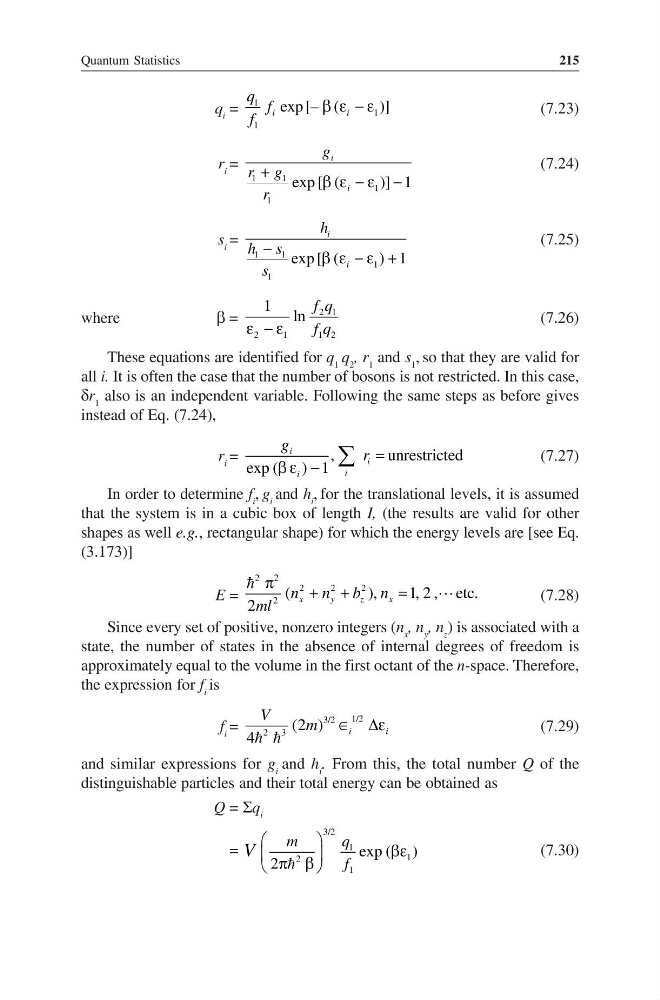
These equations are identified for q 1 q 2 , r 1 and s 1 , so that they are valid for
all i. It is often the case that the number of bosons is not restricted. In this case,
δr 1 also is an independent variable. Following the same steps as before gives
instead of Eq. (7.24),
r i =
,
unrestricted
exp ( ) 1
i
i
i
i
g
r =
β ε −
∑
(7.27)
In order to determine f i , g i and h i , for the translational levels, it is assumed
that the system is in a cubic box of length I, (the results are valid for other
shapes as well e.g., rectangular shape) for which the energy levels are [see Eq.
(3.173)]
E =
2
2
2
2
2
2
(
) ,
1 ,2, e t c .
2
x
y
z
x
n n b n
ml
π
+ +
=
(7.28)
Since every set of positive, nonzero integers (n x , n y , n z ) is associated with a
state, the number of states in the absence of internal degrees of freedom is
approximately equal to the volume in the first octant of the n-space. Therefore,
the expression for f i is
f i =
1/2
3/2
2 3
(2 )
4
i
i
V
m ∈ ∆ε
(7.29)
and similar expressions for g i and h i . From this, the total number Q of the
distinguishable particles and their total energy can be obtained as
Q = Σq i
=
3/2
1
1
2
1
exp ( )
2
q
m
f
V
βε
π β
(7.30)
215
q i =
1
1
1
exp [– (
)]
i
i
q f
f
β ε − ε
(7.23)
r i =
1
1
1
1
exp [ (
)] 1
i
i
g
r g
r
+
β ε − ε −
(7.24)
s i =
1
1
1
1
exp [ (
) 1
i
i
h
h s
s
−
β ε − ε +
(7.25)
where
β =
2 1
2
1
1 2
1 ln
f q
f q
ε − ε
(7.26)
These equations are identified for q 1 q 2 , r 1 and s 1 , so that they are valid for
all i. It is often the case that the number of bosons is not restricted. In this case,
δr 1 also is an independent variable. Following the same steps as before gives
instead of Eq. (7.24),
r i =
,
unrestricted
exp ( ) 1
i
i
i
i
g
r =
β ε −
∑
(7.27)
In order to determine f i , g i and h i , for the translational levels, it is assumed
that the system is in a cubic box of length I, (the results are valid for other
shapes as well e.g., rectangular shape) for which the energy levels are [see Eq.
(3.173)]
E =
2
2
2
2
2
2
(
) ,
1 ,2, e t c .
2
x
y
z
x
n n b n
ml
π
+ +
=
(7.28)
Since every set of positive, nonzero integers (n x , n y , n z ) is associated with a
state, the number of states in the absence of internal degrees of freedom is
approximately equal to the volume in the first octant of the n-space. Therefore,
the expression for f i is
f i =
1/2
3/2
2 3
(2 )
4
i
i
V
m ∈ ∆ε
(7.29)
and similar expressions for g i and h i . From this, the total number Q of the
distinguishable particles and their total energy can be obtained as
Q = Σq i
=
3/2
1
1
2
1
exp ( )
2
q
m
f
V
βε
π β
(7.30)