

Elements of Modern Physics
190
stimulate the emission of similar other photons and the chain reaction quickly
develops a beam of photons all moving parallel to the rod, which is
monochromatic (well-defined frequency) and is coherent (well-defined phase
and polarization). When the beam develops sufficient intensity, it emerges
through the partially silvered end. The ruby laser is a solid-state laser and operates
in pulses (several pulses per minute). The larger amount of heat released in the
crystal is cooled by liquid air.
Helium-neon laser: An example of a continuously operating laser is the
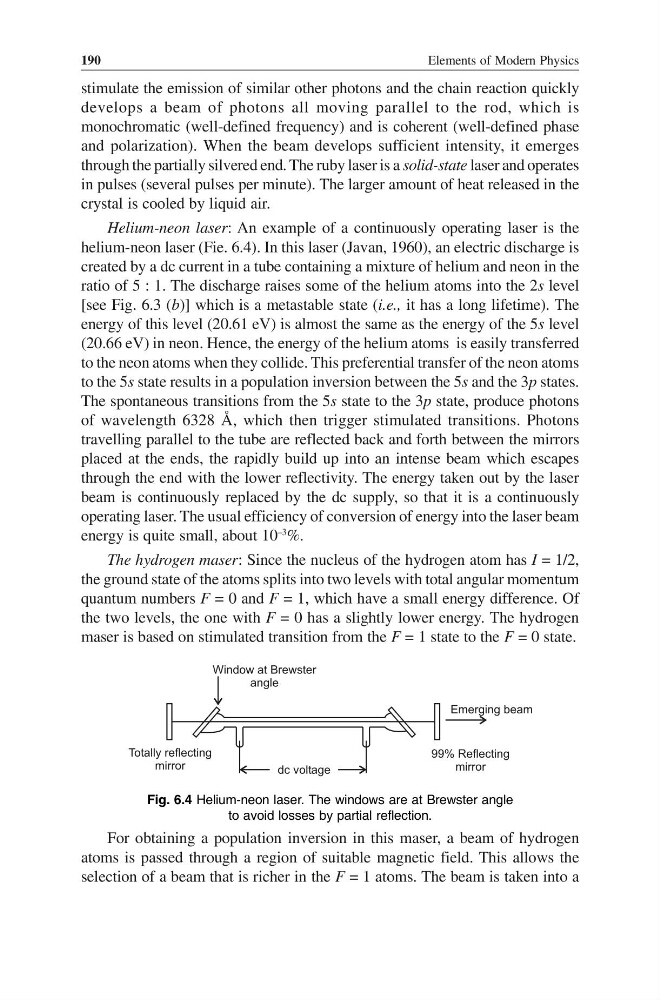
helium-neon laser (Fie. 6.4). In this laser (Javan, 1960), an electric discharge is
created by a dc current in a tube containing a mixture of helium and neon in the
ratio of 5 : 1. The discharge raises some of the helium atoms into the 2s level
[see Fig. 6.3 (b)] which is a metastable state (i.e., it has a long lifetime). The
energy of this level (20.61 eV) is almost the same as the energy of the 5s level
(20.66 eV) in neon. Hence, the energy of the helium atoms is easily transferred
to the neon atoms when they collide. This preferential transfer of the neon atoms
to the 5s state results in a population inversion between the 5s and the 3p states.
The spontaneous transitions from the 5s state to the 3p state, produce photons
of wavelength 6328 Å, which then trigger stimulated transitions. Photons
travelling parallel to the tube are reflected back and forth between the mirrors
placed at the ends, the rapidly build up into an intense beam which escapes
through the end with the lower reflectivity. The energy taken out by the laser
beam is continuously replaced by the dc supply, so that it is a continuously
operating laser. The usual efficiency of conversion of energy into the laser beam
energy is quite small, about 10
–3
%.
The hydrogen maser: Since the nucleus of the hydrogen atom has I = 1/2,
the ground state of the atoms splits into two levels with total angular momentum
quantum numbers F = 0 and F = 1, which have a small energy difference. Of
the two levels, the one with F = 0 has a slightly lower energy. The hydrogen
maser is based on stimulated transition from the F = 1 state to the F = 0 state.
dc voltage
Window at Brewster
angle
Emerging beam
99% Reflecting
mirror
Totally reflecting
mirror
Fig. 6.4 Helium-neon laser. The windows are at Brewster angle
to avoid losses by partial reflection.
For obtaining a population inversion in this maser, a beam of hydrogen
atoms is passed through a region of suitable magnetic field. This allows the
selection of a beam that is richer in the F = 1 atoms. The beam is taken into a
190
stimulate the emission of similar other photons and the chain reaction quickly
develops a beam of photons all moving parallel to the rod, which is
monochromatic (well-defined frequency) and is coherent (well-defined phase
and polarization). When the beam develops sufficient intensity, it emerges
through the partially silvered end. The ruby laser is a solid-state laser and operates
in pulses (several pulses per minute). The larger amount of heat released in the
crystal is cooled by liquid air.
Helium-neon laser: An example of a continuously operating laser is the
helium-neon laser (Fie. 6.4). In this laser (Javan, 1960), an electric discharge is
created by a dc current in a tube containing a mixture of helium and neon in the
ratio of 5 : 1. The discharge raises some of the helium atoms into the 2s level
[see Fig. 6.3 (b)] which is a metastable state (i.e., it has a long lifetime). The
energy of this level (20.61 eV) is almost the same as the energy of the 5s level
(20.66 eV) in neon. Hence, the energy of the helium atoms is easily transferred
to the neon atoms when they collide. This preferential transfer of the neon atoms
to the 5s state results in a population inversion between the 5s and the 3p states.
The spontaneous transitions from the 5s state to the 3p state, produce photons
of wavelength 6328 Å, which then trigger stimulated transitions. Photons
travelling parallel to the tube are reflected back and forth between the mirrors
placed at the ends, the rapidly build up into an intense beam which escapes
through the end with the lower reflectivity. The energy taken out by the laser
beam is continuously replaced by the dc supply, so that it is a continuously
operating laser. The usual efficiency of conversion of energy into the laser beam
energy is quite small, about 10
–3
%.
The hydrogen maser: Since the nucleus of the hydrogen atom has I = 1/2,
the ground state of the atoms splits into two levels with total angular momentum
quantum numbers F = 0 and F = 1, which have a small energy difference. Of
the two levels, the one with F = 0 has a slightly lower energy. The hydrogen
maser is based on stimulated transition from the F = 1 state to the F = 0 state.
dc voltage
Window at Brewster
angle
Emerging beam
99% Reflecting
mirror
Totally reflecting
mirror
Fig. 6.4 Helium-neon laser. The windows are at Brewster angle
to avoid losses by partial reflection.
For obtaining a population inversion in this maser, a beam of hydrogen
atoms is passed through a region of suitable magnetic field. This allows the
selection of a beam that is richer in the F = 1 atoms. The beam is taken into a