

Interaction with External Fields
189
∆E/h ≈ 2.387 × 10
10
s
–1
(6.84)
which is in the microwave range (λ ≈ 1.25 cm). At room temperature, these two
levels are almost equally populated. However, the two states have different
electric dipole moments. Therefore, an ammonia beam can be separated into
two beams by subjecting it to a suitable electric field. The beam with higher
energy is taken into a resonating chamber (whose role will be discussed shortly)
where the spontaneously emitted photons will stimulate emissions of similar
photons by other atoms, and the chain process rapidly builds up the amplitude.
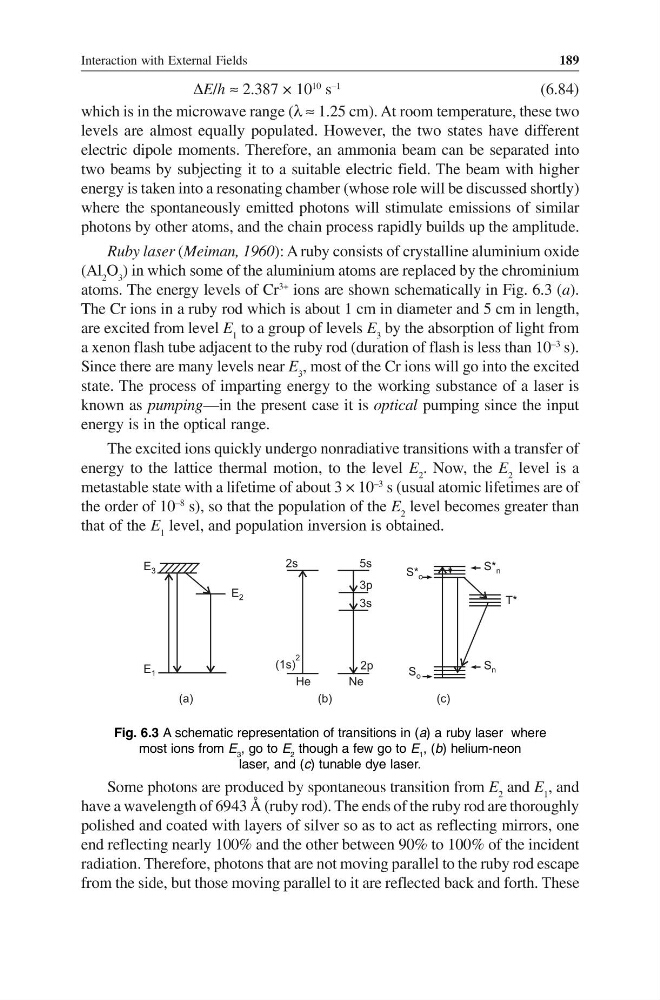
Ruby laser (Meiman, 1960): A ruby consists of crystalline aluminium oxide
(Al 2 O 3 ) in which some of the aluminium atoms are replaced by the chrominium
atoms. The energy levels of Cr
3+
ions are shown schematically in Fig. 6.3 (a).
The Cr ions in a ruby rod which is about 1 cm in diameter and 5 cm in length,
are excited from level E 1 to a group of levels E 3 by the absorption of light from
a xenon flash tube adjacent to the ruby rod (duration of flash is less than 10
–3
s).
Since there are many levels near E 3 , most of the Cr ions will go into the excited
state. The process of imparting energy to the working substance of a laser is
known as pumping—in the present case it is optical pumping since the input
energy is in the optical range.
The excited ions quickly undergo nonradiative transitions with a transfer of
energy to the lattice thermal motion, to the level E 2 . Now, the E 2 level is a
metastable state with a lifetime of about 3 × 10
–3
s (usual atomic lifetimes are of
the order of 10
–8
s), so that the population of the E 2 level becomes greater than
that of the E 1 level, and population inversion is obtained.
E 3
E 2
E 1
(a)
2s
(1s)
2
He
(b)
2p
Ne
5s
3p
3s
S* o
S* n
S o
S n
T*
(c)
Fig. 6.3 A schematic representation of transitions in (a) a ruby laser where
most ions from E 3 , go to E 2 though a few go to E 1 , (b) helium-neon
laser, and (c) tunable dye laser.
Some photons are produced by spontaneous transition from E 2 and E 1 , and
have a wavelength of 6943 Å (ruby rod). The ends of the ruby rod are thoroughly
polished and coated with layers of silver so as to act as reflecting mirrors, one
end reflecting nearly 100% and the other between 90% to 100% of the incident
radiation. Therefore, photons that are not moving parallel to the ruby rod escape
from the side, but those moving parallel to it are reflected back and forth. These
189
∆E/h ≈ 2.387 × 10
10
s
–1
(6.84)
which is in the microwave range (λ ≈ 1.25 cm). At room temperature, these two
levels are almost equally populated. However, the two states have different
electric dipole moments. Therefore, an ammonia beam can be separated into
two beams by subjecting it to a suitable electric field. The beam with higher
energy is taken into a resonating chamber (whose role will be discussed shortly)
where the spontaneously emitted photons will stimulate emissions of similar
photons by other atoms, and the chain process rapidly builds up the amplitude.
Ruby laser (Meiman, 1960): A ruby consists of crystalline aluminium oxide
(Al 2 O 3 ) in which some of the aluminium atoms are replaced by the chrominium
atoms. The energy levels of Cr
3+
ions are shown schematically in Fig. 6.3 (a).
The Cr ions in a ruby rod which is about 1 cm in diameter and 5 cm in length,
are excited from level E 1 to a group of levels E 3 by the absorption of light from
a xenon flash tube adjacent to the ruby rod (duration of flash is less than 10
–3
s).
Since there are many levels near E 3 , most of the Cr ions will go into the excited
state. The process of imparting energy to the working substance of a laser is
known as pumping—in the present case it is optical pumping since the input
energy is in the optical range.
The excited ions quickly undergo nonradiative transitions with a transfer of
energy to the lattice thermal motion, to the level E 2 . Now, the E 2 level is a
metastable state with a lifetime of about 3 × 10
–3
s (usual atomic lifetimes are of
the order of 10
–8
s), so that the population of the E 2 level becomes greater than
that of the E 1 level, and population inversion is obtained.
E 3
E 2
E 1
(a)
2s
(1s)
2
He
(b)
2p
Ne
5s
3p
3s
S* o
S* n
S o
S n
T*
(c)
Fig. 6.3 A schematic representation of transitions in (a) a ruby laser where
most ions from E 3 , go to E 2 though a few go to E 1 , (b) helium-neon
laser, and (c) tunable dye laser.
Some photons are produced by spontaneous transition from E 2 and E 1 , and
have a wavelength of 6943 Å (ruby rod). The ends of the ruby rod are thoroughly
polished and coated with layers of silver so as to act as reflecting mirrors, one
end reflecting nearly 100% and the other between 90% to 100% of the incident
radiation. Therefore, photons that are not moving parallel to the ruby rod escape
from the side, but those moving parallel to it are reflected back and forth. These