

Atoms and Molecules
163
V(r) = V 0 +
0
2
2
1
2
r r
d V
dr =
(r – r 0 )
2
+ ...
(5.63)
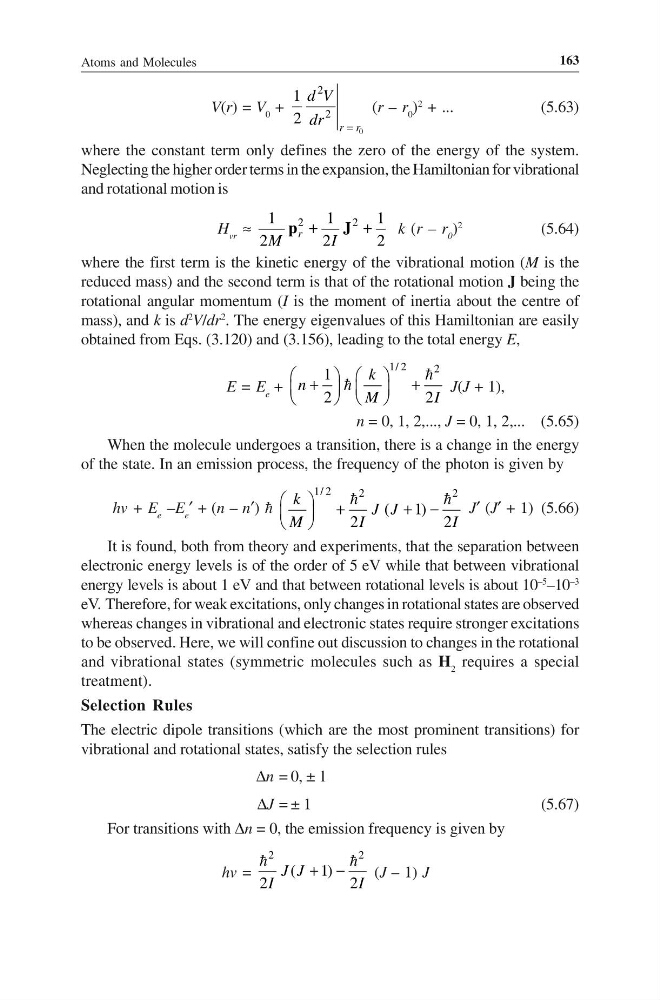
where the constant term only defines the zero of the energy of the system.
Neglecting the higher order terms in the expansion, the Hamiltonian for vibrational
and rotational motion is
H vr ≈
2
2
1
1
1
2
2
2
+
+
r
M
I
p
J
k (r – r 0 )
2
(5.64)
where the first term is the kinetic energy of the vibrational motion (M is the
reduced mass) and the second term is that of the rotational motion J being the
rotational angular momentum (I is the moment of inertia about the centre of
mass), and k is d
2
V/dr
2
. The energy eigenvalues of this Hamiltonian are easily
obtained from Eqs. (3.120) and (3.156), leading to the total energy E,
E = E e +
1/ 2
2
1
2
2
+
+
k
n
M
I
J(J + 1),
n = 0, 1, 2,..., J = 0, 1, 2,... (5.65)
When the molecule undergoes a transition, there is a change in the energy
of the state. In an emission process, the frequency of the photon is given by
hv + E e –E e ′ + (n – n′)
1/ 2
2
2
(
1)
2
2
+
+ −
k
J J
M
I
I
J′ (J′ + 1) (5.66)
It is found, both from theory and experiments, that the separation between
electronic energy levels is of the order of 5 eV while that between vibrational
energy levels is about 1 eV and that between rotational levels is about 10
–5
–10
–3
eV. Therefore, for weak excitations, only changes in rotational states are observed
whereas changes in vibrational and electronic states require stronger excitations
to be observed. Here, we will confine out discussion to changes in the rotational
and vibrational states (symmetric molecules such as H 2 requires a special
treatment).
Selection Rules
The electric dipole transitions (which are the most prominent transitions) for
vibrational and rotational states, satisfy the selection rules
∆n = 0, ± 1
∆J = ± 1
(5.67)
For transitions with ∆n = 0, the emission frequency is given by
hv =
2
2
(
1)
2
2
+ −
J J
I
I
(J – 1) J
163
V(r) = V 0 +
0
2
2
1
2
r r
d V
dr =
(r – r 0 )
2
+ ...
(5.63)
where the constant term only defines the zero of the energy of the system.
Neglecting the higher order terms in the expansion, the Hamiltonian for vibrational
and rotational motion is
H vr ≈
2
2
1
1
1
2
2
2
+
+
r
M
I
p
J
k (r – r 0 )
2
(5.64)
where the first term is the kinetic energy of the vibrational motion (M is the
reduced mass) and the second term is that of the rotational motion J being the
rotational angular momentum (I is the moment of inertia about the centre of
mass), and k is d
2
V/dr
2
. The energy eigenvalues of this Hamiltonian are easily
obtained from Eqs. (3.120) and (3.156), leading to the total energy E,
E = E e +
1/ 2
2
1
2
2
+
+
k
n
M
I
J(J + 1),
n = 0, 1, 2,..., J = 0, 1, 2,... (5.65)
When the molecule undergoes a transition, there is a change in the energy
of the state. In an emission process, the frequency of the photon is given by
hv + E e –E e ′ + (n – n′)
1/ 2
2
2
(
1)
2
2
+
+ −
k
J J
M
I
I
J′ (J′ + 1) (5.66)
It is found, both from theory and experiments, that the separation between
electronic energy levels is of the order of 5 eV while that between vibrational
energy levels is about 1 eV and that between rotational levels is about 10
–5
–10
–3
eV. Therefore, for weak excitations, only changes in rotational states are observed
whereas changes in vibrational and electronic states require stronger excitations
to be observed. Here, we will confine out discussion to changes in the rotational
and vibrational states (symmetric molecules such as H 2 requires a special
treatment).
Selection Rules
The electric dipole transitions (which are the most prominent transitions) for
vibrational and rotational states, satisfy the selection rules
∆n = 0, ± 1
∆J = ± 1
(5.67)
For transitions with ∆n = 0, the emission frequency is given by
hv =
2
2
(
1)
2
2
+ −
J J
I
I
(J – 1) J