

Elements of Modern Physics
162
– 4
– 2
2
4
E (in eV)
r o
1
2
Antibonding state, parallel spins
r (in Å)
Bonding state, antiparallel spins
– 4.75 eV at r = 0.74 Å
o
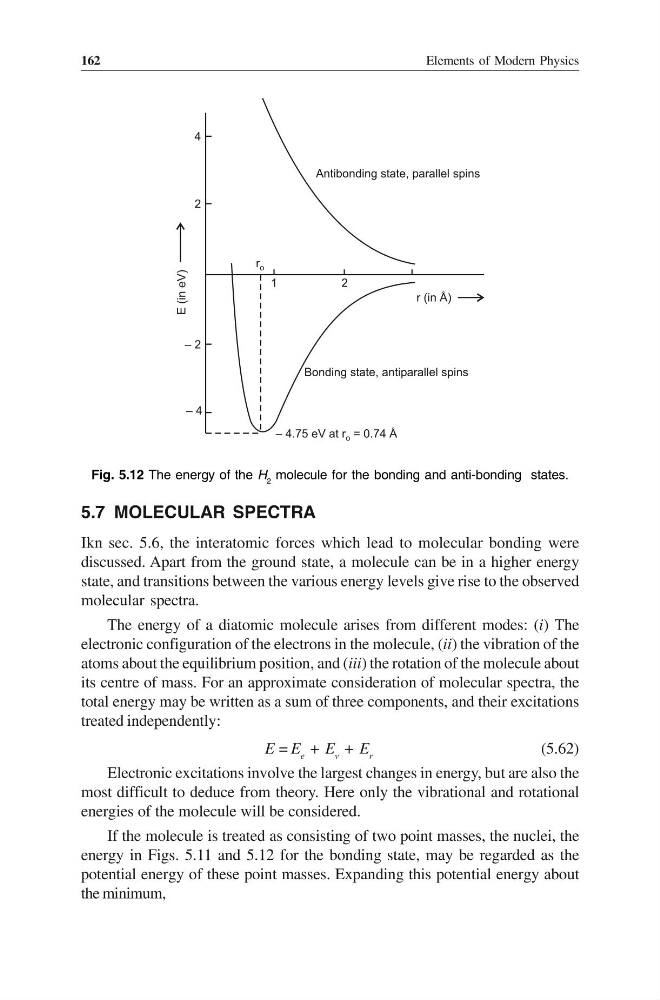
Fig. 5.12 The energy of the H 2 molecule for the bonding and anti-bonding states.
5.7 MOLECULAR SPECTRA
Ikn sec. 5.6, the interatomic forces which lead to molecular bonding were
discussed. Apart from the ground state, a molecule can be in a higher energy
state, and transitions between the various energy levels give rise to the observed
molecular spectra.
The energy of a diatomic molecule arises from different modes: (i) The
electronic configuration of the electrons in the molecule, (ii) the vibration of the
atoms about the equilibrium position, and (iii) the rotation of the molecule about
its centre of mass. For an approximate consideration of molecular spectra, the
total energy may be written as a sum of three components, and their excitations
treated independently:
E = E e + E v + E r
(5.62)
Electronic excitations involve the largest changes in energy, but are also the
most difficult to deduce from theory. Here only the vibrational and rotational
energies of the molecule will be considered.
If the molecule is treated as consisting of two point masses, the nuclei, the
energy in Figs. 5.11 and 5.12 for the bonding state, may be regarded as the
potential energy of these point masses. Expanding this potential energy about
the minimum,
162
– 4
– 2
2
4
E (in eV)
r o
1
2
Antibonding state, parallel spins
r (in Å)
Bonding state, antiparallel spins
– 4.75 eV at r = 0.74 Å
o
Fig. 5.12 The energy of the H 2 molecule for the bonding and anti-bonding states.
5.7 MOLECULAR SPECTRA
Ikn sec. 5.6, the interatomic forces which lead to molecular bonding were
discussed. Apart from the ground state, a molecule can be in a higher energy
state, and transitions between the various energy levels give rise to the observed
molecular spectra.
The energy of a diatomic molecule arises from different modes: (i) The
electronic configuration of the electrons in the molecule, (ii) the vibration of the
atoms about the equilibrium position, and (iii) the rotation of the molecule about
its centre of mass. For an approximate consideration of molecular spectra, the
total energy may be written as a sum of three components, and their excitations
treated independently:
E = E e + E v + E r
(5.62)
Electronic excitations involve the largest changes in energy, but are also the
most difficult to deduce from theory. Here only the vibrational and rotational
energies of the molecule will be considered.
If the molecule is treated as consisting of two point masses, the nuclei, the
energy in Figs. 5.11 and 5.12 for the bonding state, may be regarded as the
potential energy of these point masses. Expanding this potential energy about
the minimum,