

Atoms and Molecules
145
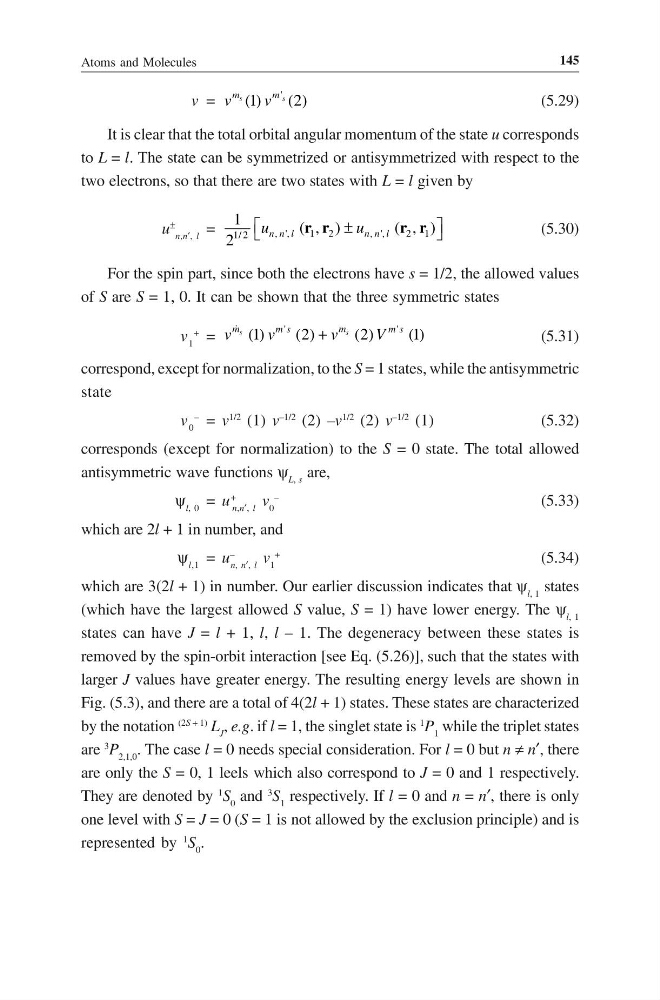
v =
'
(1)
(2)
s
s
m
m
v
v
(5.29)
It is clear that the total orbital angular momentum of the state u corresponds
to L = l. The state can be symmetrized or antisymmetrized with respect to the
two electrons, so that there are two states with L = l given by
u
±
n,n′, l
=
, ',
1 2
, ',
2 1
1/ 2
1
( , )
( , )
2
±
n n l
n n l
u
u
r r
r r
(5.30)
For the spin part, since both the electrons have s = 1/2, the allowed values
of S are S = 1, 0. It can be shown that the three symmetric states
v 1
+
=
'
'
(1)
(2)
(2)
(1)
+
s
s
m
m
m s
m s
v
v
v
V
(5.31)
correspond, except for normalization, to the S = 1 states, while the antisymmetric
state
v 0
–
= v
1/2
(1) v
–1/2
(2) –v
1/2
(2) v
–1/2
(1)
(5.32)
corresponds (except for normalization) to the S = 0 state. The total allowed
antisymmetric wave functions ψ L, s are,
ψ l, 0 = u
+
n,n′, l
v 0
–
(5.33)
which are 2l + 1 in number, and
ψ l,1 = u
–
n, n′, l
v 1
+
(5.34)
which are 3(2l + 1) in number. Our earlier discussion indicates that ψ l, 1 states
(which have the largest allowed S value, S = 1) have lower energy. The ψ l, 1
states can have J = l + 1, l, l – 1. The degeneracy between these states is
removed by the spin-orbit interaction [see Eq. (5.26)], such that the states with
larger J values have greater energy. The resulting energy levels are shown in
Fig. (5.3), and there are a total of 4(2l + 1) states. These states are characterized
by the notation
(2S + 1)
L J , e.g. if l = 1, the singlet state is
1
P 1 while the triplet states
are
3
P 2,1,0 . The case l = 0 needs special consideration. For l = 0 but n ≠ n′, there
are only the S = 0, 1 leels which also correspond to J = 0 and 1 respectively.
They are denoted by
1
S 0 and
3
S 1 respectively. If l = 0 and n = n′, there is only
one level with S = J = 0 (S = 1 is not allowed by the exclusion principle) and is
represented by
1
S 0 .
145
v =
'
(1)
(2)
s
s
m
m
v
v
(5.29)
It is clear that the total orbital angular momentum of the state u corresponds
to L = l. The state can be symmetrized or antisymmetrized with respect to the
two electrons, so that there are two states with L = l given by
u
±
n,n′, l
=
, ',
1 2
, ',
2 1
1/ 2
1
( , )
( , )
2
±
n n l
n n l
u
u
r r
r r
(5.30)
For the spin part, since both the electrons have s = 1/2, the allowed values
of S are S = 1, 0. It can be shown that the three symmetric states
v 1
+
=
'
'
(1)
(2)
(2)
(1)
+
s
s
m
m
m s
m s
v
v
v
V
(5.31)
correspond, except for normalization, to the S = 1 states, while the antisymmetric
state
v 0
–
= v
1/2
(1) v
–1/2
(2) –v
1/2
(2) v
–1/2
(1)
(5.32)
corresponds (except for normalization) to the S = 0 state. The total allowed
antisymmetric wave functions ψ L, s are,
ψ l, 0 = u
+
n,n′, l
v 0
–
(5.33)
which are 2l + 1 in number, and
ψ l,1 = u
–
n, n′, l
v 1
+
(5.34)
which are 3(2l + 1) in number. Our earlier discussion indicates that ψ l, 1 states
(which have the largest allowed S value, S = 1) have lower energy. The ψ l, 1
states can have J = l + 1, l, l – 1. The degeneracy between these states is
removed by the spin-orbit interaction [see Eq. (5.26)], such that the states with
larger J values have greater energy. The resulting energy levels are shown in
Fig. (5.3), and there are a total of 4(2l + 1) states. These states are characterized
by the notation
(2S + 1)
L J , e.g. if l = 1, the singlet state is
1
P 1 while the triplet states
are
3
P 2,1,0 . The case l = 0 needs special consideration. For l = 0 but n ≠ n′, there
are only the S = 0, 1 leels which also correspond to J = 0 and 1 respectively.
They are denoted by
1
S 0 and
3
S 1 respectively. If l = 0 and n = n′, there is only
one level with S = J = 0 (S = 1 is not allowed by the exclusion principle) and is
represented by
1
S 0 .