

Elements of Modern Physics
130
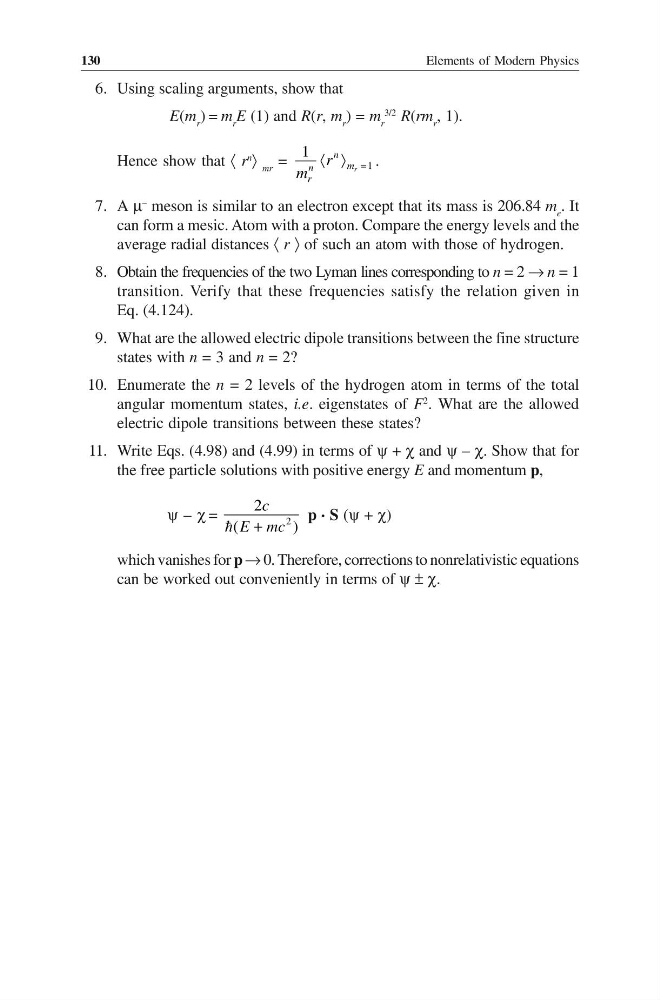
6. Using scaling arguments, show that
E(m r ) = m r E (1) and R(r, m r ) = m r
3/2
R(rm r , 1).
Hence show that 〈 r
n
〉 mr =
1
1
r
n
m
n
r
r
m
=
〈 〉
.
7. A µ
–
meson is similar to an electron except that its mass is 206.84 m e . It
can form a mesic. Atom with a proton. Compare the energy levels and the
average radial distances 〈 r 〉 of such an atom with those of hydrogen.
8. Obtain the frequencies of the two Lyman lines corresponding to n = 2 → n = 1
transition. Verify that these frequencies satisfy the relation given in
Eq. (4.124).
9. What are the allowed electric dipole transitions between the fine structure
states with n = 3 and n = 2?
10. Enumerate the n = 2 levels of the hydrogen atom in terms of the total
angular momentum states, i.e. eigenstates of F
2
. What are the allowed
electric dipole transitions between these states?
11. Write Eqs. (4.98) and (4.99) in terms of ψ + χ and ψ – χ. Show that for
the free particle solutions with positive energy E and momentum p,
ψ – χ =
2
2
(
)
c
E mc
+
p . S (ψ + χ)
which vanishes for p → 0. Therefore, corrections to nonrelativistic equations
can be worked out conveniently in terms of ψ ± χ.
130
6. Using scaling arguments, show that
E(m r ) = m r E (1) and R(r, m r ) = m r
3/2
R(rm r , 1).
Hence show that 〈 r
n
〉 mr =
1
1
r
n
m
n
r
r
m
=
〈 〉
.
7. A µ
–
meson is similar to an electron except that its mass is 206.84 m e . It
can form a mesic. Atom with a proton. Compare the energy levels and the
average radial distances 〈 r 〉 of such an atom with those of hydrogen.
8. Obtain the frequencies of the two Lyman lines corresponding to n = 2 → n = 1
transition. Verify that these frequencies satisfy the relation given in
Eq. (4.124).
9. What are the allowed electric dipole transitions between the fine structure
states with n = 3 and n = 2?
10. Enumerate the n = 2 levels of the hydrogen atom in terms of the total
angular momentum states, i.e. eigenstates of F
2
. What are the allowed
electric dipole transitions between these states?
11. Write Eqs. (4.98) and (4.99) in terms of ψ + χ and ψ – χ. Show that for
the free particle solutions with positive energy E and momentum p,
ψ – χ =
2
2
(
)
c
E mc
+
p . S (ψ + χ)
which vanishes for p → 0. Therefore, corrections to nonrelativistic equations
can be worked out conveniently in terms of ψ ± χ.