

The One-Electron Atom
129
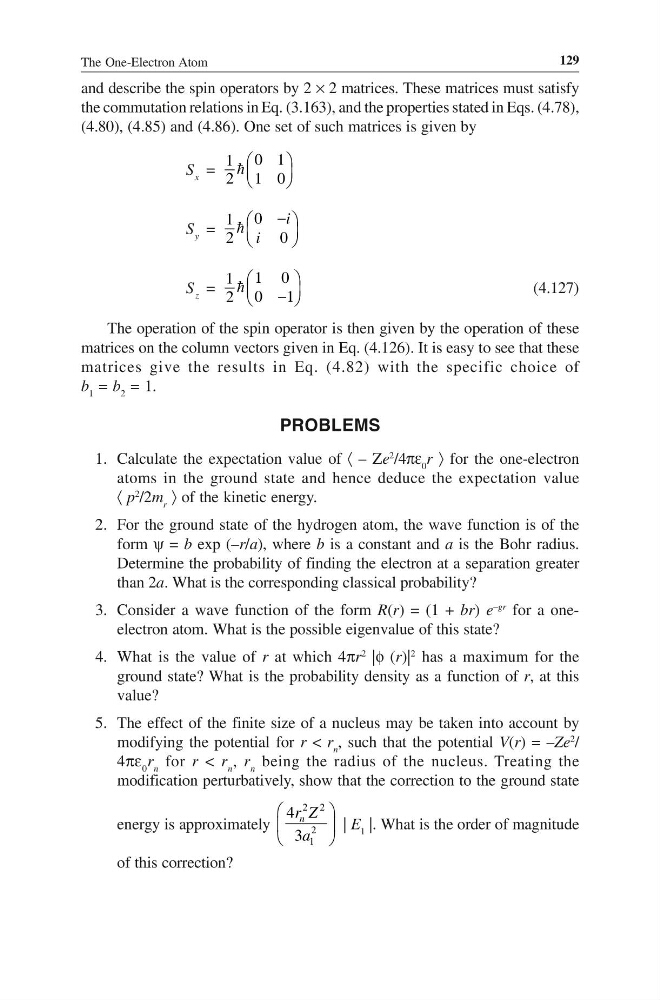
and describe the spin operators by 2 × 2 matrices. These matrices must satisfy
the commutation relations in Eq. (3.163), and the properties stated in Eqs. (4.78),
(4.80), (4.85) and (4.86). One set of such matrices is given by
S x =
0 1
1
1 0
2
S y =
0
1
0
2
i
i
−
S z =
1 0
1
0
1
2
−
(4.127)
The operation of the spin operator is then given by the operation of these
matrices on the column vectors given in Eq. (4.126). It is easy to see that these
matrices give the results in Eq. (4.82) with the specific choice of
b 1 = b 2 = 1.
PROBLEMS
1. Calculate the expectation value of 〈 – Ze
2
/4πε 0 r 〉 for the one-electron
atoms in the ground state and hence deduce the expectation value
〈 p
2
/2m r 〉 of the kinetic energy.
2. For the ground state of the hydrogen atom, the wave function is of the
form ψ = b exp (–r/a), where b is a constant and a is the Bohr radius.
Determine the probability of finding the electron at a separation greater
than 2a. What is the corresponding classical probability?
3. Consider a wave function of the form R(r) = (1 + br) e
–gr
for a oneelectron atom. What is the possible eigenvalue of this state?
4. What is the value of r at which 4πr
2
|φ (r)|
2
has a maximum for the
ground state? What is the probability density as a function of r, at this
value?
5. The effect of the finite size of a nucleus may be taken into account by
modifying the potential for r < r n , such that the potential V(r) = –Ze
2
/
4πε 0 r n for r < r n , r n being the radius of the nucleus. Treating the
modification perturbatively, show that the correction to the ground state
energy is approximately
2 2
2
1
4
3
n
r Z
a
| E 1 |. What is the order of magnitude
of this correction?
129
and describe the spin operators by 2 × 2 matrices. These matrices must satisfy
the commutation relations in Eq. (3.163), and the properties stated in Eqs. (4.78),
(4.80), (4.85) and (4.86). One set of such matrices is given by
S x =
0 1
1
1 0
2
S y =
0
1
0
2
i
i
−
S z =
1 0
1
0
1
2
−
(4.127)
The operation of the spin operator is then given by the operation of these
matrices on the column vectors given in Eq. (4.126). It is easy to see that these
matrices give the results in Eq. (4.82) with the specific choice of
b 1 = b 2 = 1.
PROBLEMS
1. Calculate the expectation value of 〈 – Ze
2
/4πε 0 r 〉 for the one-electron
atoms in the ground state and hence deduce the expectation value
〈 p
2
/2m r 〉 of the kinetic energy.
2. For the ground state of the hydrogen atom, the wave function is of the
form ψ = b exp (–r/a), where b is a constant and a is the Bohr radius.
Determine the probability of finding the electron at a separation greater
than 2a. What is the corresponding classical probability?
3. Consider a wave function of the form R(r) = (1 + br) e
–gr
for a oneelectron atom. What is the possible eigenvalue of this state?
4. What is the value of r at which 4πr
2
|φ (r)|
2
has a maximum for the
ground state? What is the probability density as a function of r, at this
value?
5. The effect of the finite size of a nucleus may be taken into account by
modifying the potential for r < r n , such that the potential V(r) = –Ze
2
/
4πε 0 r n for r < r n , r n being the radius of the nucleus. Treating the
modification perturbatively, show that the correction to the ground state
energy is approximately
2 2
2
1
4
3
n
r Z
a
| E 1 |. What is the order of magnitude
of this correction?