

Elements of Modern Physics
124
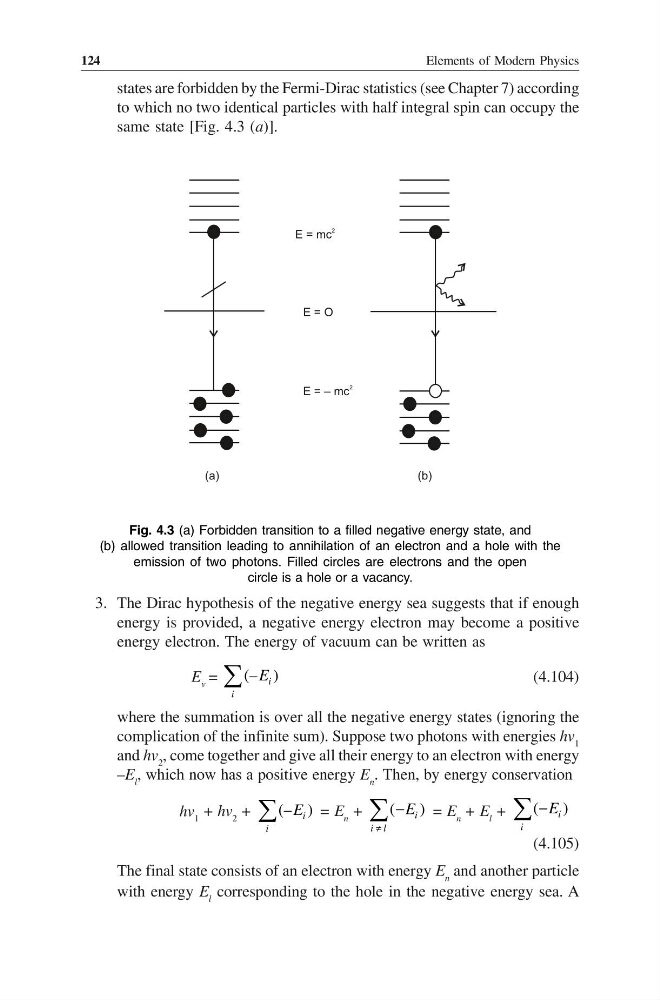
states are forbidden by the Fermi-Dirac statistics (see Chapter 7) according
to which no two identical particles with half integral spin can occupy the
same state [Fig. 4.3 (a)].
E = mc
2
E = O
E = – mc
2
(a)
(b)
Fig. 4.3 (a) Forbidden transition to a filled negative energy state, and
(b) allowed transition leading to annihilation of an electron and a hole with the
emission of two photons. Filled circles are electrons and the open
circle is a hole or a vacancy.
3. The Dirac hypothesis of the negative energy sea suggests that if enough
energy is provided, a negative energy electron may become a positive
energy electron. The energy of vacuum can be written as
E v =
(– )
i
i
E
∑
(4.104)
where the summation is over all the negative energy states (ignoring the
complication of the infinite sum). Suppose two photons with energies hv 1
and hv 2 , come together and give all their energy to an electron with energy
–E l , which now has a positive energy E n . Then, by energy conservation
hv 1 + hv 2 +
(– )
i
i
E
∑
= E n +
(
)
i
i l
E
≠
−
∑
= E n + E l +
(
)
i
i
E
−
∑
(4.105)
The final state consists of an electron with energy E n and another particle
with energy E l corresponding to the hole in the negative energy sea. A
124
states are forbidden by the Fermi-Dirac statistics (see Chapter 7) according
to which no two identical particles with half integral spin can occupy the
same state [Fig. 4.3 (a)].
E = mc
2
E = O
E = – mc
2
(a)
(b)
Fig. 4.3 (a) Forbidden transition to a filled negative energy state, and
(b) allowed transition leading to annihilation of an electron and a hole with the
emission of two photons. Filled circles are electrons and the open
circle is a hole or a vacancy.
3. The Dirac hypothesis of the negative energy sea suggests that if enough
energy is provided, a negative energy electron may become a positive
energy electron. The energy of vacuum can be written as
E v =
(– )
i
i
E
∑
(4.104)
where the summation is over all the negative energy states (ignoring the
complication of the infinite sum). Suppose two photons with energies hv 1
and hv 2 , come together and give all their energy to an electron with energy
–E l , which now has a positive energy E n . Then, by energy conservation
hv 1 + hv 2 +
(– )
i
i
E
∑
= E n +
(
)
i
i l
E
≠
−
∑
= E n + E l +
(
)
i
i
E
−
∑
(4.105)
The final state consists of an electron with energy E n and another particle
with energy E l corresponding to the hole in the negative energy sea. A