

The One-Electron Atom
123
2
2
∂
∂
− ∇⋅
+ ∇⋅ ψ
∂
∂
i
ic
i
ic
t
t
S
S
= m
2
c
2
ψ
(4.97)
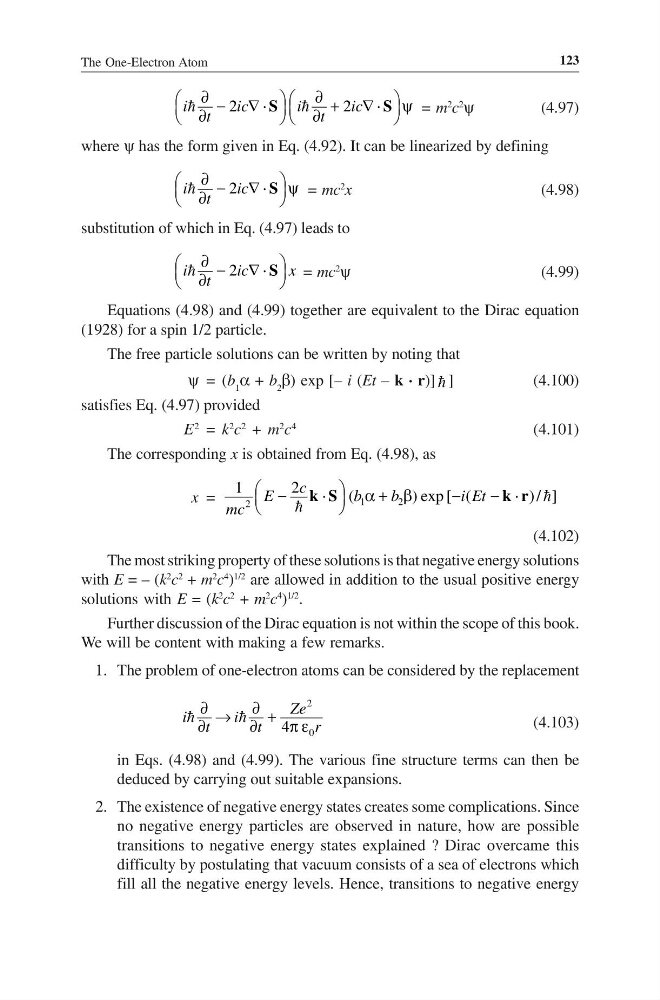
where ψ has the form given in Eq. (4.92). It can be linearized by defining
2
∂
− ∇⋅ ψ
∂
i
ic
t
S
= mc
2
x
(4.98)
substitution of which in Eq. (4.97) leads to
2
∂
− ∇⋅
∂
i
ic
x
t
S
= mc
2
ψ
(4.99)
Equations (4.98) and (4.99) together are equivalent to the Dirac equation
(1928) for a spin 1/2 particle.
The free particle solutions can be written by noting that
ψ = (b 1 α + b 2 β) exp [– i (Et – k ⋅
⋅ ⋅
⋅ ⋅ r)] ]
(4.100)
satisfies Eq. (4.97) provided
E
2
= k
2
c
2
+ m
2
c
4
(4.101)
The corresponding x is obtained from Eq. (4.98), as
x =
1
2
2
1
2
(
)e x p[ (
)/ ]
−
⋅
α+ β
−
− ⋅
c
E
b
b
iE t
mc
k S
k r
(4.102)
The most striking property of these solutions is that negative energy solutions
with E = – (k
2
c
2
+ m
2
c
4
)
1/2
are allowed in addition to the usual positive energy
solutions with E = (k
2
c
2
+ m
2
c
4
)
1/2
.
Further discussion of the Dirac equation is not within the scope of this book.
We will be content with making a few remarks.
1. The problem of one-electron atoms can be considered by the replacement
2
0
4
Ze
i
i
t
t
r
∂
∂
→
+
∂
∂
πε
(4.103)
in Eqs. (4.98) and (4.99). The various fine structure terms can then be
deduced by carrying out suitable expansions.
2. The existence of negative energy states creates some complications. Since
no negative energy particles are observed in nature, how are possible
transitions to negative energy states explained ? Dirac overcame this
difficulty by postulating that vacuum consists of a sea of electrons which
fill all the negative energy levels. Hence, transitions to negative energy
123
2
2
∂
∂
− ∇⋅
+ ∇⋅ ψ
∂
∂
i
ic
i
ic
t
t
S
S
= m
2
c
2
ψ
(4.97)
where ψ has the form given in Eq. (4.92). It can be linearized by defining
2
∂
− ∇⋅ ψ
∂
i
ic
t
S
= mc
2
x
(4.98)
substitution of which in Eq. (4.97) leads to
2
∂
− ∇⋅
∂
i
ic
x
t
S
= mc
2
ψ
(4.99)
Equations (4.98) and (4.99) together are equivalent to the Dirac equation
(1928) for a spin 1/2 particle.
The free particle solutions can be written by noting that
ψ = (b 1 α + b 2 β) exp [– i (Et – k ⋅
⋅ ⋅
⋅ ⋅ r)] ]
(4.100)
satisfies Eq. (4.97) provided
E
2
= k
2
c
2
+ m
2
c
4
(4.101)
The corresponding x is obtained from Eq. (4.98), as
x =
1
2
2
1
2
(
)e x p[ (
)/ ]
−
⋅
α+ β
−
− ⋅
c
E
b
b
iE t
mc
k S
k r
(4.102)
The most striking property of these solutions is that negative energy solutions
with E = – (k
2
c
2
+ m
2
c
4
)
1/2
are allowed in addition to the usual positive energy
solutions with E = (k
2
c
2
+ m
2
c
4
)
1/2
.
Further discussion of the Dirac equation is not within the scope of this book.
We will be content with making a few remarks.
1. The problem of one-electron atoms can be considered by the replacement
2
0
4
Ze
i
i
t
t
r
∂
∂
→
+
∂
∂
πε
(4.103)
in Eqs. (4.98) and (4.99). The various fine structure terms can then be
deduced by carrying out suitable expansions.
2. The existence of negative energy states creates some complications. Since
no negative energy particles are observed in nature, how are possible
transitions to negative energy states explained ? Dirac overcame this
difficulty by postulating that vacuum consists of a sea of electrons which
fill all the negative energy levels. Hence, transitions to negative energy