

Elements of Modern Physics
102
In this chapter, the one-electron atom is analysed within the framework of wave
mechanics. It is the ability of quantum mechanics to describe the detailed
properties of the one-electron atom which has, more than any thing else,
established the essential validity of quantum mechanical ideas, at least as a
calculational tool for describing small-distance phenomena.
The wave functions and the energy levels of the nonrelativistic one-electron
atom are first obtained. The corrections due to spin-orbit interaction and other
relativistic effects are then introduced perturbatively. Together, these results
provide a very satisfactory description of the one-electron energy levels including
the fine structure. Finally, the effect of the nuclear spin on the atomic energy
levels is discussed and a brief introduction to the formal description of spin1
2
particles is given.
4.1 SOLUTIONS OF THE SCHRÖDINGER EQUATION
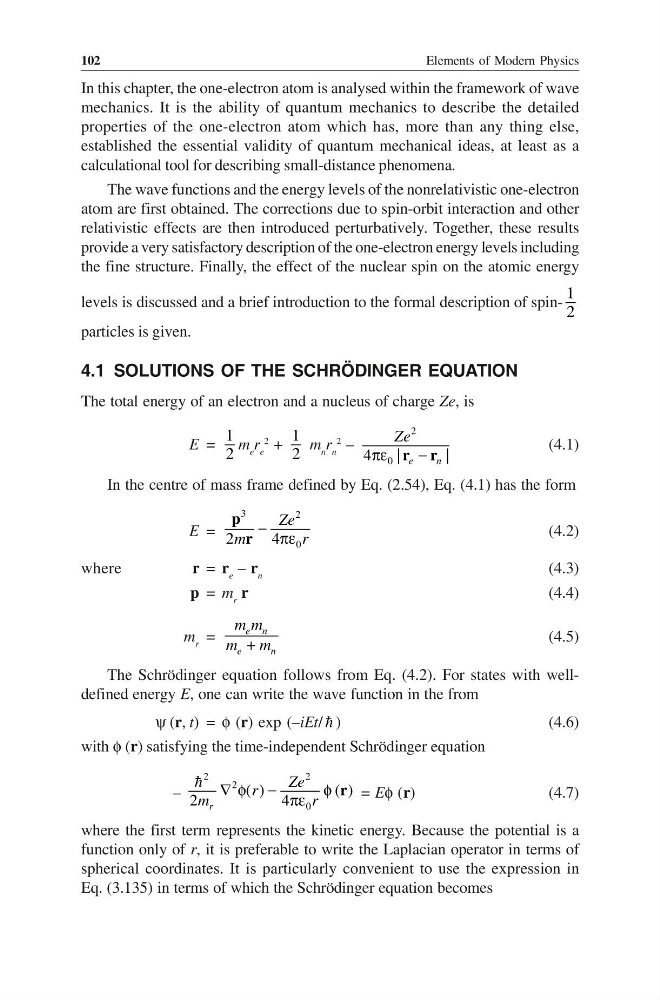
The total energy of an electron and a nucleus of charge Ze, is
E =
1
2
m e r e
2
+
1
2
m n r n
2
–
2
0
4
|
|
πε
−
e
n
Ze
r r
(4.1)
In the centre of mass frame defined by Eq. (2.54), Eq. (4.1) has the form
E =
3
2
0
2
4
− πε
Ze
m
r
p
r
(4.2)
where
r = r e – r n
(4.3)
p = m r r
(4.4)
m r =
e n
e
n
m m
m m
+
(4.5)
The Schrödinger equation follows from Eq. (4.2). For states with welldefined energy E, one can write the wave function in the from
ψ (r, t) = φ (r) exp (–iEt/ )
(4.6)
with φ (r) satisfying the time-independent Schrödinger equation
–
2
2
2
0
( )
( )
2
4
∇ φ −
φ
πε
r
Ze
r
m
r
r = Eφ (r)
(4.7)
where the first term represents the kinetic energy. Because the potential is a
function only of r, it is preferable to write the Laplacian operator in terms of
spherical coordinates. It is particularly convenient to use the expression in
Eq. (3.135) in terms of which the Schrödinger equation becomes
102
In this chapter, the one-electron atom is analysed within the framework of wave
mechanics. It is the ability of quantum mechanics to describe the detailed
properties of the one-electron atom which has, more than any thing else,
established the essential validity of quantum mechanical ideas, at least as a
calculational tool for describing small-distance phenomena.
The wave functions and the energy levels of the nonrelativistic one-electron
atom are first obtained. The corrections due to spin-orbit interaction and other
relativistic effects are then introduced perturbatively. Together, these results
provide a very satisfactory description of the one-electron energy levels including
the fine structure. Finally, the effect of the nuclear spin on the atomic energy
levels is discussed and a brief introduction to the formal description of spin1
2
particles is given.
4.1 SOLUTIONS OF THE SCHRÖDINGER EQUATION
The total energy of an electron and a nucleus of charge Ze, is
E =
1
2
m e r e
2
+
1
2
m n r n
2
–
2
0
4
|
|
πε
−
e
n
Ze
r r
(4.1)
In the centre of mass frame defined by Eq. (2.54), Eq. (4.1) has the form
E =
3
2
0
2
4
− πε
Ze
m
r
p
r
(4.2)
where
r = r e – r n
(4.3)
p = m r r
(4.4)
m r =
e n
e
n
m m
m m
+
(4.5)
The Schrödinger equation follows from Eq. (4.2). For states with welldefined energy E, one can write the wave function in the from
ψ (r, t) = φ (r) exp (–iEt/ )
(4.6)
with φ (r) satisfying the time-independent Schrödinger equation
–
2
2
2
0
( )
( )
2
4
∇ φ −
φ
πε
r
Ze
r
m
r
r = Eφ (r)
(4.7)
where the first term represents the kinetic energy. Because the potential is a
function only of r, it is preferable to write the Laplacian operator in terms of
spherical coordinates. It is particularly convenient to use the expression in
Eq. (3.135) in terms of which the Schrödinger equation becomes