

Elements of Quantum Theory
93
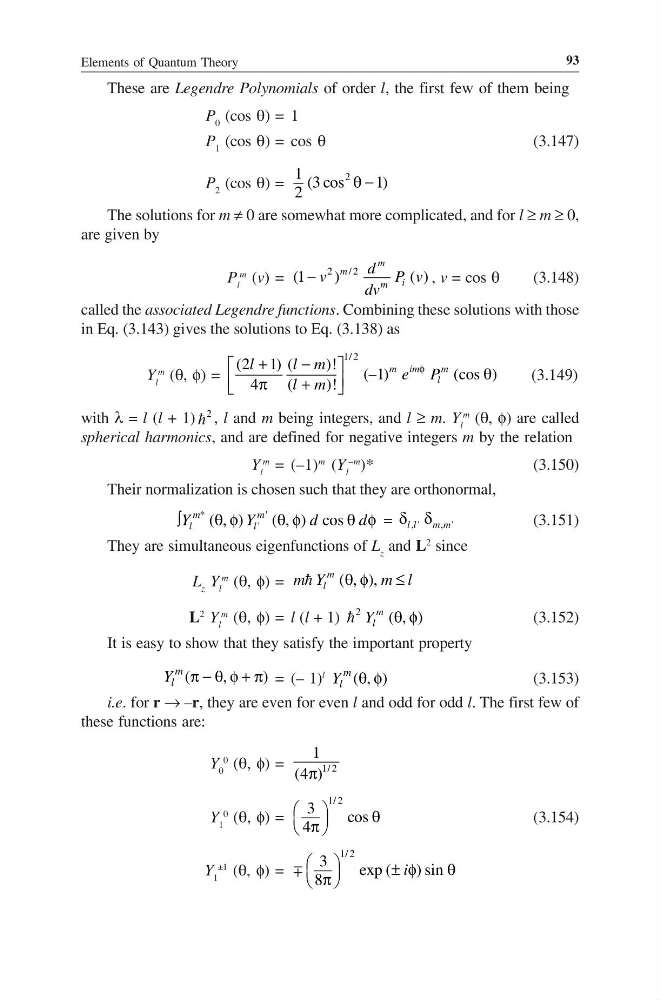
These are Legendre Polynomials of order l, the first few of them being
P 0 (cos θ) = 1
P 1 (cos θ) = cos θ
(3.147)
P 2 (cos θ) =
2
1 (3 cos
1)
2
θ −
The solutions for m ≠ 0 are somewhat more complicated, and for l ≥ m ≥ 0,
are given by
P l
m
(v) =
2
/2
(1
)
( )
−
m
m
i
m
d
v
P v
dv
, v = cos θ
(3.148)
called the associated Legendre functions. Combining these solutions with those
in Eq. (3.143) gives the solutions to Eq. (3.138) as
Y l
m
(θ, φ) =
1/ 2
(2 1) (
)!
(–1)
(cos )
4
(
)!
φ
+
−
θ
π
+
m im
m
l
l
l m
e P
l m
(3.149)
with λ = l (l + 1)
2
, l and m being integers, and l ≥ m. Y l
m
(θ, φ) are called
spherical harmonics, and are defined for negative integers m by the relation
Y l
m
= (–1)
m
(Y l
–m
)*
(3.150)
Their normalization is chosen such that they are orthonormal,
*
'
'
( , )
( , ) cos
m
m
l
l
Y
Y
d
d
∫
θ φ
θ φ
θ φ = , ' , '
l l
m m
δ δ
(3.151)
They are simultaneous eigenfunctions of L z and L
2
since
L z Y l
m
(θ, φ) =
( , ),
m
l
m Y
m l
θ φ
≤
L
2
Y l
m
(θ, φ) = l (l + 1)
2
( , )
m
l
Y θ φ
(3.152)
It is easy to show that they satisfy the important property
(
,
)
π − θ φ + π
m
l
Y
= (– 1)
l
( , )
θ φ
m
l
Y
(3.153)
i.e. for r → –r, they are even for even l and odd for odd l. The first few of
these functions are:
Y 0
0
(θ, φ) =
1/ 2
1
(4 )
π
Y 1
0
(θ, φ) =
1/ 2
3
cos
4
θ
π
(3.154)
Y 1
±1
(θ, φ) =
1/ 2
3
exp (
) sin
8
i
± φ
θ
π
∓
93
These are Legendre Polynomials of order l, the first few of them being
P 0 (cos θ) = 1
P 1 (cos θ) = cos θ
(3.147)
P 2 (cos θ) =
2
1 (3 cos
1)
2
θ −
The solutions for m ≠ 0 are somewhat more complicated, and for l ≥ m ≥ 0,
are given by
P l
m
(v) =
2
/2
(1
)
( )
−
m
m
i
m
d
v
P v
dv
, v = cos θ
(3.148)
called the associated Legendre functions. Combining these solutions with those
in Eq. (3.143) gives the solutions to Eq. (3.138) as
Y l
m
(θ, φ) =
1/ 2
(2 1) (
)!
(–1)
(cos )
4
(
)!
φ
+
−
θ
π
+
m im
m
l
l
l m
e P
l m
(3.149)
with λ = l (l + 1)
2
, l and m being integers, and l ≥ m. Y l
m
(θ, φ) are called
spherical harmonics, and are defined for negative integers m by the relation
Y l
m
= (–1)
m
(Y l
–m
)*
(3.150)
Their normalization is chosen such that they are orthonormal,
*
'
'
( , )
( , ) cos
m
m
l
l
Y
Y
d
d
∫
θ φ
θ φ
θ φ = , ' , '
l l
m m
δ δ
(3.151)
They are simultaneous eigenfunctions of L z and L
2
since
L z Y l
m
(θ, φ) =
( , ),
m
l
m Y
m l
θ φ
≤
L
2
Y l
m
(θ, φ) = l (l + 1)
2
( , )
m
l
Y θ φ
(3.152)
It is easy to show that they satisfy the important property
(
,
)
π − θ φ + π
m
l
Y
= (– 1)
l
( , )
θ φ
m
l
Y
(3.153)
i.e. for r → –r, they are even for even l and odd for odd l. The first few of
these functions are:
Y 0
0
(θ, φ) =
1/ 2
1
(4 )
π
Y 1
0
(θ, φ) =
1/ 2
3
cos
4
θ
π
(3.154)
Y 1
±1
(θ, φ) =
1/ 2
3
exp (
) sin
8
i
± φ
θ
π
∓