

Elements of Modern Physics
92
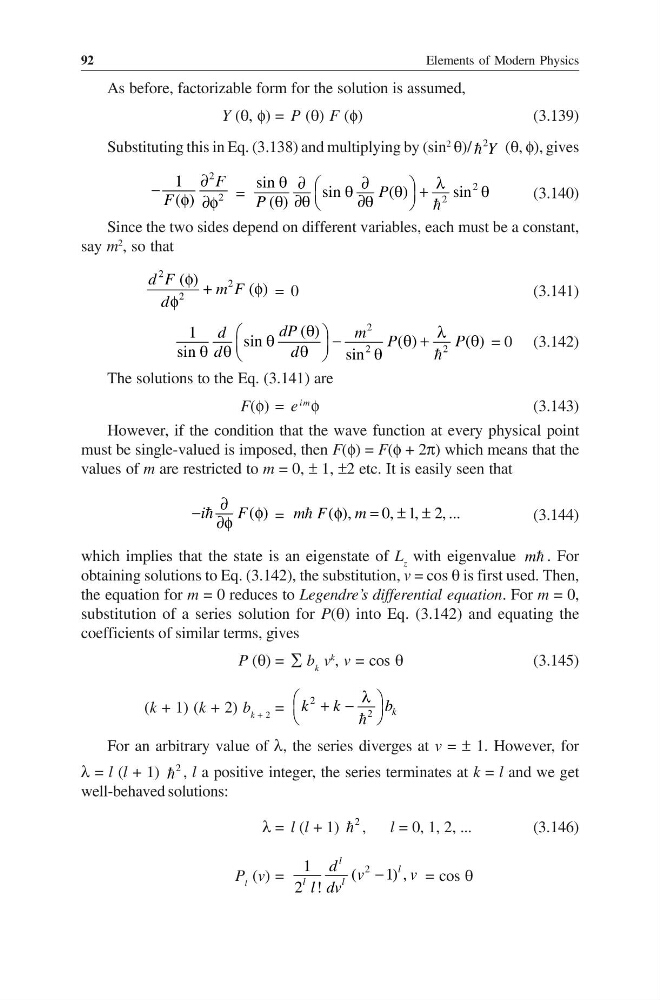
As before, factorizable form for the solution is assumed,
Y (θ, φ) = P (θ) F (φ)
(3.139)
Substituting this in Eq. (3.138) and multiplying by (sin
2
θ)/
2
Y
(θ, φ), gives
2
2
1
( )
F
F
∂
− φ ∂φ
=
2
2
sin
sin
( )
sin
( )
P
P
θ ∂
∂
λ
θ
θ +
θ
θ ∂θ
∂θ
(3.140)
Since the two sides depend on different variables, each must be a constant,
say m
2
, so that
2
2
2
( )
( )
d F
m F
d
φ +
φ
φ
= 0
(3.141)
2
2
2
( )
1
sin
( )
( )
sin
sin
θ
λ
θ
−
θ +
θ
θ θ
θ
θ
dP
d
m P
P
d
d
= 0 (3.142)
The solutions to the Eq. (3.141) are
F(φ) = e
im
φ
(3.143)
However, if the condition that the wave function at every physical point
must be single-valued is imposed, then F(φ) = F(φ + 2π) which means that the
values of m are restricted to m = 0, ± 1, ±2 etc. It is easily seen that
( )
i
F
∂
−
φ
∂φ
=
( ),
0, 1, 2,...
m F
m
φ
= ± ±
(3.144)
which implies that the state is an eigenstate of L z with eigenvalue m . For
obtaining solutions to Eq. (3.142), the substitution, v = cos θ is first used. Then,
the equation for m = 0 reduces to Legendre’s differential equation. For m = 0,
substitution of a series solution for P(θ) into Eq. (3.142) and equating the
coefficients of similar terms, gives
P (θ) = ∑ b k v
k
, v = cos θ
(3.145)
(k + 1) (k + 2) b k + 2 =
2
2
λ
+ −
k
k
k
b
For an arbitrary value of λ, the series diverges at v = ± 1. However, for
λ = l (l + 1)
2
, l a positive integer, the series terminates at k = l and we get
well-behaved solutions:
λ = l (l + 1)
2
,
l = 0, 1, 2, ...
(3.146)
P l (v) =
2
1
(
1) ,
2 !
l
l
l
l
d v
v
l dv
−
= cos θ
92
As before, factorizable form for the solution is assumed,
Y (θ, φ) = P (θ) F (φ)
(3.139)
Substituting this in Eq. (3.138) and multiplying by (sin
2
θ)/
2
Y
(θ, φ), gives
2
2
1
( )
F
F
∂
− φ ∂φ
=
2
2
sin
sin
( )
sin
( )
P
P
θ ∂
∂
λ
θ
θ +
θ
θ ∂θ
∂θ
(3.140)
Since the two sides depend on different variables, each must be a constant,
say m
2
, so that
2
2
2
( )
( )
d F
m F
d
φ +
φ
φ
= 0
(3.141)
2
2
2
( )
1
sin
( )
( )
sin
sin
θ
λ
θ
−
θ +
θ
θ θ
θ
θ
dP
d
m P
P
d
d
= 0 (3.142)
The solutions to the Eq. (3.141) are
F(φ) = e
im
φ
(3.143)
However, if the condition that the wave function at every physical point
must be single-valued is imposed, then F(φ) = F(φ + 2π) which means that the
values of m are restricted to m = 0, ± 1, ±2 etc. It is easily seen that
( )
i
F
∂
−
φ
∂φ
=
( ),
0, 1, 2,...
m F
m
φ
= ± ±
(3.144)
which implies that the state is an eigenstate of L z with eigenvalue m . For
obtaining solutions to Eq. (3.142), the substitution, v = cos θ is first used. Then,
the equation for m = 0 reduces to Legendre’s differential equation. For m = 0,
substitution of a series solution for P(θ) into Eq. (3.142) and equating the
coefficients of similar terms, gives
P (θ) = ∑ b k v
k
, v = cos θ
(3.145)
(k + 1) (k + 2) b k + 2 =
2
2
λ
+ −
k
k
k
b
For an arbitrary value of λ, the series diverges at v = ± 1. However, for
λ = l (l + 1)
2
, l a positive integer, the series terminates at k = l and we get
well-behaved solutions:
λ = l (l + 1)
2
,
l = 0, 1, 2, ...
(3.146)
P l (v) =
2
1
(
1) ,
2 !
l
l
l
l
d v
v
l dv
−
= cos θ