

Spin Transfer Torque Magnetoresistive Random Access Memory
63
system are closely intertwined with each other [2]. For example, increasing thermal
stability will correspondingly require a higher write current density to induce magnetization switching, while raising TMR via increasing the tunnel barrier thickness will
also increasing the resistance, the read/write speed and time-dependent dielectric
breakdown. As we have covered the basic concepts of the magnetic and electrical
transport properties in the previous section, this section will be devoted towards the
discussion on the key figure of merits one must consider in a STT-MRAM device.
4.1 Thermal Stability
In the previous sections, we have only considered switching of the free layer due to
the STT effect. However, unintended magnetization reversal induced from thermal
fluctuation can arise from self-heating (e.g. write operations) or from its immediate
vicinity. Therefore, thermal stability is an important key figure of merit particularly
for MRAM applications, and is defined for a given temperature T as:
=
E b
k B T
,
(31)
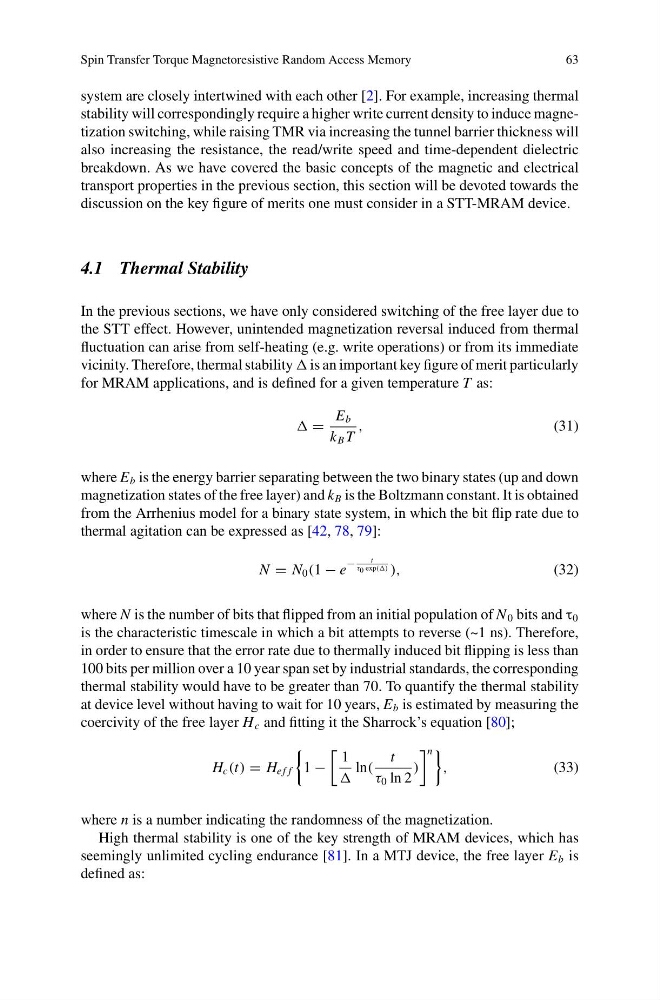
where E b is the energy barrier separating between the two binary states (up and down
magnetization states of the free layer) and k B is the Boltzmann constant. It is obtained
from the Arrhenius model for a binary state system, in which the bit flip rate due to
thermal agitation can be expressed as [42, 78, 79]:
N = N 0 (1 − e
−
t
τ 0 exp(()
),
(32)
where N is the number of bits that flipped from an initial population of N 0 bits and τ 0
is the characteristic timescale in which a bit attempts to reverse (~1 ns). Therefore,
in order to ensure that the error rate due to thermally induced bit flipping is less than
100 bits per million over a 10 year span set by industrial standards, the corresponding
thermal stability would have to be greater than 70. To quantify the thermal stability
at device level without having to wait for 10 years, E b is estimated by measuring the
coercivity of the free layer H c and fitting it the Sharrock’s equation [80];
H c (t) = H e f f
1 −
1
ln(
t
τ 0 ln 2
)
n
,
(33)
where n is a number indicating the randomness of the magnetization.
High thermal stability is one of the key strength of MRAM devices, which has
seemingly unlimited cycling endurance [81]. In a MTJ device, the free layer E b is
defined as:
63
system are closely intertwined with each other [2]. For example, increasing thermal
stability will correspondingly require a higher write current density to induce magnetization switching, while raising TMR via increasing the tunnel barrier thickness will
also increasing the resistance, the read/write speed and time-dependent dielectric
breakdown. As we have covered the basic concepts of the magnetic and electrical
transport properties in the previous section, this section will be devoted towards the
discussion on the key figure of merits one must consider in a STT-MRAM device.
4.1 Thermal Stability
In the previous sections, we have only considered switching of the free layer due to
the STT effect. However, unintended magnetization reversal induced from thermal
fluctuation can arise from self-heating (e.g. write operations) or from its immediate
vicinity. Therefore, thermal stability is an important key figure of merit particularly
for MRAM applications, and is defined for a given temperature T as:
=
E b
k B T
,
(31)
where E b is the energy barrier separating between the two binary states (up and down
magnetization states of the free layer) and k B is the Boltzmann constant. It is obtained
from the Arrhenius model for a binary state system, in which the bit flip rate due to
thermal agitation can be expressed as [42, 78, 79]:
N = N 0 (1 − e
−
t
τ 0 exp(()
),
(32)
where N is the number of bits that flipped from an initial population of N 0 bits and τ 0
is the characteristic timescale in which a bit attempts to reverse (~1 ns). Therefore,
in order to ensure that the error rate due to thermally induced bit flipping is less than
100 bits per million over a 10 year span set by industrial standards, the corresponding
thermal stability would have to be greater than 70. To quantify the thermal stability
at device level without having to wait for 10 years, E b is estimated by measuring the
coercivity of the free layer H c and fitting it the Sharrock’s equation [80];
H c (t) = H e f f
1 −
1
ln(
t
τ 0 ln 2
)
n
,
(33)
where n is a number indicating the randomness of the magnetization.
High thermal stability is one of the key strength of MRAM devices, which has
seemingly unlimited cycling endurance [81]. In a MTJ device, the free layer E b is
defined as: