

54
W. C. Law and S. De W. Wong
However, higher TMR ratio observed in bcc-CoFeB/MgO tunnel barrier could not
be explained by Jullière’s model, as it was observed that CoFeB has lower spin polarization upon annealing [50]. The findings suggest that tunneling of electron wave
functions in crystalline MTJ structures do not occur on equal tunneling probabilities
as assumed in the simplified picture above, but depends on the symmetry matching
between the Bloch states and the evanescent wave functions within the tunnel barrier.
For the sake of brevity, the quantum mechanics and tunneling mechanism will not
be described in detail, in which readers may refer to reference [51]. Instead, we note
that evanescent wave functions decay at different rates within the barrier, wherein
1 , 2 , 2 and 5 are wave function symmetries compatible with bcc-Fe grown
epitaxially on MgO. Similar ab initio calculations can be applied to Co and CoFe
electrodes, in good agreement with experimental results. The resultant conductance
G P and G AP will depend on the decay rate in D
↑ and D
↓ as the electron tunnels
through the ferromagnetic materials 1 and 2 as per Eqs. (8) and (9).
3.2 Spin Transfer Torque
The concept of STT was first predicted by Slonczewski and Berger independently,
wherein a spin polarized current can transfer angular momentum to a ferromagnetic
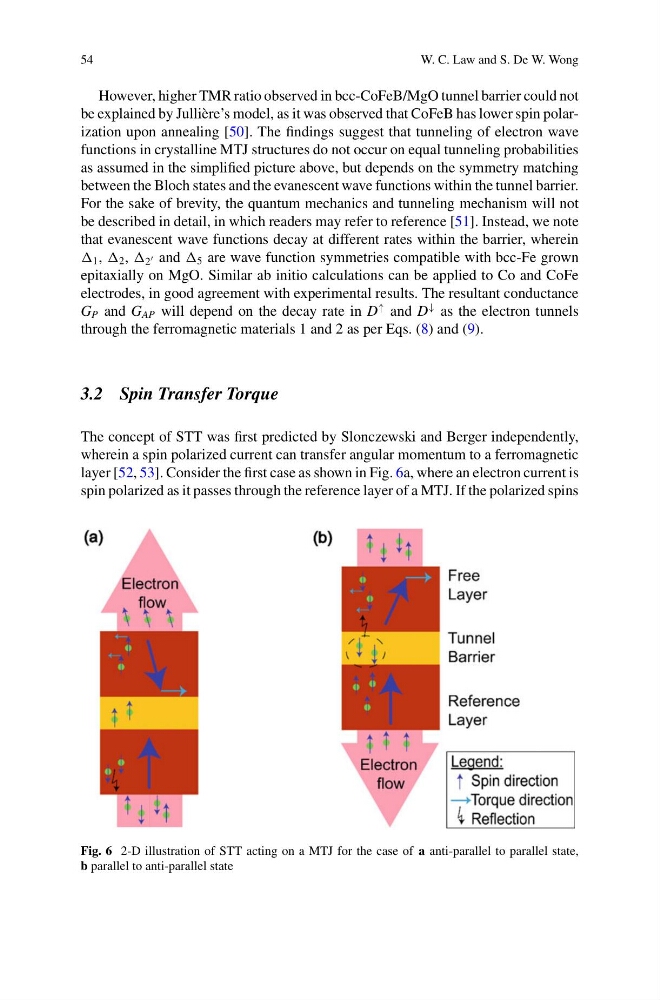
layer [52, 53]. Consider the first case as shown in Fig. 6a, where an electron current is
spin polarized as it passes through the reference layer of a MTJ. If the polarized spins
Fig. 6 2-D illustration of STT acting on a MTJ for the case of a anti-parallel to parallel state,
b parallel to anti-parallel state
W. C. Law and S. De W. Wong
However, higher TMR ratio observed in bcc-CoFeB/MgO tunnel barrier could not
be explained by Jullière’s model, as it was observed that CoFeB has lower spin polarization upon annealing [50]. The findings suggest that tunneling of electron wave
functions in crystalline MTJ structures do not occur on equal tunneling probabilities
as assumed in the simplified picture above, but depends on the symmetry matching
between the Bloch states and the evanescent wave functions within the tunnel barrier.
For the sake of brevity, the quantum mechanics and tunneling mechanism will not
be described in detail, in which readers may refer to reference [51]. Instead, we note
that evanescent wave functions decay at different rates within the barrier, wherein
1 , 2 , 2 and 5 are wave function symmetries compatible with bcc-Fe grown
epitaxially on MgO. Similar ab initio calculations can be applied to Co and CoFe
electrodes, in good agreement with experimental results. The resultant conductance
G P and G AP will depend on the decay rate in D
↑ and D
↓ as the electron tunnels
through the ferromagnetic materials 1 and 2 as per Eqs. (8) and (9).
3.2 Spin Transfer Torque
The concept of STT was first predicted by Slonczewski and Berger independently,
wherein a spin polarized current can transfer angular momentum to a ferromagnetic
layer [52, 53]. Consider the first case as shown in Fig. 6a, where an electron current is
spin polarized as it passes through the reference layer of a MTJ. If the polarized spins
Fig. 6 2-D illustration of STT acting on a MTJ for the case of a anti-parallel to parallel state,
b parallel to anti-parallel state