

432
J. Wu et al.
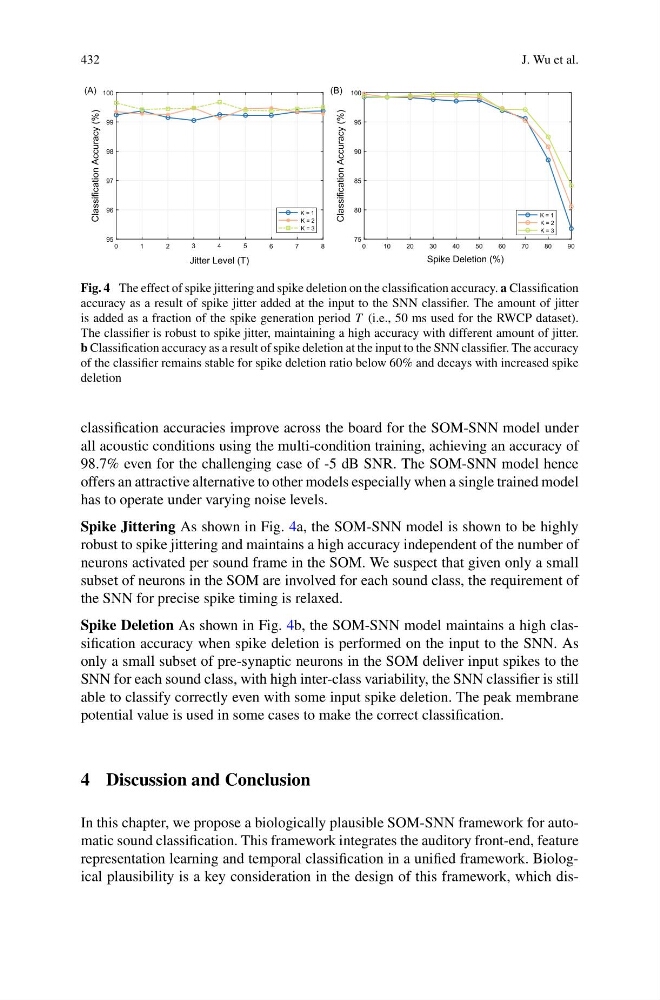
Fig. 4 The effect of spike jittering and spike deletion on the classification accuracy. a Classification
accuracy as a result of spike jitter added at the input to the SNN classifier. The amount of jitter
is added as a fraction of the spike generation period T (i.e., 50 ms used for the RWCP dataset).
The classifier is robust to spike jitter, maintaining a high accuracy with different amount of jitter.
b Classification accuracy as a result of spike deletion at the input to the SNN classifier. The accuracy
of the classifier remains stable for spike deletion ratio below 60% and decays with increased spike
deletion
classification accuracies improve across the board for the SOM-SNN model under
all acoustic conditions using the multi-condition training, achieving an accuracy of
98.7% even for the challenging case of -5 dB SNR. The SOM-SNN model hence
offers an attractive alternative to other models especially when a single trained model
has to operate under varying noise levels.
Spike Jittering As shown in Fig. 4a, the SOM-SNN model is shown to be highly
robust to spike jittering and maintains a high accuracy independent of the number of
neurons activated per sound frame in the SOM. We suspect that given only a small
subset of neurons in the SOM are involved for each sound class, the requirement of
the SNN for precise spike timing is relaxed.
Spike Deletion As shown in Fig. 4b, the SOM-SNN model maintains a high classification accuracy when spike deletion is performed on the input to the SNN. As
only a small subset of pre-synaptic neurons in the SOM deliver input spikes to the
SNN for each sound class, with high inter-class variability, the SNN classifier is still
able to classify correctly even with some input spike deletion. The peak membrane
potential value is used in some cases to make the correct classification.
4 Discussion and Conclusion
In this chapter, we propose a biologically plausible SOM-SNN framework for automatic sound classification. This framework integrates the auditory front-end, feature
representation learning and temporal classification in a unified framework. Biological plausibility is a key consideration in the design of this framework, which dis-
J. Wu et al.
Fig. 4 The effect of spike jittering and spike deletion on the classification accuracy. a Classification
accuracy as a result of spike jitter added at the input to the SNN classifier. The amount of jitter
is added as a fraction of the spike generation period T (i.e., 50 ms used for the RWCP dataset).
The classifier is robust to spike jitter, maintaining a high accuracy with different amount of jitter.
b Classification accuracy as a result of spike deletion at the input to the SNN classifier. The accuracy
of the classifier remains stable for spike deletion ratio below 60% and decays with increased spike
deletion
classification accuracies improve across the board for the SOM-SNN model under
all acoustic conditions using the multi-condition training, achieving an accuracy of
98.7% even for the challenging case of -5 dB SNR. The SOM-SNN model hence
offers an attractive alternative to other models especially when a single trained model
has to operate under varying noise levels.
Spike Jittering As shown in Fig. 4a, the SOM-SNN model is shown to be highly
robust to spike jittering and maintains a high accuracy independent of the number of
neurons activated per sound frame in the SOM. We suspect that given only a small
subset of neurons in the SOM are involved for each sound class, the requirement of
the SNN for precise spike timing is relaxed.
Spike Deletion As shown in Fig. 4b, the SOM-SNN model maintains a high classification accuracy when spike deletion is performed on the input to the SNN. As
only a small subset of pre-synaptic neurons in the SOM deliver input spikes to the
SNN for each sound class, with high inter-class variability, the SNN classifier is still
able to classify correctly even with some input spike deletion. The peak membrane
potential value is used in some cases to make the correct classification.
4 Discussion and Conclusion
In this chapter, we propose a biologically plausible SOM-SNN framework for automatic sound classification. This framework integrates the auditory front-end, feature
representation learning and temporal classification in a unified framework. Biological plausibility is a key consideration in the design of this framework, which dis-