

Microwave Oscillators and Detectors Based …
35
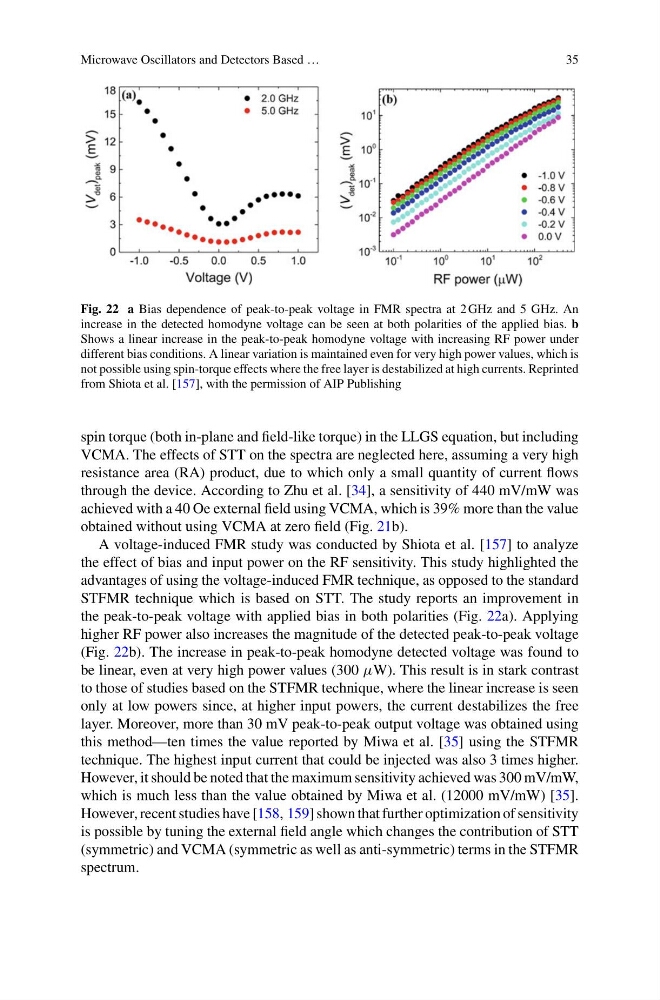
Fig. 22 a Bias dependence of peak-to-peak voltage in FMR spectra at 2 GHz and 5 GHz. An
increase in the detected homodyne voltage can be seen at both polarities of the applied bias. b
Shows a linear increase in the peak-to-peak homodyne voltage with increasing RF power under
different bias conditions. A linear variation is maintained even for very high power values, which is
not possible using spin-torque effects where the free layer is destabilized at high currents. Reprinted
from Shiota et al. [157], with the permission of AIP Publishing
spin torque (both in-plane and field-like torque) in the LLGS equation, but including
VCMA. The effects of STT on the spectra are neglected here, assuming a very high
resistance area (RA) product, due to which only a small quantity of current flows
through the device. According to Zhu et al. [34], a sensitivity of 440 mV/mW was
achieved with a 40 Oe external field using VCMA, which is 39% more than the value
obtained without using VCMA at zero field (Fig. 21b).
A voltage-induced FMR study was conducted by Shiota et al. [157] to analyze
the effect of bias and input power on the RF sensitivity. This study highlighted the
advantages of using the voltage-induced FMR technique, as opposed to the standard
STFMR technique which is based on STT. The study reports an improvement in
the peak-to-peak voltage with applied bias in both polarities (Fig. 22a). Applying
higher RF power also increases the magnitude of the detected peak-to-peak voltage
(Fig. 22b). The increase in peak-to-peak homodyne detected voltage was found to
be linear, even at very high power values (300 μW). This result is in stark contrast
to those of studies based on the STFMR technique, where the linear increase is seen
only at low powers since, at higher input powers, the current destabilizes the free
layer. Moreover, more than 30 mV peak-to-peak output voltage was obtained using
this method—ten times the value reported by Miwa et al. [35] using the STFMR
technique. The highest input current that could be injected was also 3 times higher.
However, it should be noted that the maximum sensitivity achieved was 300 mV/mW,
which is much less than the value obtained by Miwa et al. (12000 mV/mW) [35].
However, recent studies have [158, 159] shown that further optimization of sensitivity
is possible by tuning the external field angle which changes the contribution of STT
(symmetric) and VCMA (symmetric as well as anti-symmetric) terms in the STFMR
spectrum.
35
Fig. 22 a Bias dependence of peak-to-peak voltage in FMR spectra at 2 GHz and 5 GHz. An
increase in the detected homodyne voltage can be seen at both polarities of the applied bias. b
Shows a linear increase in the peak-to-peak homodyne voltage with increasing RF power under
different bias conditions. A linear variation is maintained even for very high power values, which is
not possible using spin-torque effects where the free layer is destabilized at high currents. Reprinted
from Shiota et al. [157], with the permission of AIP Publishing
spin torque (both in-plane and field-like torque) in the LLGS equation, but including
VCMA. The effects of STT on the spectra are neglected here, assuming a very high
resistance area (RA) product, due to which only a small quantity of current flows
through the device. According to Zhu et al. [34], a sensitivity of 440 mV/mW was
achieved with a 40 Oe external field using VCMA, which is 39% more than the value
obtained without using VCMA at zero field (Fig. 21b).
A voltage-induced FMR study was conducted by Shiota et al. [157] to analyze
the effect of bias and input power on the RF sensitivity. This study highlighted the
advantages of using the voltage-induced FMR technique, as opposed to the standard
STFMR technique which is based on STT. The study reports an improvement in
the peak-to-peak voltage with applied bias in both polarities (Fig. 22a). Applying
higher RF power also increases the magnitude of the detected peak-to-peak voltage
(Fig. 22b). The increase in peak-to-peak homodyne detected voltage was found to
be linear, even at very high power values (300 μW). This result is in stark contrast
to those of studies based on the STFMR technique, where the linear increase is seen
only at low powers since, at higher input powers, the current destabilizes the free
layer. Moreover, more than 30 mV peak-to-peak output voltage was obtained using
this method—ten times the value reported by Miwa et al. [35] using the STFMR
technique. The highest input current that could be injected was also 3 times higher.
However, it should be noted that the maximum sensitivity achieved was 300 mV/mW,
which is much less than the value obtained by Miwa et al. (12000 mV/mW) [35].
However, recent studies have [158, 159] shown that further optimization of sensitivity
is possible by tuning the external field angle which changes the contribution of STT
(symmetric) and VCMA (symmetric as well as anti-symmetric) terms in the STFMR
spectrum.