

RRAM-Based Neuromorphic Computing Systems
401
determined weights by the following equation,
σ
±
=
(σ max − σ min )
|W max |
× W
±
+ σ min
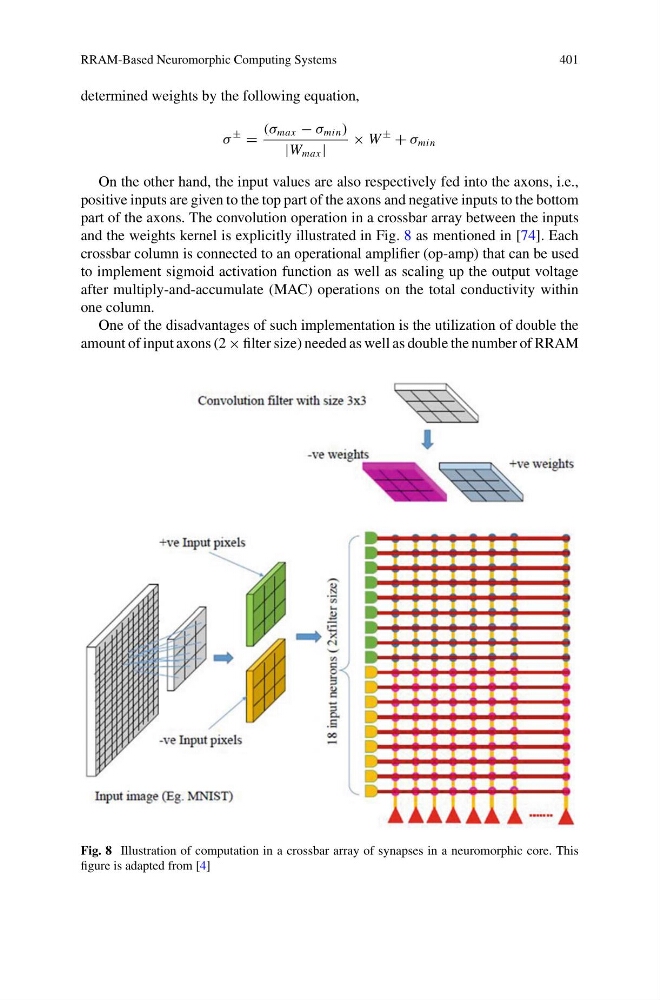
On the other hand, the input values are also respectively fed into the axons, i.e.,
positive inputs are given to the top part of the axons and negative inputs to the bottom
part of the axons. The convolution operation in a crossbar array between the inputs
and the weights kernel is explicitly illustrated in Fig. 8 as mentioned in [74]. Each
crossbar column is connected to an operational amplifier (op-amp) that can be used
to implement sigmoid activation function as well as scaling up the output voltage
after multiply-and-accumulate (MAC) operations on the total conductivity within
one column.
One of the disadvantages of such implementation is the utilization of double the
amount of input axons (2 × filter size) needed as well as double the number of RRAM
Fig. 8 Illustration of computation in a crossbar array of synapses in a neuromorphic core. This
figure is adapted from [4]
401
determined weights by the following equation,
σ
±
=
(σ max − σ min )
|W max |
× W
±
+ σ min
On the other hand, the input values are also respectively fed into the axons, i.e.,
positive inputs are given to the top part of the axons and negative inputs to the bottom
part of the axons. The convolution operation in a crossbar array between the inputs
and the weights kernel is explicitly illustrated in Fig. 8 as mentioned in [74]. Each
crossbar column is connected to an operational amplifier (op-amp) that can be used
to implement sigmoid activation function as well as scaling up the output voltage
after multiply-and-accumulate (MAC) operations on the total conductivity within
one column.
One of the disadvantages of such implementation is the utilization of double the
amount of input axons (2 × filter size) needed as well as double the number of RRAM
Fig. 8 Illustration of computation in a crossbar array of synapses in a neuromorphic core. This
figure is adapted from [4]