

394
P. A. Dananjaya et al.
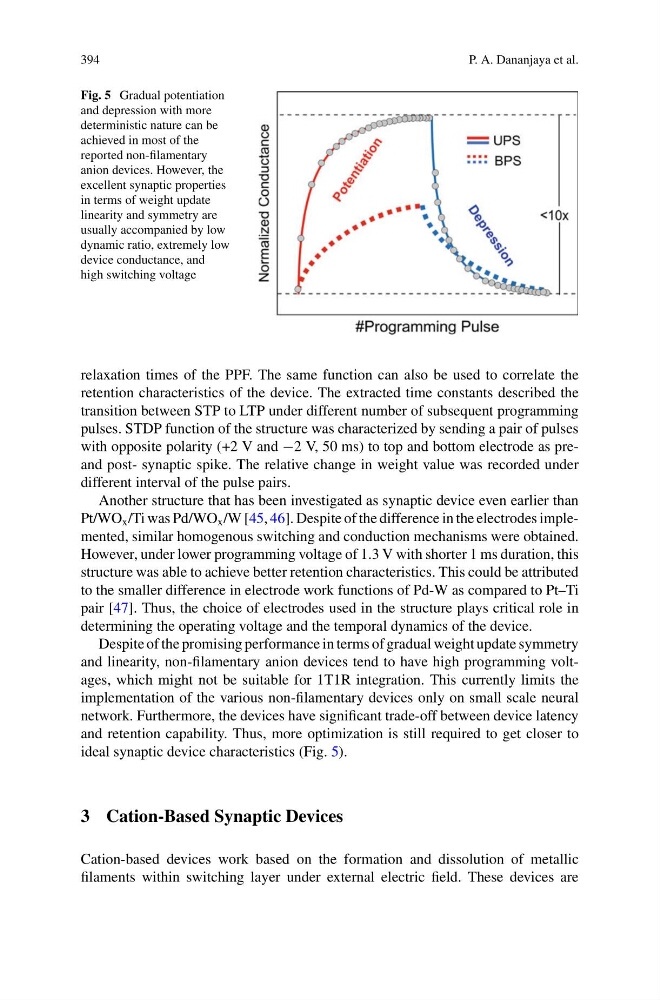
Fig. 5 Gradual potentiation
and depression with more
deterministic nature can be
achieved in most of the
reported non-filamentary
anion devices. However, the
excellent synaptic properties
in terms of weight update
linearity and symmetry are
usually accompanied by low
dynamic ratio, extremely low
device conductance, and
high switching voltage
relaxation times of the PPF. The same function can also be used to correlate the
retention characteristics of the device. The extracted time constants described the
transition between STP to LTP under different number of subsequent programming
pulses. STDP function of the structure was characterized by sending a pair of pulses
with opposite polarity (+2 V and −2 V, 50 ms) to top and bottom electrode as preand post- synaptic spike. The relative change in weight value was recorded under
different interval of the pulse pairs.
Another structure that has been investigated as synaptic device even earlier than
Pt/WO x /Ti was Pd/WO x /W [45, 46]. Despite of the difference in the electrodes implemented, similar homogenous switching and conduction mechanisms were obtained.
However, under lower programming voltage of 1.3 V with shorter 1 ms duration, this
structure was able to achieve better retention characteristics. This could be attributed
to the smaller difference in electrode work functions of Pd-W as compared to Pt–Ti
pair [47]. Thus, the choice of electrodes used in the structure plays critical role in
determining the operating voltage and the temporal dynamics of the device.
Despite of the promising performance in terms of gradual weight update symmetry
and linearity, non-filamentary anion devices tend to have high programming voltages, which might not be suitable for 1T1R integration. This currently limits the
implementation of the various non-filamentary devices only on small scale neural
network. Furthermore, the devices have significant trade-off between device latency
and retention capability. Thus, more optimization is still required to get closer to
ideal synaptic device characteristics (Fig. 5).
3 Cation-Based Synaptic Devices
Cation-based devices work based on the formation and dissolution of metallic
filaments within switching layer under external electric field. These devices are
P. A. Dananjaya et al.
Fig. 5 Gradual potentiation
and depression with more
deterministic nature can be
achieved in most of the
reported non-filamentary
anion devices. However, the
excellent synaptic properties
in terms of weight update
linearity and symmetry are
usually accompanied by low
dynamic ratio, extremely low
device conductance, and
high switching voltage
relaxation times of the PPF. The same function can also be used to correlate the
retention characteristics of the device. The extracted time constants described the
transition between STP to LTP under different number of subsequent programming
pulses. STDP function of the structure was characterized by sending a pair of pulses
with opposite polarity (+2 V and −2 V, 50 ms) to top and bottom electrode as preand post- synaptic spike. The relative change in weight value was recorded under
different interval of the pulse pairs.
Another structure that has been investigated as synaptic device even earlier than
Pt/WO x /Ti was Pd/WO x /W [45, 46]. Despite of the difference in the electrodes implemented, similar homogenous switching and conduction mechanisms were obtained.
However, under lower programming voltage of 1.3 V with shorter 1 ms duration, this
structure was able to achieve better retention characteristics. This could be attributed
to the smaller difference in electrode work functions of Pd-W as compared to Pt–Ti
pair [47]. Thus, the choice of electrodes used in the structure plays critical role in
determining the operating voltage and the temporal dynamics of the device.
Despite of the promising performance in terms of gradual weight update symmetry
and linearity, non-filamentary anion devices tend to have high programming voltages, which might not be suitable for 1T1R integration. This currently limits the
implementation of the various non-filamentary devices only on small scale neural
network. Furthermore, the devices have significant trade-off between device latency
and retention capability. Thus, more optimization is still required to get closer to
ideal synaptic device characteristics (Fig. 5).
3 Cation-Based Synaptic Devices
Cation-based devices work based on the formation and dissolution of metallic
filaments within switching layer under external electric field. These devices are