

384
P. A. Dananjaya et al.
the complexity of the human brain and the on-going research to gain the full understanding of it, significant amount of efforts and progress has been made in closely
emulating it in terms of its functionalities to execute various complex tasks.
In recent years, RRAM devices have emerged as one of the most promising candidates as a major component in neuromorphic engineering to mimic the functionality
of synapses in the human brain [5]. With its relatively simple building blocks of twoterminal device structure, it has demonstrated various synaptic behaviors, e.g. potentiation, depression, and spike-timing dependent plasticity (STDP). Furthermore, its
two-terminal nature enables the implementation of high-density crossbar array architecture. The RRAM-based crossbar array can be used both as a high-density memory
component as well as a computation unit.
An ideal synaptic device is one of the major elements required to realize a robust
neuromorphic computing platform. It plays major role in determining the interconnectivity strength among neurons in the system by storing the weight values. These
values are updated according to the learning rules implemented during training. In
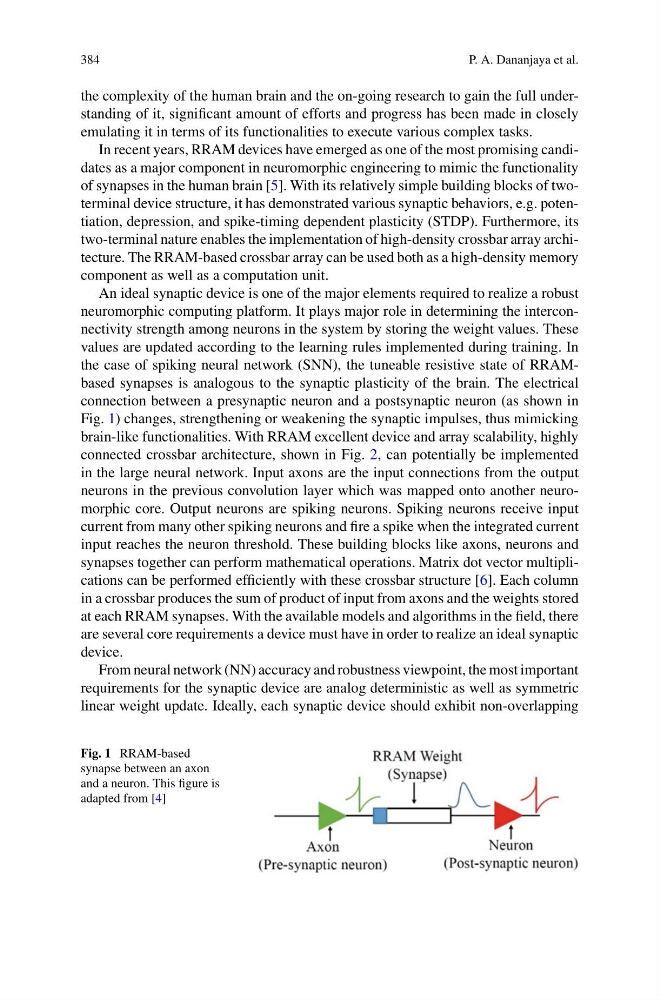
the case of spiking neural network (SNN), the tuneable resistive state of RRAMbased synapses is analogous to the synaptic plasticity of the brain. The electrical
connection between a presynaptic neuron and a postsynaptic neuron (as shown in
Fig. 1) changes, strengthening or weakening the synaptic impulses, thus mimicking
brain-like functionalities. With RRAM excellent device and array scalability, highly
connected crossbar architecture, shown in Fig. 2, can potentially be implemented
in the large neural network. Input axons are the input connections from the output
neurons in the previous convolution layer which was mapped onto another neuromorphic core. Output neurons are spiking neurons. Spiking neurons receive input
current from many other spiking neurons and fire a spike when the integrated current
input reaches the neuron threshold. These building blocks like axons, neurons and
synapses together can perform mathematical operations. Matrix dot vector multiplications can be performed efficiently with these crossbar structure [6]. Each column
in a crossbar produces the sum of product of input from axons and the weights stored
at each RRAM synapses. With the available models and algorithms in the field, there
are several core requirements a device must have in order to realize an ideal synaptic
device.
From neural network (NN) accuracy and robustness viewpoint, the most important
requirements for the synaptic device are analog deterministic as well as symmetric
linear weight update. Ideally, each synaptic device should exhibit non-overlapping
Fig. 1 RRAM-based
synapse between an axon
and a neuron. This figure is
adapted from [4]
P. A. Dananjaya et al.
the complexity of the human brain and the on-going research to gain the full understanding of it, significant amount of efforts and progress has been made in closely
emulating it in terms of its functionalities to execute various complex tasks.
In recent years, RRAM devices have emerged as one of the most promising candidates as a major component in neuromorphic engineering to mimic the functionality
of synapses in the human brain [5]. With its relatively simple building blocks of twoterminal device structure, it has demonstrated various synaptic behaviors, e.g. potentiation, depression, and spike-timing dependent plasticity (STDP). Furthermore, its
two-terminal nature enables the implementation of high-density crossbar array architecture. The RRAM-based crossbar array can be used both as a high-density memory
component as well as a computation unit.
An ideal synaptic device is one of the major elements required to realize a robust
neuromorphic computing platform. It plays major role in determining the interconnectivity strength among neurons in the system by storing the weight values. These
values are updated according to the learning rules implemented during training. In
the case of spiking neural network (SNN), the tuneable resistive state of RRAMbased synapses is analogous to the synaptic plasticity of the brain. The electrical
connection between a presynaptic neuron and a postsynaptic neuron (as shown in
Fig. 1) changes, strengthening or weakening the synaptic impulses, thus mimicking
brain-like functionalities. With RRAM excellent device and array scalability, highly
connected crossbar architecture, shown in Fig. 2, can potentially be implemented
in the large neural network. Input axons are the input connections from the output
neurons in the previous convolution layer which was mapped onto another neuromorphic core. Output neurons are spiking neurons. Spiking neurons receive input
current from many other spiking neurons and fire a spike when the integrated current
input reaches the neuron threshold. These building blocks like axons, neurons and
synapses together can perform mathematical operations. Matrix dot vector multiplications can be performed efficiently with these crossbar structure [6]. Each column
in a crossbar produces the sum of product of input from axons and the weights stored
at each RRAM synapses. With the available models and algorithms in the field, there
are several core requirements a device must have in order to realize an ideal synaptic
device.
From neural network (NN) accuracy and robustness viewpoint, the most important
requirements for the synaptic device are analog deterministic as well as symmetric
linear weight update. Ideally, each synaptic device should exhibit non-overlapping
Fig. 1 RRAM-based
synapse between an axon
and a neuron. This figure is
adapted from [4]