

Microwave Oscillators and Detectors Based …
31
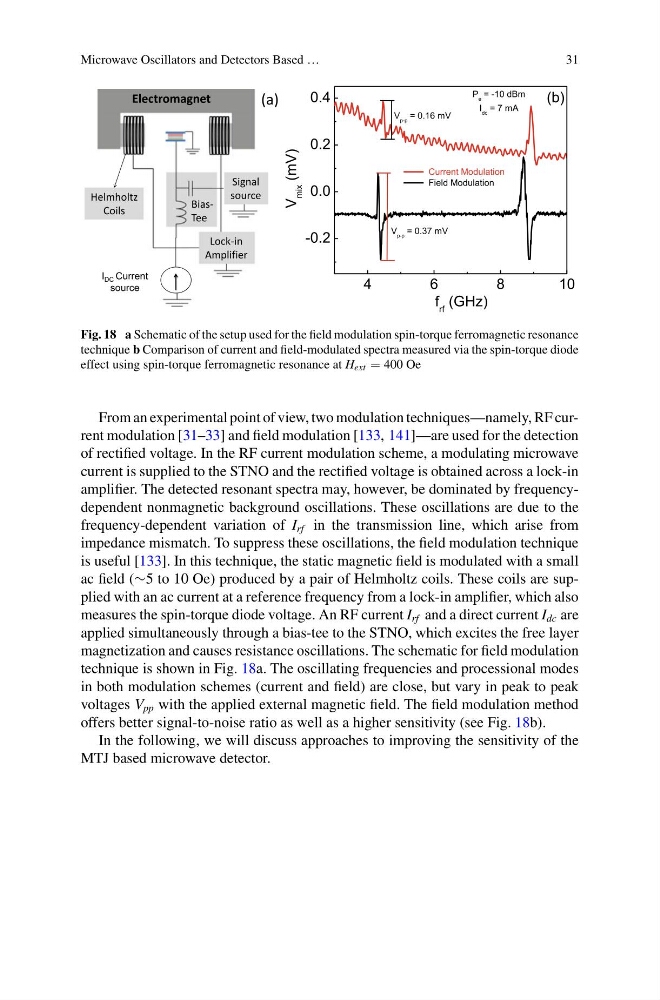
Fig. 18 a Schematic of the setup used for the field modulation spin-torque ferromagnetic resonance
technique b Comparison of current and field-modulated spectra measured via the spin-torque diode
effect using spin-torque ferromagnetic resonance at H ext = 400 Oe
From an experimental point of view, two modulation techniques—namely, RF current modulation [31–33] and field modulation [133, 141]—are used for the detection
of rectified voltage. In the RF current modulation scheme, a modulating microwave
current is supplied to the STNO and the rectified voltage is obtained across a lock-in
amplifier. The detected resonant spectra may, however, be dominated by frequencydependent nonmagnetic background oscillations. These oscillations are due to the
frequency-dependent variation of I rf in the transmission line, which arise from
impedance mismatch. To suppress these oscillations, the field modulation technique
is useful [133]. In this technique, the static magnetic field is modulated with a small
ac field (∼5 to 10 Oe) produced by a pair of Helmholtz coils. These coils are supplied with an ac current at a reference frequency from a lock-in amplifier, which also
measures the spin-torque diode voltage. An RF current I rf and a direct current I dc are
applied simultaneously through a bias-tee to the STNO, which excites the free layer
magnetization and causes resistance oscillations. The schematic for field modulation
technique is shown in Fig. 18a. The oscillating frequencies and processional modes
in both modulation schemes (current and field) are close, but vary in peak to peak
voltages V pp with the applied external magnetic field. The field modulation method
offers better signal-to-noise ratio as well as a higher sensitivity (see Fig. 18b).
In the following, we will discuss approaches to improving the sensitivity of the
MTJ based microwave detector.
31
Fig. 18 a Schematic of the setup used for the field modulation spin-torque ferromagnetic resonance
technique b Comparison of current and field-modulated spectra measured via the spin-torque diode
effect using spin-torque ferromagnetic resonance at H ext = 400 Oe
From an experimental point of view, two modulation techniques—namely, RF current modulation [31–33] and field modulation [133, 141]—are used for the detection
of rectified voltage. In the RF current modulation scheme, a modulating microwave
current is supplied to the STNO and the rectified voltage is obtained across a lock-in
amplifier. The detected resonant spectra may, however, be dominated by frequencydependent nonmagnetic background oscillations. These oscillations are due to the
frequency-dependent variation of I rf in the transmission line, which arise from
impedance mismatch. To suppress these oscillations, the field modulation technique
is useful [133]. In this technique, the static magnetic field is modulated with a small
ac field (∼5 to 10 Oe) produced by a pair of Helmholtz coils. These coils are supplied with an ac current at a reference frequency from a lock-in amplifier, which also
measures the spin-torque diode voltage. An RF current I rf and a direct current I dc are
applied simultaneously through a bias-tee to the STNO, which excites the free layer
magnetization and causes resistance oscillations. The schematic for field modulation
technique is shown in Fig. 18a. The oscillating frequencies and processional modes
in both modulation schemes (current and field) are close, but vary in peak to peak
voltages V pp with the applied external magnetic field. The field modulation method
offers better signal-to-noise ratio as well as a higher sensitivity (see Fig. 18b).
In the following, we will discuss approaches to improving the sensitivity of the
MTJ based microwave detector.