

30
P. K. Muduli et al.
9 MTJ-Based Microwave Detector
Microwave or radio frequency (RF) detectors can be realized when the dc input is
replaced by a microwave current in an MTJ-based STNO. The microwave detection
in an MTJ nanopillar is a result of the giant TMR and magnetization dynamics
induced by the spin-transfer torque. In the case of a RF current I rf = I sin(2π f e t)
with frequency f e close to the resonance frequency of the STNO, a large dc voltage is
produced by the microwave current mixing with the signal generated by the dynamic
response of the STNO in a phenomenon called the spin-torque diode effect [31]. The
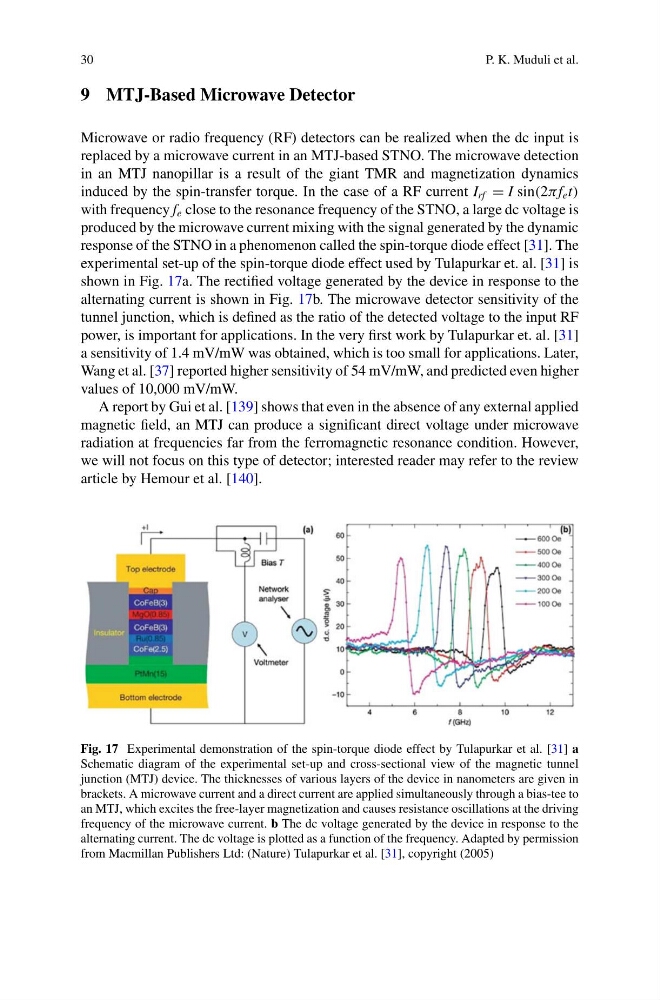
experimental set-up of the spin-torque diode effect used by Tulapurkar et. al. [31] is
shown in Fig. 17a. The rectified voltage generated by the device in response to the
alternating current is shown in Fig. 17b. The microwave detector sensitivity of the
tunnel junction, which is defined as the ratio of the detected voltage to the input RF
power, is important for applications. In the very first work by Tulapurkar et. al. [31]
a sensitivity of 1.4 mV/mW was obtained, which is too small for applications. Later,
Wang et al. [37] reported higher sensitivity of 54 mV/mW, and predicted even higher
values of 10,000 mV/mW.
A report by Gui et al. [139] shows that even in the absence of any external applied
magnetic field, an MTJ can produce a significant direct voltage under microwave
radiation at frequencies far from the ferromagnetic resonance condition. However,
we will not focus on this type of detector; interested reader may refer to the review
article by Hemour et al. [140].
Fig. 17 Experimental demonstration of the spin-torque diode effect by Tulapurkar et al. [31] a
Schematic diagram of the experimental set-up and cross-sectional view of the magnetic tunnel
junction (MTJ) device. The thicknesses of various layers of the device in nanometers are given in
brackets. A microwave current and a direct current are applied simultaneously through a bias-tee to
an MTJ, which excites the free-layer magnetization and causes resistance oscillations at the driving
frequency of the microwave current. b The dc voltage generated by the device in response to the
alternating current. The dc voltage is plotted as a function of the frequency. Adapted by permission
from Macmillan Publishers Ltd: (Nature) Tulapurkar et al. [31], copyright (2005)
P. K. Muduli et al.
9 MTJ-Based Microwave Detector
Microwave or radio frequency (RF) detectors can be realized when the dc input is
replaced by a microwave current in an MTJ-based STNO. The microwave detection
in an MTJ nanopillar is a result of the giant TMR and magnetization dynamics
induced by the spin-transfer torque. In the case of a RF current I rf = I sin(2π f e t)
with frequency f e close to the resonance frequency of the STNO, a large dc voltage is
produced by the microwave current mixing with the signal generated by the dynamic
response of the STNO in a phenomenon called the spin-torque diode effect [31]. The
experimental set-up of the spin-torque diode effect used by Tulapurkar et. al. [31] is
shown in Fig. 17a. The rectified voltage generated by the device in response to the
alternating current is shown in Fig. 17b. The microwave detector sensitivity of the
tunnel junction, which is defined as the ratio of the detected voltage to the input RF
power, is important for applications. In the very first work by Tulapurkar et. al. [31]
a sensitivity of 1.4 mV/mW was obtained, which is too small for applications. Later,
Wang et al. [37] reported higher sensitivity of 54 mV/mW, and predicted even higher
values of 10,000 mV/mW.
A report by Gui et al. [139] shows that even in the absence of any external applied
magnetic field, an MTJ can produce a significant direct voltage under microwave
radiation at frequencies far from the ferromagnetic resonance condition. However,
we will not focus on this type of detector; interested reader may refer to the review
article by Hemour et al. [140].
Fig. 17 Experimental demonstration of the spin-torque diode effect by Tulapurkar et al. [31] a
Schematic diagram of the experimental set-up and cross-sectional view of the magnetic tunnel
junction (MTJ) device. The thicknesses of various layers of the device in nanometers are given in
brackets. A microwave current and a direct current are applied simultaneously through a bias-tee to
an MTJ, which excites the free-layer magnetization and causes resistance oscillations at the driving
frequency of the microwave current. b The dc voltage generated by the device in response to the
alternating current. The dc voltage is plotted as a function of the frequency. Adapted by permission
from Macmillan Publishers Ltd: (Nature) Tulapurkar et al. [31], copyright (2005)