

RRAM Device Characterizations and Modelling
377
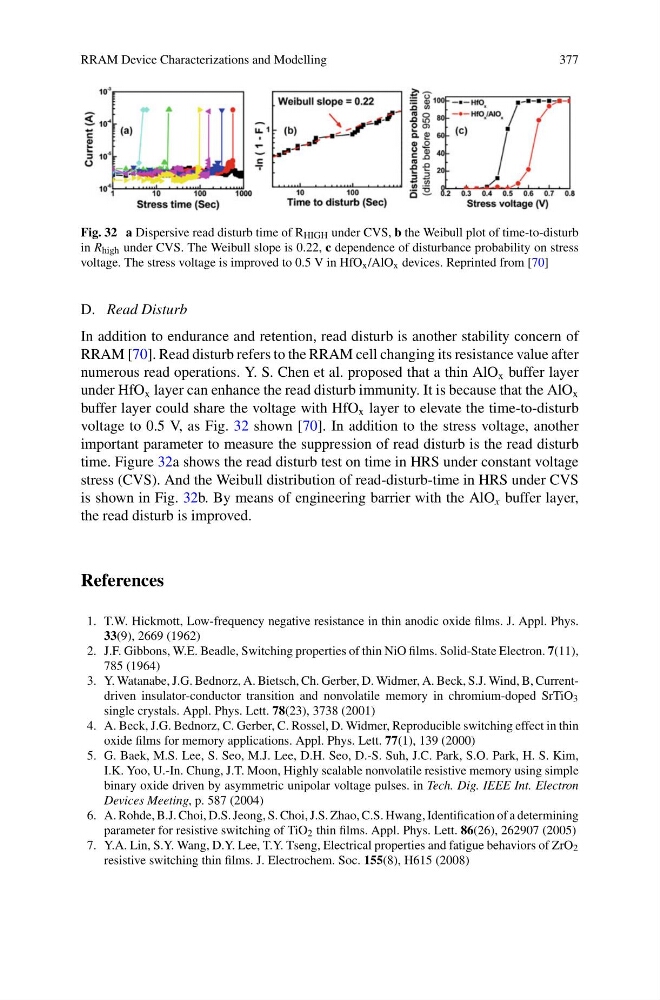
Fig. 32 a Dispersive read disturb time of R HIGH under CVS, b the Weibull plot of time-to-disturb
in R high under CVS. The Weibull slope is 0.22, c dependence of disturbance probability on stress
voltage. The stress voltage is improved to 0.5 V in HfO x /AlO x devices. Reprinted from [70]
D. Read Disturb
In addition to endurance and retention, read disturb is another stability concern of
RRAM [70]. Read disturb refers to the RRAM cell changing its resistance value after
numerous read operations. Y. S. Chen et al. proposed that a thin AlO x buffer layer
under HfO x layer can enhance the read disturb immunity. It is because that the AlO x
buffer layer could share the voltage with HfO x layer to elevate the time-to-disturb
voltage to 0.5 V, as Fig. 32 shown [70]. In addition to the stress voltage, another
important parameter to measure the suppression of read disturb is the read disturb
time. Figure 32a shows the read disturb test on time in HRS under constant voltage
stress (CVS). And the Weibull distribution of read-disturb-time in HRS under CVS
is shown in Fig. 32b. By means of engineering barrier with the AlO x buffer layer,
the read disturb is improved.
References
1. T.W. Hickmott, Low-frequency negative resistance in thin anodic oxide films. J. Appl. Phys.
33(9), 2669 (1962)
2. J.F. Gibbons, W.E. Beadle, Switching properties of thin NiO films. Solid-State Electron. 7(11),
785 (1964)
3. Y. Watanabe, J.G. Bednorz, A. Bietsch, Ch. Gerber, D. Widmer, A. Beck, S.J. Wind, B, Currentdriven insulator-conductor transition and nonvolatile memory in chromium-doped SrTiO 3
single crystals. Appl. Phys. Lett. 78(23), 3738 (2001)
4. A. Beck, J.G. Bednorz, C. Gerber, C. Rossel, D. Widmer, Reproducible switching effect in thin
oxide films for memory applications. Appl. Phys. Lett. 77(1), 139 (2000)
5. G. Baek, M.S. Lee, S. Seo, M.J. Lee, D.H. Seo, D.-S. Suh, J.C. Park, S.O. Park, H. S. Kim,
I.K. Yoo, U.-In. Chung, J.T. Moon, Highly scalable nonvolatile resistive memory using simple
binary oxide driven by asymmetric unipolar voltage pulses. in Tech. Dig. IEEE Int. Electron
Devices Meeting, p. 587 (2004)
6. A. Rohde, B.J. Choi, D.S. Jeong, S. Choi, J.S. Zhao, C.S. Hwang, Identification of a determining
parameter for resistive switching of TiO 2 thin films. Appl. Phys. Lett. 86(26), 262907 (2005)
7. Y.A. Lin, S.Y. Wang, D.Y. Lee, T.Y. Tseng, Electrical properties and fatigue behaviors of ZrO 2
resistive switching thin films. J. Electrochem. Soc. 155(8), H615 (2008)
377
Fig. 32 a Dispersive read disturb time of R HIGH under CVS, b the Weibull plot of time-to-disturb
in R high under CVS. The Weibull slope is 0.22, c dependence of disturbance probability on stress
voltage. The stress voltage is improved to 0.5 V in HfO x /AlO x devices. Reprinted from [70]
D. Read Disturb
In addition to endurance and retention, read disturb is another stability concern of
RRAM [70]. Read disturb refers to the RRAM cell changing its resistance value after
numerous read operations. Y. S. Chen et al. proposed that a thin AlO x buffer layer
under HfO x layer can enhance the read disturb immunity. It is because that the AlO x
buffer layer could share the voltage with HfO x layer to elevate the time-to-disturb
voltage to 0.5 V, as Fig. 32 shown [70]. In addition to the stress voltage, another
important parameter to measure the suppression of read disturb is the read disturb
time. Figure 32a shows the read disturb test on time in HRS under constant voltage
stress (CVS). And the Weibull distribution of read-disturb-time in HRS under CVS
is shown in Fig. 32b. By means of engineering barrier with the AlO x buffer layer,
the read disturb is improved.
References
1. T.W. Hickmott, Low-frequency negative resistance in thin anodic oxide films. J. Appl. Phys.
33(9), 2669 (1962)
2. J.F. Gibbons, W.E. Beadle, Switching properties of thin NiO films. Solid-State Electron. 7(11),
785 (1964)
3. Y. Watanabe, J.G. Bednorz, A. Bietsch, Ch. Gerber, D. Widmer, A. Beck, S.J. Wind, B, Currentdriven insulator-conductor transition and nonvolatile memory in chromium-doped SrTiO 3
single crystals. Appl. Phys. Lett. 78(23), 3738 (2001)
4. A. Beck, J.G. Bednorz, C. Gerber, C. Rossel, D. Widmer, Reproducible switching effect in thin
oxide films for memory applications. Appl. Phys. Lett. 77(1), 139 (2000)
5. G. Baek, M.S. Lee, S. Seo, M.J. Lee, D.H. Seo, D.-S. Suh, J.C. Park, S.O. Park, H. S. Kim,
I.K. Yoo, U.-In. Chung, J.T. Moon, Highly scalable nonvolatile resistive memory using simple
binary oxide driven by asymmetric unipolar voltage pulses. in Tech. Dig. IEEE Int. Electron
Devices Meeting, p. 587 (2004)
6. A. Rohde, B.J. Choi, D.S. Jeong, S. Choi, J.S. Zhao, C.S. Hwang, Identification of a determining
parameter for resistive switching of TiO 2 thin films. Appl. Phys. Lett. 86(26), 262907 (2005)
7. Y.A. Lin, S.Y. Wang, D.Y. Lee, T.Y. Tseng, Electrical properties and fatigue behaviors of ZrO 2
resistive switching thin films. J. Electrochem. Soc. 155(8), H615 (2008)