

RRAM Device Characterizations and Modelling
371
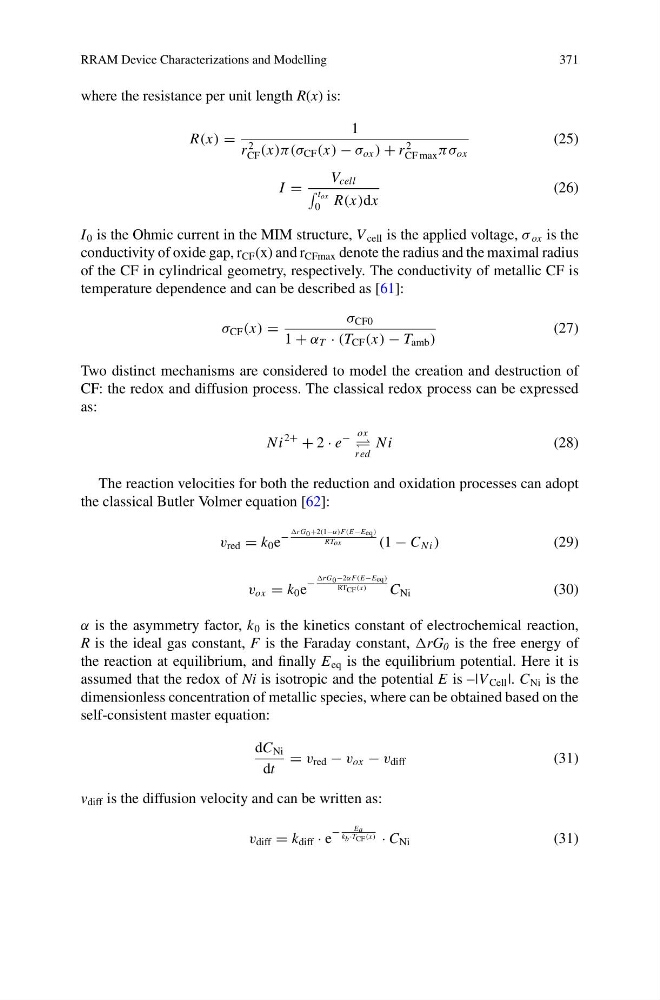
where the resistance per unit length R(x) is:
R(x) =
1
r
2
CF (x)π(σ CF (x) − σ ox ) + r
2
CF max πσ ox
(25)
I =
V cell
t ox
0 R(x)dx
(26)
I 0 is the Ohmic current in the MIM structure, V cell is the applied voltage, σ ox is the
conductivity of oxide gap, r CF (x) and r CFmax denote the radius and the maximal radius
of the CF in cylindrical geometry, respectively. The conductivity of metallic CF is
temperature dependence and can be described as [61]:
σ CF (x) =
σ CF0
1 + α T · (T CF (x) − T amb )
(27)
Two distinct mechanisms are considered to model the creation and destruction of
CF: the redox and diffusion process. The classical redox process can be expressed
as:
Ni
2+
+ 2 · e
− ox
red
Ni
(28)
The reaction velocities for both the reduction and oxidation processes can adopt
the classical Butler Volmer equation [62]:
v red = k 0 e
−
rG 0 +2(1−α)F(E−Eeq)
RTox
(1 − C Ni )
(29)
v ox = k 0 e
−
rG 0 −2α F(E−Eeq)
RT CF (x)
C Ni
(30)
α is the asymmetry factor, k 0 is the kinetics constant of electrochemical reaction,
R is the ideal gas constant, F is the Faraday constant, rG 0 is the free energy of
the reaction at equilibrium, and finally E eq is the equilibrium potential. Here it is
assumed that the redox of Ni is isotropic and the potential E is |V Cell |. C Ni is the
dimensionless concentration of metallic species, where can be obtained based on the
self-consistent master equation:
dC Ni
dt
= v red − v ox − v diff
(31)
v diff is the diffusion velocity and can be written as:
v diff = k diff · e
−
Ea
k b ·T CF (x)
· C Ni
(31)
371
where the resistance per unit length R(x) is:
R(x) =
1
r
2
CF (x)π(σ CF (x) − σ ox ) + r
2
CF max πσ ox
(25)
I =
V cell
t ox
0 R(x)dx
(26)
I 0 is the Ohmic current in the MIM structure, V cell is the applied voltage, σ ox is the
conductivity of oxide gap, r CF (x) and r CFmax denote the radius and the maximal radius
of the CF in cylindrical geometry, respectively. The conductivity of metallic CF is
temperature dependence and can be described as [61]:
σ CF (x) =
σ CF0
1 + α T · (T CF (x) − T amb )
(27)
Two distinct mechanisms are considered to model the creation and destruction of
CF: the redox and diffusion process. The classical redox process can be expressed
as:
Ni
2+
+ 2 · e
− ox
red
Ni
(28)
The reaction velocities for both the reduction and oxidation processes can adopt
the classical Butler Volmer equation [62]:
v red = k 0 e
−
rG 0 +2(1−α)F(E−Eeq)
RTox
(1 − C Ni )
(29)
v ox = k 0 e
−
rG 0 −2α F(E−Eeq)
RT CF (x)
C Ni
(30)
α is the asymmetry factor, k 0 is the kinetics constant of electrochemical reaction,
R is the ideal gas constant, F is the Faraday constant, rG 0 is the free energy of
the reaction at equilibrium, and finally E eq is the equilibrium potential. Here it is
assumed that the redox of Ni is isotropic and the potential E is |V Cell |. C Ni is the
dimensionless concentration of metallic species, where can be obtained based on the
self-consistent master equation:
dC Ni
dt
= v red − v ox − v diff
(31)
v diff is the diffusion velocity and can be written as:
v diff = k diff · e
−
Ea
k b ·T CF (x)
· C Ni
(31)