

RRAM Device Characterizations and Modelling
357
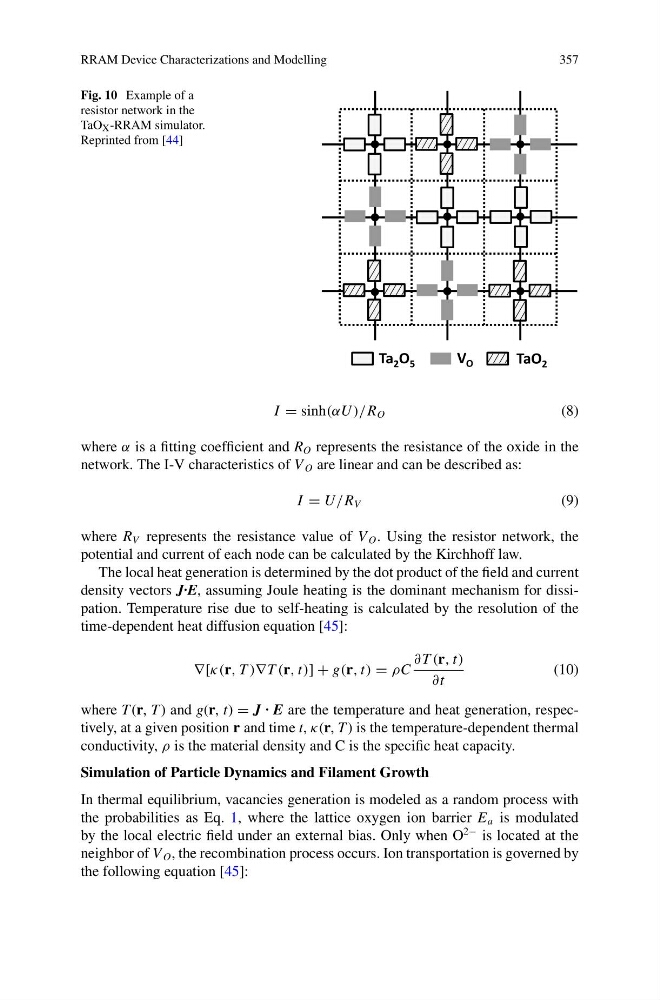
Fig. 10 Example of a
resistor network in the
TaO X -RRAM simulator.
Reprinted from [44]
Ta 2 O 5
V O
TaO 2
I = sinh(αU )/R O
(8)
where α is a fitting coefficient and R O represents the resistance of the oxide in the
network. The I-V characteristics of V O are linear and can be described as:
I = U/R V
(9)
where R V represents the resistance value of V O . Using the resistor network, the
potential and current of each node can be calculated by the Kirchhoff law.
The local heat generation is determined by the dot product of the field and current
density vectors J·E, assuming Joule heating is the dominant mechanism for dissipation. Temperature rise due to self-heating is calculated by the resolution of the
time-dependent heat diffusion equation [45]:
∇[κ(r, T )∇T (r, t)] + g(r, t) = ρC
∂ T (r, t)
∂t
(10)
where T (r, T ) and g(r, t) = J · E are the temperature and heat generation, respectively, at a given position r and time t, κ(r, T ) is the temperature-dependent thermal
conductivity, ρ is the material density and C is the specific heat capacity.
Simulation of Particle Dynamics and Filament Growth
In thermal equilibrium, vacancies generation is modeled as a random process with
the probabilities as Eq. 1, where the lattice oxygen ion barrier E a is modulated
by the local electric field under an external bias. Only when O
2− is located at the
neighbor of V O , the recombination process occurs. Ion transportation is governed by
the following equation [45]:
357
Fig. 10 Example of a
resistor network in the
TaO X -RRAM simulator.
Reprinted from [44]
Ta 2 O 5
V O
TaO 2
I = sinh(αU )/R O
(8)
where α is a fitting coefficient and R O represents the resistance of the oxide in the
network. The I-V characteristics of V O are linear and can be described as:
I = U/R V
(9)
where R V represents the resistance value of V O . Using the resistor network, the
potential and current of each node can be calculated by the Kirchhoff law.
The local heat generation is determined by the dot product of the field and current
density vectors J·E, assuming Joule heating is the dominant mechanism for dissipation. Temperature rise due to self-heating is calculated by the resolution of the
time-dependent heat diffusion equation [45]:
∇[κ(r, T )∇T (r, t)] + g(r, t) = ρC
∂ T (r, t)
∂t
(10)
where T (r, T ) and g(r, t) = J · E are the temperature and heat generation, respectively, at a given position r and time t, κ(r, T ) is the temperature-dependent thermal
conductivity, ρ is the material density and C is the specific heat capacity.
Simulation of Particle Dynamics and Filament Growth
In thermal equilibrium, vacancies generation is modeled as a random process with
the probabilities as Eq. 1, where the lattice oxygen ion barrier E a is modulated
by the local electric field under an external bias. Only when O
2− is located at the
neighbor of V O , the recombination process occurs. Ion transportation is governed by
the following equation [45]: