

Microwave Oscillators and Detectors Based …
27
nonlinearly on the dc bias current. Due to this nonlinearity, the fundamental models
describing linear frequency modulation fail to describe the modulation behavior. In
2005, nonlinear frequency modulation (NFM) was reported by Pufall et al. [20] for a
nanocontact-based STNO. To fit their experimental power of carrier and sidebands,
the NFM method was implemented. In 2010, Muduli et al. [22] showed that the
nonlinear frequency and amplitude modulation (NFAM) [22–24, 129, 130] theory
is the most appropriate model for explaining the modulation of STNOs. The NFAM
model was required to explain two main experimental observations: (1) unequal
sideband amplitudes around the carrier spectrum and (2) shifts in the frequency
of the carrier spectrum with the increase in the modulation current. Pogoryelov et
al. [25] showed the validity of the NFAM model on a pair of synchronized nanocontact
STNOs.
With regard to the modulation of MTJ-based STNOs, Martin et al. [124] first
reported modulation of MTJ-vortex-based STNO devices. They also applied the
NFM model to their experimental data and showed that the characteristic time of the
vortex dynamics must be taken into account to explain the modulation data. This is
because the modulation period approaches the transient time.
8.1 Single Sideband Modulation of MTJ-Based STNO
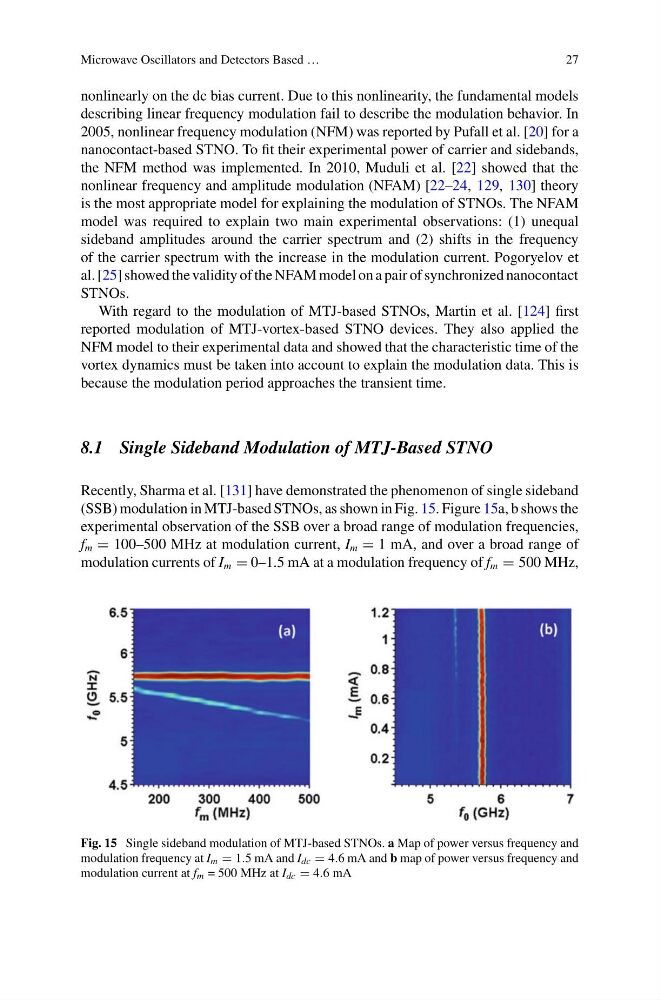
Recently, Sharma et al. [131] have demonstrated the phenomenon of single sideband
(SSB) modulation in MTJ-based STNOs, as shown in Fig. 15. Figure 15a, b shows the
experimental observation of the SSB over a broad range of modulation frequencies,
f m = 100–500 MHz at modulation current, I m = 1 mA, and over a broad range of
modulation currents of I m = 0–1.5 mA at a modulation frequency of f m = 500 MHz,
Fig. 15 Single sideband modulation of MTJ-based STNOs. a Map of power versus frequency and
modulation frequency at I m = 1.5 mA and I dc = 4.6 mA and b map of power versus frequency and
modulation current at f m = 500 MHz at I dc = 4.6 mA
27
nonlinearly on the dc bias current. Due to this nonlinearity, the fundamental models
describing linear frequency modulation fail to describe the modulation behavior. In
2005, nonlinear frequency modulation (NFM) was reported by Pufall et al. [20] for a
nanocontact-based STNO. To fit their experimental power of carrier and sidebands,
the NFM method was implemented. In 2010, Muduli et al. [22] showed that the
nonlinear frequency and amplitude modulation (NFAM) [22–24, 129, 130] theory
is the most appropriate model for explaining the modulation of STNOs. The NFAM
model was required to explain two main experimental observations: (1) unequal
sideband amplitudes around the carrier spectrum and (2) shifts in the frequency
of the carrier spectrum with the increase in the modulation current. Pogoryelov et
al. [25] showed the validity of the NFAM model on a pair of synchronized nanocontact
STNOs.
With regard to the modulation of MTJ-based STNOs, Martin et al. [124] first
reported modulation of MTJ-vortex-based STNO devices. They also applied the
NFM model to their experimental data and showed that the characteristic time of the
vortex dynamics must be taken into account to explain the modulation data. This is
because the modulation period approaches the transient time.
8.1 Single Sideband Modulation of MTJ-Based STNO
Recently, Sharma et al. [131] have demonstrated the phenomenon of single sideband
(SSB) modulation in MTJ-based STNOs, as shown in Fig. 15. Figure 15a, b shows the
experimental observation of the SSB over a broad range of modulation frequencies,
f m = 100–500 MHz at modulation current, I m = 1 mA, and over a broad range of
modulation currents of I m = 0–1.5 mA at a modulation frequency of f m = 500 MHz,
Fig. 15 Single sideband modulation of MTJ-based STNOs. a Map of power versus frequency and
modulation frequency at I m = 1.5 mA and I dc = 4.6 mA and b map of power versus frequency and
modulation current at f m = 500 MHz at I dc = 4.6 mA