

26
P. K. Muduli et al.
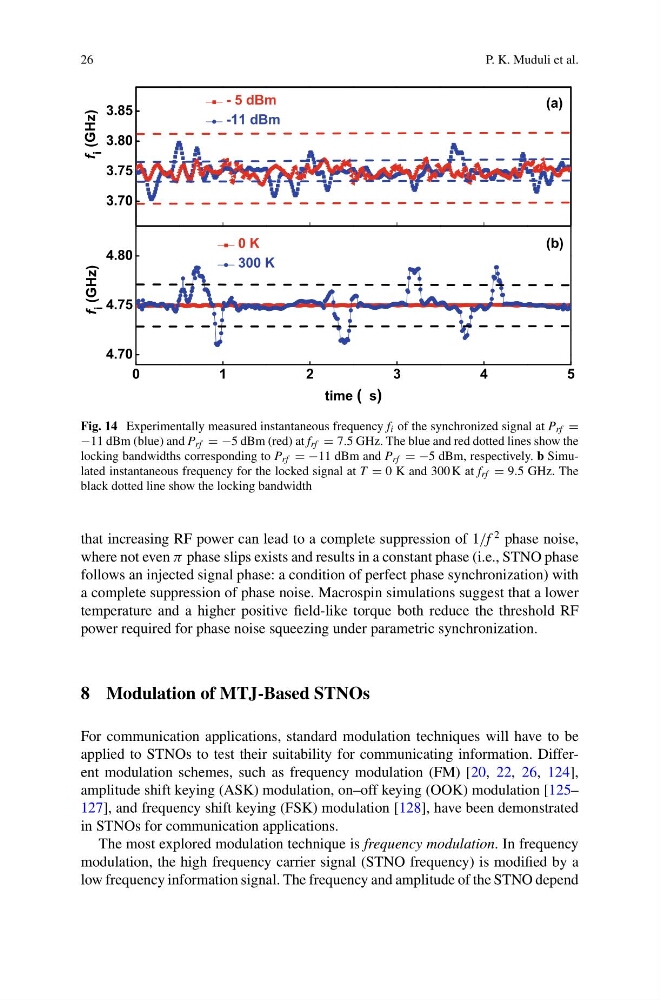
Fig. 14 Experimentally measured instantaneous frequency f i of the synchronized signal at P rf =
−11 dBm (blue) and P rf = −5 dBm (red) at f rf = 7.5 GHz. The blue and red dotted lines show the
locking bandwidths corresponding to P rf = −11 dBm and P rf = −5 dBm, respectively. b Simulated instantaneous frequency for the locked signal at T = 0 K and 300 K at f rf = 9.5 GHz. The
black dotted line show the locking bandwidth
that increasing RF power can lead to a complete suppression of 1/f
2 phase noise,
where not even π phase slips exists and results in a constant phase (i.e., STNO phase
follows an injected signal phase: a condition of perfect phase synchronization) with
a complete suppression of phase noise. Macrospin simulations suggest that a lower
temperature and a higher positive field-like torque both reduce the threshold RF
power required for phase noise squeezing under parametric synchronization.
8 Modulation of MTJ-Based STNOs
For communication applications, standard modulation techniques will have to be
applied to STNOs to test their suitability for communicating information. Different modulation schemes, such as frequency modulation (FM) [20, 22, 26, 124],
amplitude shift keying (ASK) modulation, on–off keying (OOK) modulation [125–
127], and frequency shift keying (FSK) modulation [128], have been demonstrated
in STNOs for communication applications.
The most explored modulation technique is frequency modulation. In frequency
modulation, the high frequency carrier signal (STNO frequency) is modified by a
low frequency information signal. The frequency and amplitude of the STNO depend
P. K. Muduli et al.
Fig. 14 Experimentally measured instantaneous frequency f i of the synchronized signal at P rf =
−11 dBm (blue) and P rf = −5 dBm (red) at f rf = 7.5 GHz. The blue and red dotted lines show the
locking bandwidths corresponding to P rf = −11 dBm and P rf = −5 dBm, respectively. b Simulated instantaneous frequency for the locked signal at T = 0 K and 300 K at f rf = 9.5 GHz. The
black dotted line show the locking bandwidth
that increasing RF power can lead to a complete suppression of 1/f
2 phase noise,
where not even π phase slips exists and results in a constant phase (i.e., STNO phase
follows an injected signal phase: a condition of perfect phase synchronization) with
a complete suppression of phase noise. Macrospin simulations suggest that a lower
temperature and a higher positive field-like torque both reduce the threshold RF
power required for phase noise squeezing under parametric synchronization.
8 Modulation of MTJ-Based STNOs
For communication applications, standard modulation techniques will have to be
applied to STNOs to test their suitability for communicating information. Different modulation schemes, such as frequency modulation (FM) [20, 22, 26, 124],
amplitude shift keying (ASK) modulation, on–off keying (OOK) modulation [125–
127], and frequency shift keying (FSK) modulation [128], have been demonstrated
in STNOs for communication applications.
The most explored modulation technique is frequency modulation. In frequency
modulation, the high frequency carrier signal (STNO frequency) is modified by a
low frequency information signal. The frequency and amplitude of the STNO depend