

334
V. Y. Zhuo et al.
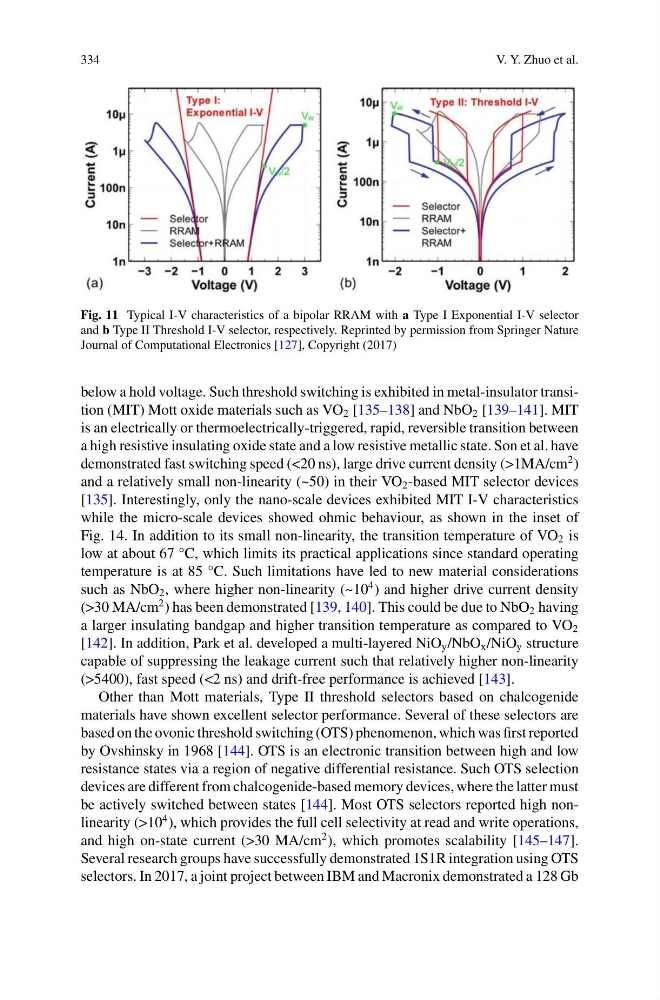
Fig. 11 Typical I-V characteristics of a bipolar RRAM with a Type I Exponential I-V selector
and b Type II Threshold I-V selector, respectively. Reprinted by permission from Springer Nature
Journal of Computational Electronics [127], Copyright (2017)
below a hold voltage. Such threshold switching is exhibited in metal-insulator transition (MIT) Mott oxide materials such as VO 2 [135–138] and NbO 2 [139–141]. MIT
is an electrically or thermoelectrically-triggered, rapid, reversible transition between
a high resistive insulating oxide state and a low resistive metallic state. Son et al. have
demonstrated fast switching speed (<20 ns), large drive current density (>1MA/cm
2 )
and a relatively small non-linearity (~50) in their VO 2 -based MIT selector devices
[135]. Interestingly, only the nano-scale devices exhibited MIT I-V characteristics
while the micro-scale devices showed ohmic behaviour, as shown in the inset of
Fig. 14. In addition to its small non-linearity, the transition temperature of VO 2 is
low at about 67 °C, which limits its practical applications since standard operating
temperature is at 85 °C. Such limitations have led to new material considerations
such as NbO 2 , where higher non-linearity (~10
4 ) and higher drive current density
(>30 MA/cm
2 ) has been demonstrated [139, 140]. This could be due to NbO 2 having
a larger insulating bandgap and higher transition temperature as compared to VO 2
[142]. In addition, Park et al. developed a multi-layered NiO y /NbO x /NiO y structure
capable of suppressing the leakage current such that relatively higher non-linearity
(>5400), fast speed (<2 ns) and drift-free performance is achieved [143].
Other than Mott materials, Type II threshold selectors based on chalcogenide
materials have shown excellent selector performance. Several of these selectors are
based on the ovonic threshold switching (OTS) phenomenon, which was first reported
by Ovshinsky in 1968 [144]. OTS is an electronic transition between high and low
resistance states via a region of negative differential resistance. Such OTS selection
devices are different from chalcogenide-based memory devices, where the latter must
be actively switched between states [144]. Most OTS selectors reported high nonlinearity (>10
4 ), which provides the full cell selectivity at read and write operations,
and high on-state current (>30 MA/cm
2 ), which promotes scalability [145–147].
Several research groups have successfully demonstrated 1S1R integration using OTS
selectors. In 2017, a joint project between IBM and Macronix demonstrated a 128 Gb
V. Y. Zhuo et al.
Fig. 11 Typical I-V characteristics of a bipolar RRAM with a Type I Exponential I-V selector
and b Type II Threshold I-V selector, respectively. Reprinted by permission from Springer Nature
Journal of Computational Electronics [127], Copyright (2017)
below a hold voltage. Such threshold switching is exhibited in metal-insulator transition (MIT) Mott oxide materials such as VO 2 [135–138] and NbO 2 [139–141]. MIT
is an electrically or thermoelectrically-triggered, rapid, reversible transition between
a high resistive insulating oxide state and a low resistive metallic state. Son et al. have
demonstrated fast switching speed (<20 ns), large drive current density (>1MA/cm
2 )
and a relatively small non-linearity (~50) in their VO 2 -based MIT selector devices
[135]. Interestingly, only the nano-scale devices exhibited MIT I-V characteristics
while the micro-scale devices showed ohmic behaviour, as shown in the inset of
Fig. 14. In addition to its small non-linearity, the transition temperature of VO 2 is
low at about 67 °C, which limits its practical applications since standard operating
temperature is at 85 °C. Such limitations have led to new material considerations
such as NbO 2 , where higher non-linearity (~10
4 ) and higher drive current density
(>30 MA/cm
2 ) has been demonstrated [139, 140]. This could be due to NbO 2 having
a larger insulating bandgap and higher transition temperature as compared to VO 2
[142]. In addition, Park et al. developed a multi-layered NiO y /NbO x /NiO y structure
capable of suppressing the leakage current such that relatively higher non-linearity
(>5400), fast speed (<2 ns) and drift-free performance is achieved [143].
Other than Mott materials, Type II threshold selectors based on chalcogenide
materials have shown excellent selector performance. Several of these selectors are
based on the ovonic threshold switching (OTS) phenomenon, which was first reported
by Ovshinsky in 1968 [144]. OTS is an electronic transition between high and low
resistance states via a region of negative differential resistance. Such OTS selection
devices are different from chalcogenide-based memory devices, where the latter must
be actively switched between states [144]. Most OTS selectors reported high nonlinearity (>10
4 ), which provides the full cell selectivity at read and write operations,
and high on-state current (>30 MA/cm
2 ), which promotes scalability [145–147].
Several research groups have successfully demonstrated 1S1R integration using OTS
selectors. In 2017, a joint project between IBM and Macronix demonstrated a 128 Gb