

322
V. Y. Zhuo et al.
2.1 RRAM Conduction Mechanisms
In 2006, Szot et al. observed the CF inside insulating oxide using electron microscopy
and proposed that the resistive switching was due to the reversible formation and
rupture of the CF [27]. Ever since, the CF mechanism has been widely acknowledged.
On the other hand, the non-filamentary switching phenomenon, also known as the
interfacial switching mode, triggered by Schottky barrier changes at the dielectricelectrode interface, was also reported [5, 28, 29]. However, Schottky barrier changes
are not exclusive to interfacial oxides and are also reported for filamentary switching
oxides [5, 30–32]. The main difference between filamentary and interfacial switching
modes is the dependence of the resistance to the device size, whereby for the former,
the resistance is independent.
The CF within the dielectric is the localized conduction channel that is usually
tens or hundreds of nanometers in diameter [33]. When the CF is formed between the
electrodes, the RRAM device exhibits LRS. Conversely when the CF is ruptured, the
device exhibits HRS. For cation RRAM devices, the resistive mechanisms are clear
due to the ease at which the metal cations can be observed using microscopy techniques and thus verify the kinetic processes of the CF [34, 35]. As for anion RRAM,
conduction depends on conductive channels created by oxygen vacancies, which is
difficult to detect and to accurately fit with conventional current models. Though
many attempts have been made to explain the conduction mechanism with Schottky
emission, Poole-Frenkel emission, trap-assisted tunneling and other models, there is
no single model that can accurately describe the conduction mechanism [31, 36].
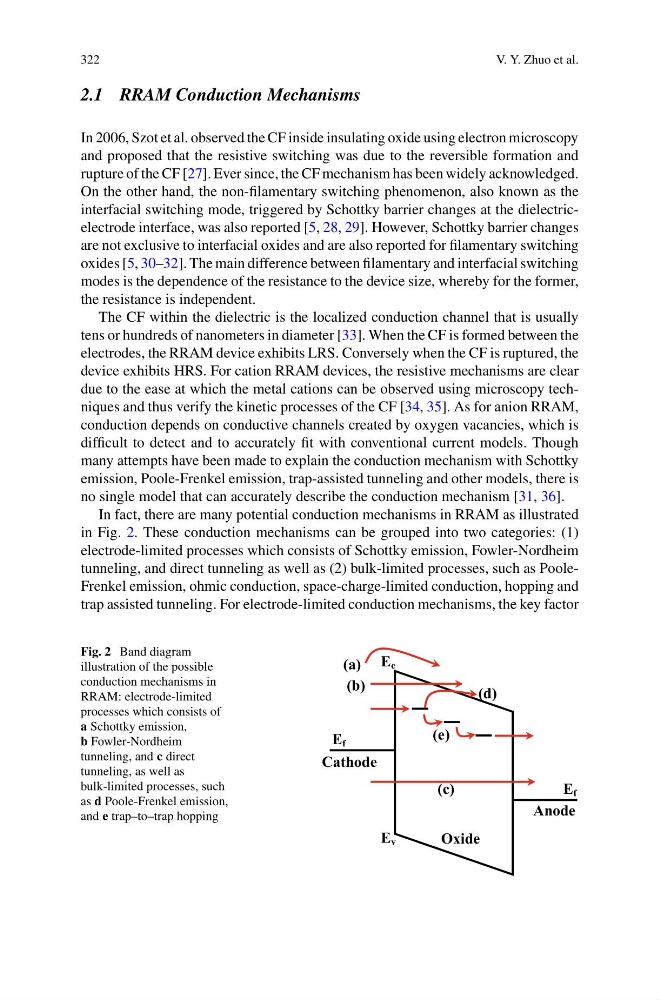
In fact, there are many potential conduction mechanisms in RRAM as illustrated
in Fig. 2. These conduction mechanisms can be grouped into two categories: (1)
electrode-limited processes which consists of Schottky emission, Fowler-Nordheim
tunneling, and direct tunneling as well as (2) bulk-limited processes, such as PooleFrenkel emission, ohmic conduction, space-charge-limited conduction, hopping and
trap assisted tunneling. For electrode-limited conduction mechanisms, the key factor
Fig. 2 Band diagram
illustration of the possible
conduction mechanisms in
RRAM: electrode-limited
processes which consists of
a Schottky emission,
b Fowler-Nordheim
tunneling, and c direct
tunneling, as well as
bulk-limited processes, such
as d Poole-Frenkel emission,
and e trap–to–trap hopping
E f
E f
Cathode
Anode
Oxide
E c
E v
(a)
(b)
(c)
(e)
(d)
V. Y. Zhuo et al.
2.1 RRAM Conduction Mechanisms
In 2006, Szot et al. observed the CF inside insulating oxide using electron microscopy
and proposed that the resistive switching was due to the reversible formation and
rupture of the CF [27]. Ever since, the CF mechanism has been widely acknowledged.
On the other hand, the non-filamentary switching phenomenon, also known as the
interfacial switching mode, triggered by Schottky barrier changes at the dielectricelectrode interface, was also reported [5, 28, 29]. However, Schottky barrier changes
are not exclusive to interfacial oxides and are also reported for filamentary switching
oxides [5, 30–32]. The main difference between filamentary and interfacial switching
modes is the dependence of the resistance to the device size, whereby for the former,
the resistance is independent.
The CF within the dielectric is the localized conduction channel that is usually
tens or hundreds of nanometers in diameter [33]. When the CF is formed between the
electrodes, the RRAM device exhibits LRS. Conversely when the CF is ruptured, the
device exhibits HRS. For cation RRAM devices, the resistive mechanisms are clear
due to the ease at which the metal cations can be observed using microscopy techniques and thus verify the kinetic processes of the CF [34, 35]. As for anion RRAM,
conduction depends on conductive channels created by oxygen vacancies, which is
difficult to detect and to accurately fit with conventional current models. Though
many attempts have been made to explain the conduction mechanism with Schottky
emission, Poole-Frenkel emission, trap-assisted tunneling and other models, there is
no single model that can accurately describe the conduction mechanism [31, 36].
In fact, there are many potential conduction mechanisms in RRAM as illustrated
in Fig. 2. These conduction mechanisms can be grouped into two categories: (1)
electrode-limited processes which consists of Schottky emission, Fowler-Nordheim
tunneling, and direct tunneling as well as (2) bulk-limited processes, such as PooleFrenkel emission, ohmic conduction, space-charge-limited conduction, hopping and
trap assisted tunneling. For electrode-limited conduction mechanisms, the key factor
Fig. 2 Band diagram
illustration of the possible
conduction mechanisms in
RRAM: electrode-limited
processes which consists of
a Schottky emission,
b Fowler-Nordheim
tunneling, and c direct
tunneling, as well as
bulk-limited processes, such
as d Poole-Frenkel emission,
and e trap–to–trap hopping
E f
E f
Cathode
Anode
Oxide
E c
E v
(a)
(b)
(c)
(e)
(d)