

Spintronics for Neuromorphic Engineering
313
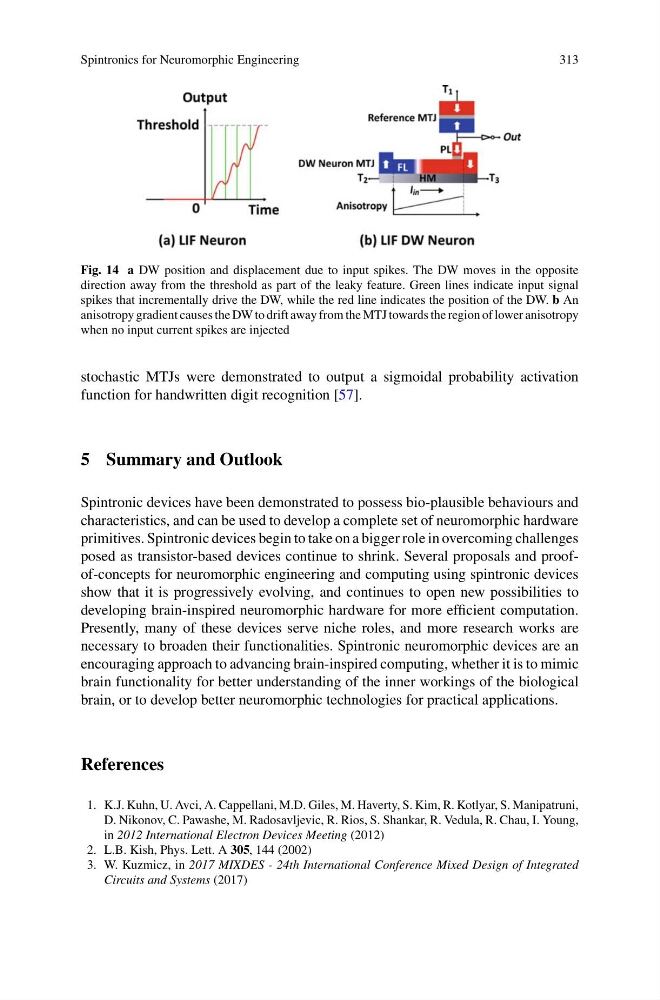
Fig. 14 a DW position and displacement due to input spikes. The DW moves in the opposite
direction away from the threshold as part of the leaky feature. Green lines indicate input signal
spikes that incrementally drive the DW, while the red line indicates the position of the DW. b An
anisotropy gradient causes the DW to drift away from the MTJ towards the region of lower anisotropy
when no input current spikes are injected
stochastic MTJs were demonstrated to output a sigmoidal probability activation
function for handwritten digit recognition [57].
5 Summary and Outlook
Spintronic devices have been demonstrated to possess bio-plausible behaviours and
characteristics, and can be used to develop a complete set of neuromorphic hardware
primitives. Spintronic devices begin to take on a bigger role in overcoming challenges
posed as transistor-based devices continue to shrink. Several proposals and proofof-concepts for neuromorphic engineering and computing using spintronic devices
show that it is progressively evolving, and continues to open new possibilities to
developing brain-inspired neuromorphic hardware for more efficient computation.
Presently, many of these devices serve niche roles, and more research works are
necessary to broaden their functionalities. Spintronic neuromorphic devices are an
encouraging approach to advancing brain-inspired computing, whether it is to mimic
brain functionality for better understanding of the inner workings of the biological
brain, or to develop better neuromorphic technologies for practical applications.
References
1. K.J. Kuhn, U. Avci, A. Cappellani, M.D. Giles, M. Haverty, S. Kim, R. Kotlyar, S. Manipatruni,
D. Nikonov, C. Pawashe, M. Radosavljevic, R. Rios, S. Shankar, R. Vedula, R. Chau, I. Young,
in 2012 International Electron Devices Meeting (2012)
2. L.B. Kish, Phys. Lett. A 305, 144 (2002)
3. W. Kuzmicz, in 2017 MIXDES - 24th International Conference Mixed Design of Integrated
Circuits and Systems (2017)
313
Fig. 14 a DW position and displacement due to input spikes. The DW moves in the opposite
direction away from the threshold as part of the leaky feature. Green lines indicate input signal
spikes that incrementally drive the DW, while the red line indicates the position of the DW. b An
anisotropy gradient causes the DW to drift away from the MTJ towards the region of lower anisotropy
when no input current spikes are injected
stochastic MTJs were demonstrated to output a sigmoidal probability activation
function for handwritten digit recognition [57].
5 Summary and Outlook
Spintronic devices have been demonstrated to possess bio-plausible behaviours and
characteristics, and can be used to develop a complete set of neuromorphic hardware
primitives. Spintronic devices begin to take on a bigger role in overcoming challenges
posed as transistor-based devices continue to shrink. Several proposals and proofof-concepts for neuromorphic engineering and computing using spintronic devices
show that it is progressively evolving, and continues to open new possibilities to
developing brain-inspired neuromorphic hardware for more efficient computation.
Presently, many of these devices serve niche roles, and more research works are
necessary to broaden their functionalities. Spintronic neuromorphic devices are an
encouraging approach to advancing brain-inspired computing, whether it is to mimic
brain functionality for better understanding of the inner workings of the biological
brain, or to develop better neuromorphic technologies for practical applications.
References
1. K.J. Kuhn, U. Avci, A. Cappellani, M.D. Giles, M. Haverty, S. Kim, R. Kotlyar, S. Manipatruni,
D. Nikonov, C. Pawashe, M. Radosavljevic, R. Rios, S. Shankar, R. Vedula, R. Chau, I. Young,
in 2012 International Electron Devices Meeting (2012)
2. L.B. Kish, Phys. Lett. A 305, 144 (2002)
3. W. Kuzmicz, in 2017 MIXDES - 24th International Conference Mixed Design of Integrated
Circuits and Systems (2017)