

312
G. J. Lim et al.
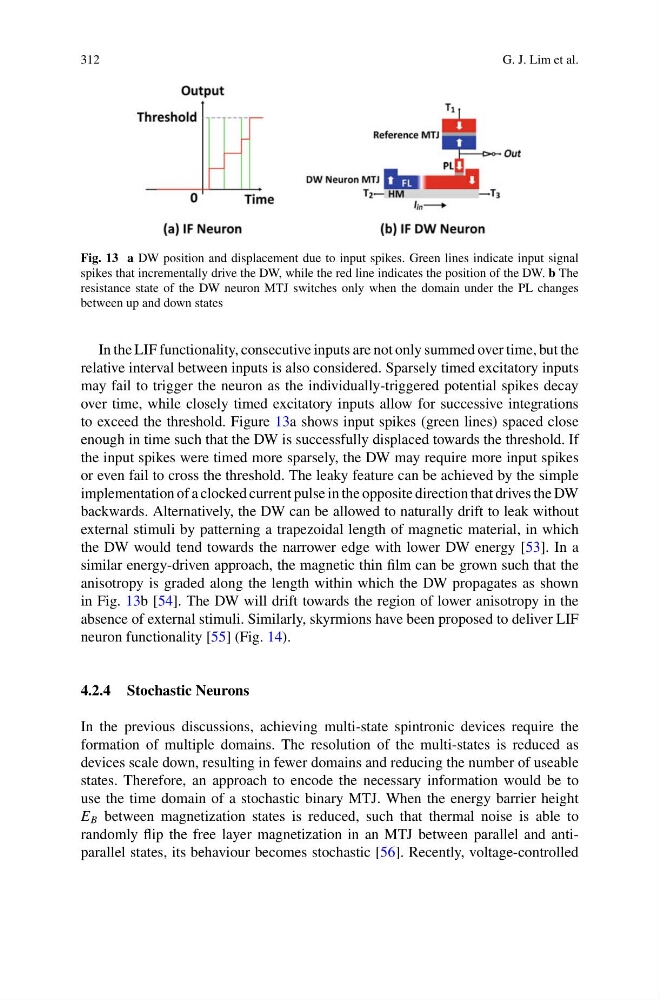
Fig. 13 a DW position and displacement due to input spikes. Green lines indicate input signal
spikes that incrementally drive the DW, while the red line indicates the position of the DW. b The
resistance state of the DW neuron MTJ switches only when the domain under the PL changes
between up and down states
In the LIF functionality, consecutive inputs are not only summed over time, but the
relative interval between inputs is also considered. Sparsely timed excitatory inputs
may fail to trigger the neuron as the individually-triggered potential spikes decay
over time, while closely timed excitatory inputs allow for successive integrations
to exceed the threshold. Figure 13a shows input spikes (green lines) spaced close
enough in time such that the DW is successfully displaced towards the threshold. If
the input spikes were timed more sparsely, the DW may require more input spikes
or even fail to cross the threshold. The leaky feature can be achieved by the simple
implementation of a clocked current pulse in the opposite direction that drives the DW
backwards. Alternatively, the DW can be allowed to naturally drift to leak without
external stimuli by patterning a trapezoidal length of magnetic material, in which
the DW would tend towards the narrower edge with lower DW energy [53]. In a
similar energy-driven approach, the magnetic thin film can be grown such that the
anisotropy is graded along the length within which the DW propagates as shown
in Fig. 13b [54]. The DW will drift towards the region of lower anisotropy in the
absence of external stimuli. Similarly, skyrmions have been proposed to deliver LIF
neuron functionality [55] (Fig. 14).
4.2.4 Stochastic Neurons
In the previous discussions, achieving multi-state spintronic devices require the
formation of multiple domains. The resolution of the multi-states is reduced as
devices scale down, resulting in fewer domains and reducing the number of useable
states. Therefore, an approach to encode the necessary information would be to
use the time domain of a stochastic binary MTJ. When the energy barrier height
E B between magnetization states is reduced, such that thermal noise is able to
randomly flip the free layer magnetization in an MTJ between parallel and antiparallel states, its behaviour becomes stochastic [56]. Recently, voltage-controlled
G. J. Lim et al.
Fig. 13 a DW position and displacement due to input spikes. Green lines indicate input signal
spikes that incrementally drive the DW, while the red line indicates the position of the DW. b The
resistance state of the DW neuron MTJ switches only when the domain under the PL changes
between up and down states
In the LIF functionality, consecutive inputs are not only summed over time, but the
relative interval between inputs is also considered. Sparsely timed excitatory inputs
may fail to trigger the neuron as the individually-triggered potential spikes decay
over time, while closely timed excitatory inputs allow for successive integrations
to exceed the threshold. Figure 13a shows input spikes (green lines) spaced close
enough in time such that the DW is successfully displaced towards the threshold. If
the input spikes were timed more sparsely, the DW may require more input spikes
or even fail to cross the threshold. The leaky feature can be achieved by the simple
implementation of a clocked current pulse in the opposite direction that drives the DW
backwards. Alternatively, the DW can be allowed to naturally drift to leak without
external stimuli by patterning a trapezoidal length of magnetic material, in which
the DW would tend towards the narrower edge with lower DW energy [53]. In a
similar energy-driven approach, the magnetic thin film can be grown such that the
anisotropy is graded along the length within which the DW propagates as shown
in Fig. 13b [54]. The DW will drift towards the region of lower anisotropy in the
absence of external stimuli. Similarly, skyrmions have been proposed to deliver LIF
neuron functionality [55] (Fig. 14).
4.2.4 Stochastic Neurons
In the previous discussions, achieving multi-state spintronic devices require the
formation of multiple domains. The resolution of the multi-states is reduced as
devices scale down, resulting in fewer domains and reducing the number of useable
states. Therefore, an approach to encode the necessary information would be to
use the time domain of a stochastic binary MTJ. When the energy barrier height
E B between magnetization states is reduced, such that thermal noise is able to
randomly flip the free layer magnetization in an MTJ between parallel and antiparallel states, its behaviour becomes stochastic [56]. Recently, voltage-controlled