

310
G. J. Lim et al.
with binary output can be achieved with commercially available MTJs. However,
one may require non-step transfer functions in order to handle non-binary inputs
and outputs. For both step and non-step neurons, the magnetization dynamics and
time-domain are not considered. We know that the biological brain does indeed have
time-dependence behaviour, therefore, spintronic neurons with features such as in
leaky-integrate-and-fire (LIF), or simply IF if no leaky feature is present, as well as
stochasticity would emulate biological neurons more closely. The various spintronic
neuronal behaviours are discussed in increasing bio-fidelity.
4.2.1 Stepwise Neurons
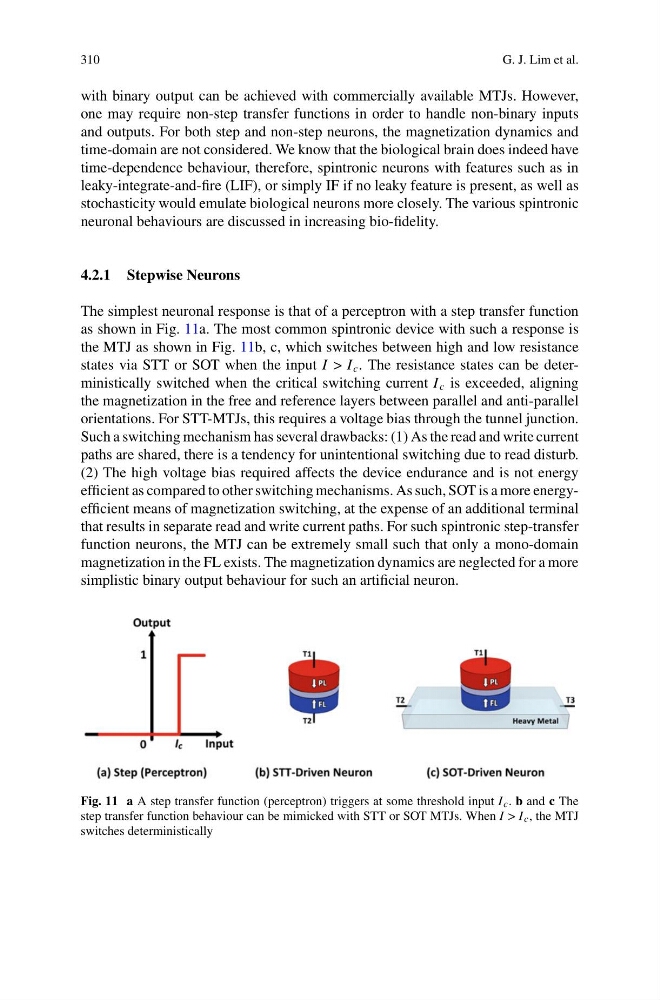
The simplest neuronal response is that of a perceptron with a step transfer function
as shown in Fig. 11a. The most common spintronic device with such a response is
the MTJ as shown in Fig. 11b, c, which switches between high and low resistance
states via STT or SOT when the input I > I c . The resistance states can be deterministically switched when the critical switching current I c is exceeded, aligning
the magnetization in the free and reference layers between parallel and anti-parallel
orientations. For STT-MTJs, this requires a voltage bias through the tunnel junction.
Such a switching mechanism has several drawbacks: (1) As the read and write current
paths are shared, there is a tendency for unintentional switching due to read disturb.
(2) The high voltage bias required affects the device endurance and is not energy
efficient as compared to other switching mechanisms. As such, SOT is a more energyefficient means of magnetization switching, at the expense of an additional terminal
that results in separate read and write current paths. For such spintronic step-transfer
function neurons, the MTJ can be extremely small such that only a mono-domain
magnetization in the FL exists. The magnetization dynamics are neglected for a more
simplistic binary output behaviour for such an artificial neuron.
Fig. 11 a A step transfer function (perceptron) triggers at some threshold input I c . b and c The
step transfer function behaviour can be mimicked with STT or SOT MTJs. When I > I c , the MTJ
switches deterministically
G. J. Lim et al.
with binary output can be achieved with commercially available MTJs. However,
one may require non-step transfer functions in order to handle non-binary inputs
and outputs. For both step and non-step neurons, the magnetization dynamics and
time-domain are not considered. We know that the biological brain does indeed have
time-dependence behaviour, therefore, spintronic neurons with features such as in
leaky-integrate-and-fire (LIF), or simply IF if no leaky feature is present, as well as
stochasticity would emulate biological neurons more closely. The various spintronic
neuronal behaviours are discussed in increasing bio-fidelity.
4.2.1 Stepwise Neurons
The simplest neuronal response is that of a perceptron with a step transfer function
as shown in Fig. 11a. The most common spintronic device with such a response is
the MTJ as shown in Fig. 11b, c, which switches between high and low resistance
states via STT or SOT when the input I > I c . The resistance states can be deterministically switched when the critical switching current I c is exceeded, aligning
the magnetization in the free and reference layers between parallel and anti-parallel
orientations. For STT-MTJs, this requires a voltage bias through the tunnel junction.
Such a switching mechanism has several drawbacks: (1) As the read and write current
paths are shared, there is a tendency for unintentional switching due to read disturb.
(2) The high voltage bias required affects the device endurance and is not energy
efficient as compared to other switching mechanisms. As such, SOT is a more energyefficient means of magnetization switching, at the expense of an additional terminal
that results in separate read and write current paths. For such spintronic step-transfer
function neurons, the MTJ can be extremely small such that only a mono-domain
magnetization in the FL exists. The magnetization dynamics are neglected for a more
simplistic binary output behaviour for such an artificial neuron.
Fig. 11 a A step transfer function (perceptron) triggers at some threshold input I c . b and c The
step transfer function behaviour can be mimicked with STT or SOT MTJs. When I > I c , the MTJ
switches deterministically