

Spintronics for Neuromorphic Engineering
309
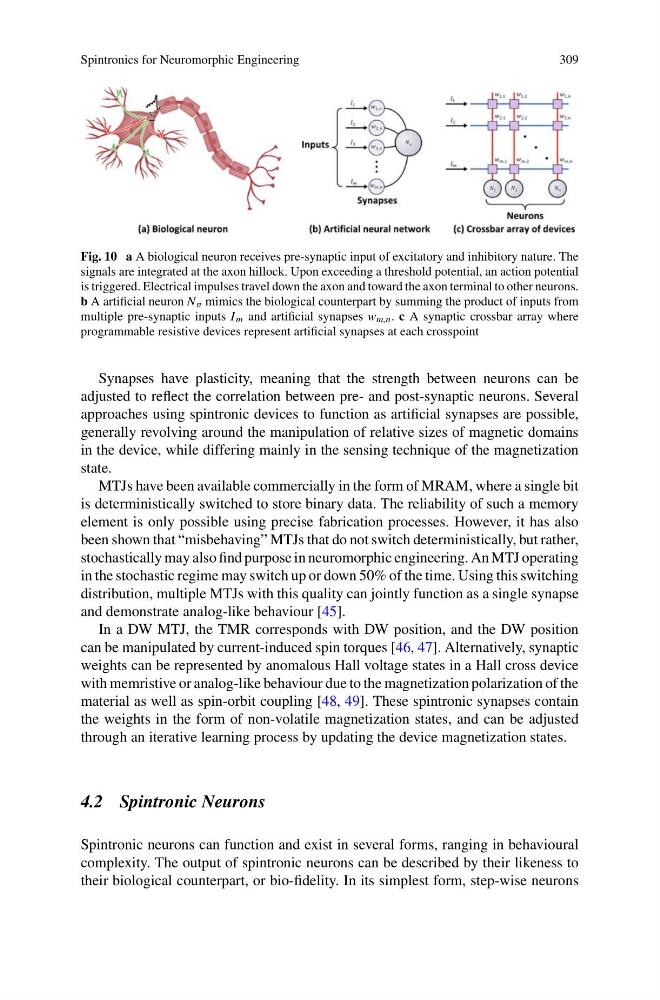
Fig. 10 a A biological neuron receives pre-synaptic input of excitatory and inhibitory nature. The
signals are integrated at the axon hillock. Upon exceeding a threshold potential, an action potential
is triggered. Electrical impulses travel down the axon and toward the axon terminal to other neurons.
b A artificial neuron N n mimics the biological counterpart by summing the product of inputs from
multiple pre-synaptic inputs I m and artificial synapses w m,n . c A synaptic crossbar array where
programmable resistive devices represent artificial synapses at each crosspoint
Synapses have plasticity, meaning that the strength between neurons can be
adjusted to reflect the correlation between pre- and post-synaptic neurons. Several
approaches using spintronic devices to function as artificial synapses are possible,
generally revolving around the manipulation of relative sizes of magnetic domains
in the device, while differing mainly in the sensing technique of the magnetization
state.
MTJs have been available commercially in the form of MRAM, where a single bit
is deterministically switched to store binary data. The reliability of such a memory
element is only possible using precise fabrication processes. However, it has also
been shown that “misbehaving” MTJs that do not switch deterministically, but rather,
stochastically may also find purpose in neuromorphic engineering. An MTJ operating
in the stochastic regime may switch up or down 50% of the time. Using this switching
distribution, multiple MTJs with this quality can jointly function as a single synapse
and demonstrate analog-like behaviour [45].
In a DW MTJ, the TMR corresponds with DW position, and the DW position
can be manipulated by current-induced spin torques [46, 47]. Alternatively, synaptic
weights can be represented by anomalous Hall voltage states in a Hall cross device
with memristive or analog-like behaviour due to the magnetization polarization of the
material as well as spin-orbit coupling [48, 49]. These spintronic synapses contain
the weights in the form of non-volatile magnetization states, and can be adjusted
through an iterative learning process by updating the device magnetization states.
4.2 Spintronic Neurons
Spintronic neurons can function and exist in several forms, ranging in behavioural
complexity. The output of spintronic neurons can be described by their likeness to
their biological counterpart, or bio-fidelity. In its simplest form, step-wise neurons
309
Fig. 10 a A biological neuron receives pre-synaptic input of excitatory and inhibitory nature. The
signals are integrated at the axon hillock. Upon exceeding a threshold potential, an action potential
is triggered. Electrical impulses travel down the axon and toward the axon terminal to other neurons.
b A artificial neuron N n mimics the biological counterpart by summing the product of inputs from
multiple pre-synaptic inputs I m and artificial synapses w m,n . c A synaptic crossbar array where
programmable resistive devices represent artificial synapses at each crosspoint
Synapses have plasticity, meaning that the strength between neurons can be
adjusted to reflect the correlation between pre- and post-synaptic neurons. Several
approaches using spintronic devices to function as artificial synapses are possible,
generally revolving around the manipulation of relative sizes of magnetic domains
in the device, while differing mainly in the sensing technique of the magnetization
state.
MTJs have been available commercially in the form of MRAM, where a single bit
is deterministically switched to store binary data. The reliability of such a memory
element is only possible using precise fabrication processes. However, it has also
been shown that “misbehaving” MTJs that do not switch deterministically, but rather,
stochastically may also find purpose in neuromorphic engineering. An MTJ operating
in the stochastic regime may switch up or down 50% of the time. Using this switching
distribution, multiple MTJs with this quality can jointly function as a single synapse
and demonstrate analog-like behaviour [45].
In a DW MTJ, the TMR corresponds with DW position, and the DW position
can be manipulated by current-induced spin torques [46, 47]. Alternatively, synaptic
weights can be represented by anomalous Hall voltage states in a Hall cross device
with memristive or analog-like behaviour due to the magnetization polarization of the
material as well as spin-orbit coupling [48, 49]. These spintronic synapses contain
the weights in the form of non-volatile magnetization states, and can be adjusted
through an iterative learning process by updating the device magnetization states.
4.2 Spintronic Neurons
Spintronic neurons can function and exist in several forms, ranging in behavioural
complexity. The output of spintronic neurons can be described by their likeness to
their biological counterpart, or bio-fidelity. In its simplest form, step-wise neurons