

300
G. J. Lim et al.
magnetic moment tends to orient itself along the direction of lowest energy. This preference in magnetic alignment is known as magnetic anisotropy and is determined
by several factors such as the crystal structure and shape of the magnetic material.
In the general case of thin film magnets, the magnetization can be in-plane (IP) or
out-of-plane (OOP) of the film surface, as a result of in-plane magnetic anisotropy
(IMA) or perpendicular magnetic anisotropy (PMA), respectively. Figure 1a shows
arrows of opposite magnetizations corresponding to blue and red regions for IMA and
PMA materials. Materials with IMA commonly form in bulk magnetic thin films. For
PMA materials, the dominant magnetocrystalline anisotropy forces the magnetization direction to be along the normal of the film plane [12, 13]. The axis of anisotropy
is also known as the easy axis and can be identified through magnetic hysteresis
measurements. PMA materials are favoured for high-density memory applications
due to much smaller demagnetization field as compared to IMA materials. Aside
from memory density, the stability of the memory is also an important factor. The
stability of a magnet is determined by the tendency of switching between magnetization states due to thermal noise. It is largely dependent on the magnetic material
volume and magnetic anisotropy, and its retention time is given by:
τ = τ 0 exp
K u V
k B T
where τ 0 is the characteristic attempt time of 1 ns, K u is the anisotropy per unit
volume, V is the volume of the magnetic material, k- B is the Boltzmann constant,
and T is the temperature. For a magnetic element suited for long term memory storage
stability with τ = 10 years, the energy barrier E B = K u V should be > 40k B T. Such
magnetic elements can maintain a stable up or down state due to the large E B , but
can be deterministically flipped between states by overcoming E B with additional
spin torques as shown in Fig. 2b. On the other hand, magnetic elements with low E B
are susceptible to environmental perturbation such as thermal noise that introduce
stochastic and random magnetization switching, and remain relevant in probabilistic
computing and solving neural network problems [14, 15].
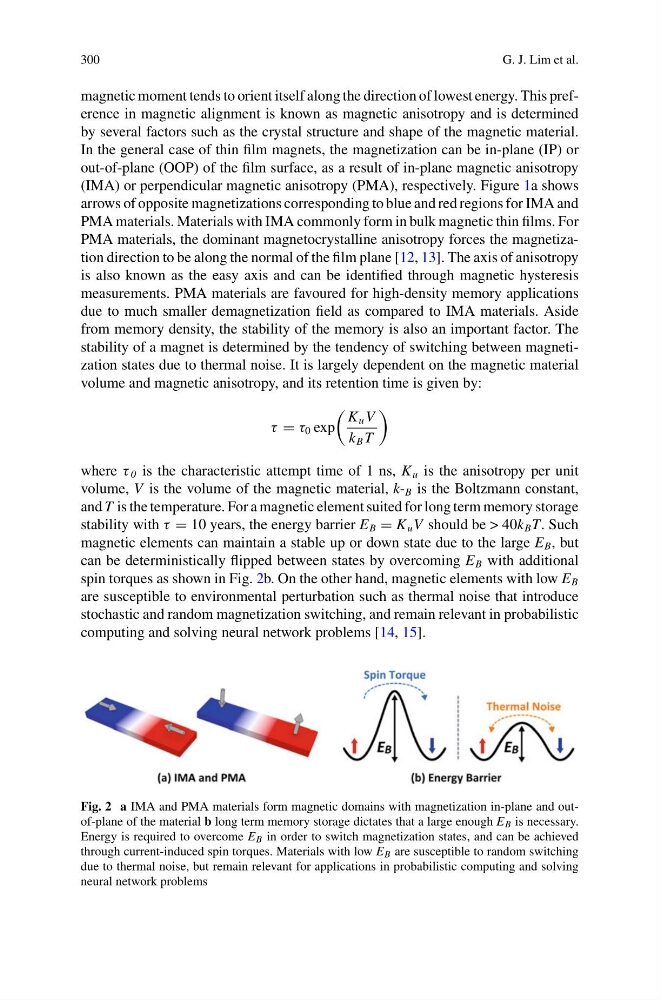
Fig. 2 a IMA and PMA materials form magnetic domains with magnetization in-plane and outof-plane of the material b long term memory storage dictates that a large enough E B is necessary.
Energy is required to overcome E B in order to switch magnetization states, and can be achieved
through current-induced spin torques. Materials with low E B are susceptible to random switching
due to thermal noise, but remain relevant for applications in probabilistic computing and solving
neural network problems
G. J. Lim et al.
magnetic moment tends to orient itself along the direction of lowest energy. This preference in magnetic alignment is known as magnetic anisotropy and is determined
by several factors such as the crystal structure and shape of the magnetic material.
In the general case of thin film magnets, the magnetization can be in-plane (IP) or
out-of-plane (OOP) of the film surface, as a result of in-plane magnetic anisotropy
(IMA) or perpendicular magnetic anisotropy (PMA), respectively. Figure 1a shows
arrows of opposite magnetizations corresponding to blue and red regions for IMA and
PMA materials. Materials with IMA commonly form in bulk magnetic thin films. For
PMA materials, the dominant magnetocrystalline anisotropy forces the magnetization direction to be along the normal of the film plane [12, 13]. The axis of anisotropy
is also known as the easy axis and can be identified through magnetic hysteresis
measurements. PMA materials are favoured for high-density memory applications
due to much smaller demagnetization field as compared to IMA materials. Aside
from memory density, the stability of the memory is also an important factor. The
stability of a magnet is determined by the tendency of switching between magnetization states due to thermal noise. It is largely dependent on the magnetic material
volume and magnetic anisotropy, and its retention time is given by:
τ = τ 0 exp
K u V
k B T
where τ 0 is the characteristic attempt time of 1 ns, K u is the anisotropy per unit
volume, V is the volume of the magnetic material, k- B is the Boltzmann constant,
and T is the temperature. For a magnetic element suited for long term memory storage
stability with τ = 10 years, the energy barrier E B = K u V should be > 40k B T. Such
magnetic elements can maintain a stable up or down state due to the large E B , but
can be deterministically flipped between states by overcoming E B with additional
spin torques as shown in Fig. 2b. On the other hand, magnetic elements with low E B
are susceptible to environmental perturbation such as thermal noise that introduce
stochastic and random magnetization switching, and remain relevant in probabilistic
computing and solving neural network problems [14, 15].
Fig. 2 a IMA and PMA materials form magnetic domains with magnetization in-plane and outof-plane of the material b long term memory storage dictates that a large enough E B is necessary.
Energy is required to overcome E B in order to switch magnetization states, and can be achieved
through current-induced spin torques. Materials with low E B are susceptible to random switching
due to thermal noise, but remain relevant for applications in probabilistic computing and solving
neural network problems